Establishing secure connection…Loading editor…Preparing document…

General Security Agreement

This template is fully customizable. Edit the text, fill out the fields, and send it for signature. Give it a try!
General Security Agreement

What a General Security Agreement Is and when it applies

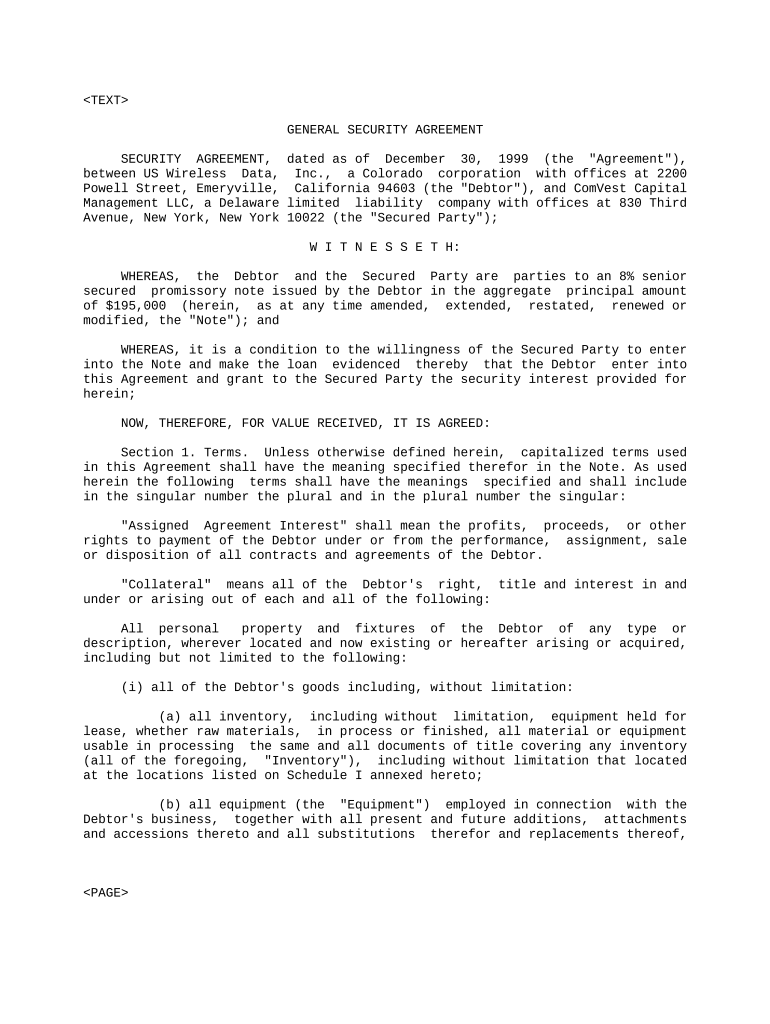
The General Security Agreement is a secured‑transaction contract where a debtor grants a secured party a security interest in specified collateral to secure repayment or performance of obligations such as loans, credit lines, or lease payments. It identifies the parties, describes collateral by category or serial number, sets out representations and covenants, defines events of default, and specifies remedies and perfection steps. Use of a clear agreement supports enforcement, priority determination, and remedies like repossession or foreclosure when a debtor defaults.

Why a General Security Agreement matters in secured lending

A General Security Agreement creates a transparent legal basis for a lender to claim designated collateral, lowers credit risk, and enables financing on clearer terms; when properly drafted and perfected under UCC Article 9, it establishes priority and reduces disputes over asset recovery.

Why a General Security Agreement matters in secured lending

Who commonly relies on a General Security Agreement

Lenders, borrowers, private equity firms, and their counsel commonly use a General Security Agreement to document collateral-based financing arrangements.

  • Commercial banks securing business loans with equipment, inventory, or receivables.
  • Asset-based lenders and factoring companies establishing priority claims against accounts receivable.
  • Private companies granting security for lines of credit, leases, or vendor obligations.

Typical signing parties and their roles

Lender (Bank)

Bank legal and credit teams use the General Security Agreement to specify collateral, define default triggers, and outline remedies. They ensure accuracy for UCC‑1 perfection, coordinate recording where needed, and verify corporate authority before funding.

Borrower (Company)

Company officers and finance teams sign to grant the security interest and promise performance. Borrowers must describe assets accurately, disclose existing encumbrances, and provide authorizing resolutions to avoid challenges to the agreement.

Essential sections that make a General Security Agreement effective

Core sections and clauses that make a General Security Agreement legally effective and operational for secured lending and asset-based transactions.

Parties

Identify debtor and secured party with full legal names, business forms, addresses, and corporate authorization. Include EIN or taxpayer number where relevant to reduce identity-related disputes during perfection and enforcement.
Grant Clause

A clear grant of security interest linking collateral to specific obligations. Use precise language to avoid scope disputes and state whether the security is fixed, floating, or continuing across accounts or after-acquired property.

Collateral Description

Describe collateral by category and, when needed, by serial numbers or schedules. Vague descriptions risk ineffective perfection; include fixtures, inventory, receivables, intangibles, and accessions where applicable.

Representations

Debtor statements about ownership, authority, and absence of conflicting liens. These representations support remedies and may trigger defaults if materially false, affecting enforcement and potential lender recovery.

Covenants

Ongoing obligations such as insurance, taxes, preservation of collateral, and notice of new liens. Affirmative and negative covenants limit debtor actions that could impair the collateral or lender priority.

Default & Remedies

Define events of default, acceleration rights, repossession processes, and sale procedures. Include cure periods, notice requirements, and commercially reasonable disposition standards to withstand judicial review.

Key data elements to collect for the agreement

Debtor Name: Full legal entity or individual's name
Secured Party: Legal name and contact information
Collateral: Detailed categories and schedule references
Obligations Secured: Principal, interest, fees, and contingencies
Effective Date: Enter as MM/DD/YYYY format
Governing Law: State law chosen for interpretation

Step‑by‑step: completing and preparing for perfection

Follow these steps to complete a General Security Agreement accurately and prepare for UCC‑1 filing and perfection.

  • 01
    Gather Parties: Collect legal names, EINs, and authority documentation.
  • 02
    Describe Collateral: List categories, serial numbers, and schedules.
  • 03
    Draft Terms: Include grant, covenants, default, remedies, and perfection.
  • 04
    Sign & File: Obtain signatures, then file UCC‑1 to perfect.

Operational flow from drafting to enforcement

Routing, signing, and UCC filing form the operational flow: drafting, execution, perfection, and post‑closing monitoring.

  • Draft: Assemble agreement and schedules for collateral.
  • Approve: Legal reviews terms and confirms corporate authority.
  • Execute: Signatures by authorized officers and notary if required.
  • Perfect: File UCC‑1 and take possession if necessary.

Sample online workflow settings for digital processing

Sample online workflow settings to prepare, route, and record a General Security Agreement in a digital signing system.

Field Configuration
Authentication Email plus SMS code for signer verification
Document Format PDF/A or DOCX; preserve field data for export
Signer Order Sequential or parallel routing options
Storage Retain audit trail and signed PDF for retention period

Technical capabilities to look for in a signing platform

Platforms used to distribute and sign a General Security Agreement must support secure storage, audit trails, and exportable signed records.

  • File Formats: PDF, DOCX, and fillable fields
  • Integrations: CRM and ERP: Salesforce, NetSuite
  • Authentication: Email, SMS, SSO options supported

Timing checkpoints for execution, filing, and monitoring

Key timing considerations for execution, perfection, and post‑closing obligations when using a General Security Agreement.

Signing Deadline:

Execute before funding or advance of credit

UCC-1 Filing:

File promptly after execution to perfect interest

Insurance Notice:

Obtain proof of insurance before disbursement

Cure Periods:

Observe contractual notice and cure timeframes

Reporting Covenants:

Provide financial updates as required by agreement

Consequences and risks of mistakes in the agreement

Unperfected Interest: Loses priority to other secured creditors
Incorrect Collateral: Collateral description too vague
Authority Defect: Invalid signatures may void security interest
Priority Dispute: Leads to litigation and higher costs
Bankruptcy Risk: Automatic stay limits remedies
Regulatory Penalties: Industry fines for noncompliance

Practical drafting habits that reduce future disputes

Practical drafting and execution tips to reduce future disputes, ensure priority, and ease enforcement of the security interest.

Use Specific Descriptions
Avoid catch‑all phrases. List collateral categories and identify high‑value items by serial number or schedule. Precise descriptions reduce the risk of court findings of insufficiency and support effective repossession or sale without additional litigation.
Coordinate UCC-1 Timely Filing
File the UCC‑1 financing statement in the correct jurisdiction immediately after execution. Verify debtor name format and collateral code; mistakes in filing details can result in loss of priority to later‑recorded claimants.
Confirm Signing Authority
Obtain corporate resolutions, partnership consents, or other proof of authority when an entity signs. Third parties may challenge signatures absent proper authorization, delaying enforcement and increasing legal costs and litigation exposure.
Maintain Audit Trail and Records
Keep signed originals, exported signed PDFs, UCC‑1 receipts, correspondence, and payment records. Digital audit trails with timestamps and signer attribution simplify enforcement, court submissions, and responses to creditor challenges during litigation or bankruptcy.

How a General Security Agreement compares to related instruments

Quick comparison of related instruments to clarify when a General Security Agreement is the appropriate secured‑transaction tool versus real‑property or assignment remedies.

Criteria General Security Agreement Mortgage Pledge Deed of Trust Assignment
Security Interest Type personal property real property lien personal property real property lien contract rights
Typical Collateral equipment, receivables real estate stocks, inventory real estate contracts, royalties
Public Filing Required ucc‑1 filing recorded deed delivery/pledge recorded deed ucc‑1 possible
Notarization not required required not required required not required

eSignature vendor pricing and feature snapshot relevant to executing the agreement

Comparing baseline pricing and key plan features across major eSignature vendors for executing a General Security Agreement.

signNow DocuSign Adobe Sign PandaDoc HelloSign
Starting Price $8/user/mo $15/user/mo $14/user/mo $19/user/mo $15/user/mo
Free Trial 7-day free trial Varies Varies Varies Varies
Bulk Send Yes Yes Yes Yes No
Audit Trail Yes Yes Yes Yes Yes
HIPAA Compliant Yes Yes Yes No No

Frequently asked questions about General Security Agreements

Answers to frequent legal, procedural, and technical questions about completing and enforcing a General Security Agreement.


Need help? Contact support

be ready to get more
Join over 28 million airSlate SignNow users