Establishing secure connection…Loading editor…Preparing document…

Shared Services Agreement

This template is fully customizable. Edit the text, fill out the fields, and send it for signature. Give it a try!
Shared Services Agreement

What a Shared Services Agreement Is and When It Applies

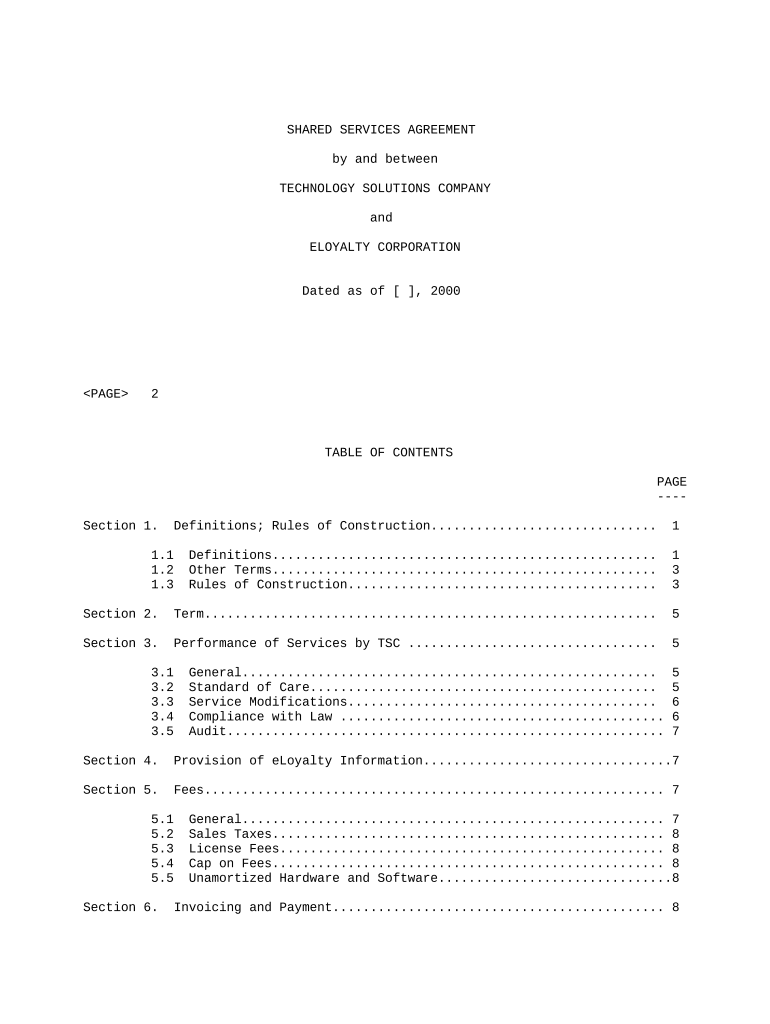
A Shared Services Agreement is a written contract that defines the allocation, delivery, and cost‑sharing of centralized services between two or more business units or affiliated entities. Typical services include HR, IT, finance, payroll, procurement, facilities management, and compliance support. The agreement specifies scope, service levels, chargeback or cost allocation methods, performance metrics, data security responsibilities, dispute resolution, term and termination, and transition or exit procedures. It documents mutual expectations and reduces operational ambiguity when multiple organizational units rely on a single provider for routine or specialized services.

Why a Clear Shared Services Agreement Matters

A well-drafted agreement reduces disputes, clarifies financial allocation, assigns responsibility for compliance and data protection, and provides a roadmap for service levels and change management. It also supports auditing and regulatory reviews by documenting who performs and pays for each function.

Why a Clear Shared Services Agreement Matters

Who Typically Uses a Shared Services Agreement

Use the agreement when services cross legal entities or when cost allocation, service continuity, or regulatory accountability must be documented in writing.

  • Corporate finance teams reallocating treasury, accounting, or payroll costs to subsidiaries
  • IT or HR departments delivering standardized services to affiliated business units
  • Shared service centers established to centralize procurement, legal, or compliance tasks

Core Elements to Include in a Professional Agreement

Include clear definitions, service scope, financial terms, performance measures, data and security obligations, and termination mechanics to make the agreement enforceable and operationally useful.

Definitions

Define parties, services, service period, business day, and key terms such as 'Service Level', 'Change Request', and 'Confidential Information' to avoid ambiguity in performance and billing.
Scope of Services

List services in detail, any exclusions, delivery methods, hours of operation, and responsibilities for service initiation, upgrades, and decommissioning to set expectations.

Financials

Describe chargeback models, billing frequency, invoicing details, expense recovery, currency, tax treatment, and dispute resolution for invoices to reduce later disagreements.

Service Levels

Specify metrics (uptime, response times, resolution targets), reporting cadence, remediation credits, and measurement methodology so performance is objectively measured.

Compliance & Security

Assign responsibility for regulatory compliance (HIPAA, SOX, privacy laws), encryption, access control, breach notification, and any required BAAs or data processing addenda.

Termination & Transition

Set notice periods, exit assistance, data return or destruction procedures, and transitional support to ensure orderly handover on termination or transfer.

Step‑by‑Step: How to Complete a Shared Services Agreement

Follow this sequence to gather information, document terms, and obtain valid signatures.

  • 01
    Gather Data: Compile service lists, current costs, and internal SLAs.
  • 02
    Draft Terms: Create scope, billing, and SLA language consistent with policy.
  • 03
    Review & Approve: Legal, finance, and IT review, then approve redlines.
  • 04
    Execute: Obtain authorized signatures and distribute fully executed copies.

How to Configure an Online Completion Workflow

Set up a repeatable digital workflow that routes, authenticates, and archives the agreement.

Field Configuration
Signers Add signer emails and role order; enable delegated signing if needed
Authentication Select email link or SMS code; use KBA for higher assurance
Templates Create a reusable template with preplaced fields and conditional logic
Archive Enable secure storage, audit trail, and versioning

Digital Signing and eSubmission Considerations

Ensure the provider can deliver retention, export, and access controls consistent with internal records policies and any regulatory requirements applicable to your industry.

  • File formats: PDF, DOCX
  • Integrations: Salesforce, NetSuite, Google Workspace
  • Security: AES-256 at rest

Typical Routing: From Draft to Execution

A simple routing pattern clarifies responsibilities and shortens execution time.

  • Draft: Originator prepares and inserts fillable fields
  • Review: Legal and finance review and request edits
  • Approval: Authorized approvers sign in sequence
  • Archive: Store executed copy and audit trail

Key Timing: Notice Periods, Billing, and Renewal Dates

Record deadlines in the agreement and in a calendar to prevent lapses in service or automatic renewals.

Billing Cycle:

State invoice frequency and payment terms (e.g., Net 30)

Notice to Terminate:

Specify required notice (e.g., 60 or 90 days)

Renewal:

Automatic renewal terms and opt‑out deadlines

SLA Reporting:

Monthly or quarterly performance reporting dates

Change Requests:

Timeline for proposing and implementing scope changes

Key Milestones from Negotiation to Transition

Track major stages and assign owners to ensure the agreement is implemented without operational gaps.

01

Negotiation

Finalize scope and financial model with stakeholders

02

Approval

Obtain legal and executive sign‑off

03

Go‑Live

Start date for service delivery and billing

04

Transition

Execute exit plan if services move or terminate

Common Mistakes to Avoid When Preparing the Agreement

  • Leaving scope language vague, which leads to disputes over who performs or pays for services and increases downstream change orders
  • Failing to define cost allocation methodology, resulting in inconsistent internal billing and disputes during audits
  • Omitting data handling responsibilities, which creates regulatory risk for HIPAA or financial data and unclear breach notification duties
  • Not specifying metrics or measurement methods for SLAs, making it hard to enforce performance or apply remedies

Consequences of an Incorrect or Incomplete Agreement

Financial Disputes: Invoice challenges and retroactive adjustments
Regulatory Exposure: Noncompliance fines or breach notification obligations
Operational Disruption: Service interruptions during transition or disputes
Liability Allocation: Ambiguous indemnities increasing legal risk
Audit Findings: Negative audit outcomes and required remediations
Reputational Harm: Stakeholder confidence loss and partner friction

Essential Security and Compliance Data to Record

Encryption: AES-256 at rest
Transport: TLS 1.2/1.3
Certifications: SOC 2 Type II
HIPAA: BAA required
Audit Trail: Timestamps and IP logs
Access Control: Role-based permissions

Comparing eSignature Vendors for Shared Services Agreements

A concise feature and pricing snapshot can help compare options; signNow is listed first per comparison standards.

signNow DocuSign Adobe Sign PandaDoc HelloSign
Starting Price $8/user/mo $15/user/mo $14/user/mo $19/user/mo $15/user/mo
Free Trial 7-day free trial Varies by plan Varies by plan Varies by plan Varies by plan
Bulk Send Yes Yes Yes Yes No
Audit Trail Yes Yes Yes Yes Yes
HIPAA Compliant Yes Yes Yes No No

Frequently Asked Questions About Shared Services Agreements

Answers to common questions about validity, signatures, notarization, amendments, and recordkeeping for Shared Services Agreements.


Need help? Contact support

be ready to get more
Join over 28 million airSlate SignNow users