Sworn Statement
A concise sworn declaration identifying the decedent, affiant, and legal basis for distribution; signed under penalty of perjury and typically notarized to assure authenticity.
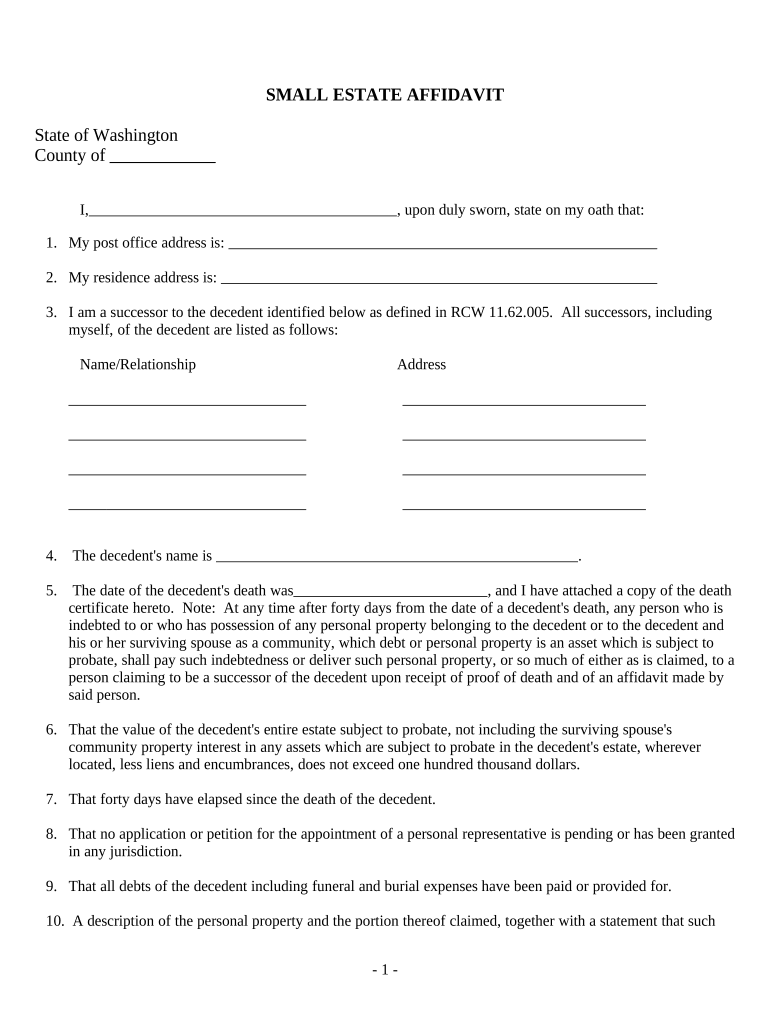
A Small Estate Affidavit speeds distribution of modest assets by avoiding formal probate, lowers legal and filing costs, and lets heirs access bank accounts, vehicles, and personal property faster when state thresholds are met.

The affidavit is generally prepared by a family member, heir, or the person legally entitled to collect the decedent's assets.
Institutions and third parties review the affidavit alongside supporting documents; acceptance and extra steps depend on the institution and state rules.
An individual named by law or will who claims entitlement; completes affidavit sections about relationship, provides ID and a certified death certificate, and often affirms there is no pending probate. They should understand state-specific thresholds and possible creditor notice requirements.
A family member or informal executor who gathers asset details, lists creditors, and signs under oath; may act when no formal executor is appointed. They must be prepared to present proof of identity and supporting documents to institutions or the county clerk.
A single heir needed access to a decedent's checking account to pay final bills and funeral costs, but the account balance fell under the state's probate threshold.
A family member needed to transfer a car titled solely in the decedent's name and the vehicle value met the small-estate limit.
A concise sworn declaration identifying the decedent, affiant, and legal basis for distribution; signed under penalty of perjury and typically notarized to assure authenticity.
An itemized list of assets claimed, including account numbers, vehicle VINs, titles, and approximate values; attachments such as statements or original titles strengthen acceptance.
A short section citing the applicable state statute or threshold and affirming that the estate qualifies for small-estate procedures under local law.
Full legal names, addresses, and relationships of heirs or beneficiaries, and a clear statement of who is entitled to each item or fund claimed.
Certified death certificate, account statements, title documents, and any required proof of relationship, all attached and referenced by exhibit number.
A notarized signature block and any required witness attestations per state law to authenticate the affiant's oath and prevent future disputes.
| signNow | DocuSign | Adobe Sign | PandaDoc | HelloSign | |
|---|---|---|---|---|---|
| Starting Price | $8 per user per month billed annually | $15 per user per month billed annually | $14 per user per month billed annually | $19 per user per month billed annually | $15 per user per month billed annually |
| Free Trial | Yes — 7-day free trial, no credit card required | Trial offerings vary by vendor | Trial offerings vary by vendor | Trial offerings vary by vendor | Trial offerings vary by vendor |
| Bulk Send | Yes — available on select plans | Yes — available on select plans | Yes — available on select plans | Yes — available on select plans | No — not available on standard plans |
| Audit Trail | Yes — full audit trail and logs | Yes — full audit trail and logs | Yes — full audit trail and logs | Yes — audit trail included | Yes — audit trail included |
| HIPAA Compliant | Yes — BAA available on request | Yes — BAA available on request | Yes — BAA available on request | No — BAA not standard | No — BAA not standard |
| Envelope Cap | No cap on envelopes per account | 100 envelopes per user per year limit | Varies by plan and account | Varies by subscription and plan | Varies by account and plan |
Confirm date of death and notify institutions and heirs promptly
Gather certified death certificate, titles, statements, and evidence of entitlement
Complete affidavit, notarize where required, and submit to payor or clerk
Institution reviews, confirms eligibility, and releases assets to entitled parties