Establishing secure connection…Loading editor…Preparing document…

Notice of Possession Acknowledgment

This template is fully customizable. Edit the text, fill out the fields, and send it for signature. Give it a try!
Notice of Possession Acknowledgment

What the Notice of Possession Acknowledgment Is

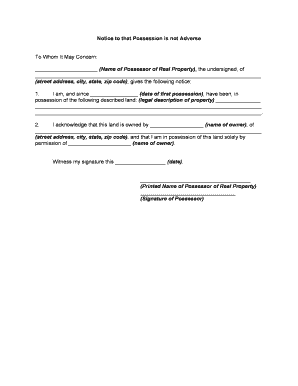
A Notice of Possession Acknowledgment is a written record signed by a party who takes physical possession of property, goods, or leased premises and confirms the effective date and condition of possession. It documents the transfer or receipt of control, notes any existing damage or defects, and records the parties, property description, and possession terms. The form is used to reduce disputes by creating an auditable record of who had possession at a specific time and under what conditions.

Why this acknowledgment matters

A clear, signed acknowledgment reduces later disputes, provides evidence for insurance and liability claims, and supports accurate recordkeeping for leases, bailments, and property transfers.

Why this acknowledgment matters

Who commonly completes a Notice of Possession Acknowledgment

Typical signers include property managers, tenants, shipping recipients, contractors, and custodial staff who take control of assets or premises.

  • Property managers and landlords documenting tenant move-in condition and start of tenancy.
  • Tenants and occupants acknowledging receipt and condition of leased premises or equipment.
  • Logistics and receiving staff confirming delivery, acceptance, or custody transfer of goods.

Who can sign and their typical role

Property Owner

An owner or authorized representative signs when transferring possession to a tenant, contractor, or custodian. Their signature confirms transfer terms and documents pre-existing conditions, protecting against false later claims.

Authorized Agent

A property manager, facilities coordinator, or receiving clerk signs as the party taking or delivering possession. The agent should note authority, contact details, and date to ensure proper attribution.

Core elements to include in a professional acknowledgment

A complete Notice of Possession Acknowledgment combines identifying data, a precise description of the item or space, condition notes, effective date, signatures, and any notarization or witness fields required by law or policy.

Document Title

A clear title such as 'Notice of Possession Acknowledgment' and a short purpose line to avoid confusion with other handoff documents.
Parties

Full legal names and contact details of the party relinquishing possession and the party receiving possession to ensure correct attribution.

Property Description

Precise address, unit number, serial number, or inventory ID so the record unambiguously identifies the asset or premises being transferred.

Condition Notes

A short condition statement and space for labeled photos or attachments to record damage, defects, or missing items at the time of possession.

Effective Date

A clear date and time the possession begins, recorded in MM/DD/YYYY format where possible to avoid date-format confusion.

Signature Block

Signature, printed name, job title, date, and optional witness or notary fields to support enforceability and verification.

Step-by-step: Completing the acknowledgment

Follow these sequential steps to create a clear, enforceable Notice of Possession Acknowledgment.

  • 01
    Prepare document: Enter parties, property details, and effective date.
  • 02
    Record condition: Note defects and attach photos or checklists.
  • 03
    Identify signers: Include printed names, titles, and contact details.
  • 04
    Obtain signatures: Sign, date, and add witness or notary if required.

How to configure an online completion workflow

Set up an e-sign workflow that captures identity, timestamps, and the completed record for retention and audit.

Field Configuration
Signer Order Sequential or parallel depending on parties involved
Authentication Email link plus optional SMS or knowledge-based checks
Attachments Allow photo uploads and PDF exhibits for condition evidence
Audit Trail Capture IP, timestamp, and action history for each signer

Where to send or file the completed acknowledgment

Decide routing for originals, copies, and archived records to meet business and legal needs.

  • To Tenant/Recipient: Provide a signed copy to the party taking possession.
  • To Owner/Landlord: Send the signed copy to the property owner or management.
  • Insurance Folder: File with insurance claim or loss control records when relevant.
  • Corporate Archive: Store a copy in the organization’s records retention system.

Delivery and eSubmission channels to consider

Choose delivery channels that preserve the signed record and support auditability across systems.

  • Email Delivery: Signed PDF copy for recipient records.
  • Cloud Archive: Store in secure cloud with access controls.
  • API Integration: Push signed record to CRM or ERP systems.

Preserve an immutable signed file and an audit trail; integrate with document management or recordkeeping systems for retrieval and compliance.

Saving, exporting, and supporting documents

Ensure the final package includes the signed acknowledgment plus any supporting attachments and is stored in stable, retrievable formats.

Export Formats

Save signed records as PDF/A or standard PDF to preserve appearance and metadata for legal and archival use.

Supporting Exhibits

Attach color photographs, inventory lists, checklists, or repair estimates labeled and dated to corroborate condition statements.

Versioning

Keep an audit log with timestamps for each revision to show when changes were made and by whom.

Access Controls

Restrict edit and download permissions to authorized personnel in your records system to prevent unauthorized changes.

Common timing considerations and internal deadlines

Timing expectations depend on contract terms, insurance rules, and internal policies; set deadlines to preserve evidence and meet notice periods.

Immediate Acknowledgment:

Complete at the time of handoff or within 24–72 hours.

Insurance Claims:

File condition reports per insurer deadlines, often within days of discovery.

Lease Obligations:

Follow move-in inspection windows defined in the lease agreement.

Internal Reporting:

Upload signed copy to records system within 5 business days.

Retention Start:

Retention periods begin on the possession effective date.

Key milestones in the possession acknowledgment lifecycle

Track these sequential milestones from preparation through long-term retention to reduce risk and ensure compliance.

01

Document Preparation

Complete fields and attach evidence before handoff.

02

Handoff & Inspection

Conduct joint walkthrough and note condition.

03

Signatures Collected

Obtain signatures, witness, or notary as required.

04

Archive & Retain

Store final package in records system per retention policy.

Common preparation mistakes to avoid

  • Leaving the property description vague or incomplete, which creates ambiguity about what was transferred.
  • Recording ambiguous condition statements such as 'acceptable' without photos or itemized notes for disputes.
  • Failing to capture signer authority or capacity, e.g., entity representative vs individual, which can invalidate attribution.
  • Delaying signature collection past delivery, which undermines the document’s evidentiary value and timeline clarity.

Risks and potential consequences of an incorrect acknowledgment

Invalid Record: May be inadmissible in disputes
Insurance Denial: Claims could be reduced or rejected
Liability Exposure: Incorrect dates shift responsibility periods
Contract Breach: Noncompliance with lease or service terms
Tax/Reporting Impact: Incorrect asset handoffs can complicate accounting
Operational Delay: Missing files slow claims and remediation

Real examples of use in the field

These short examples show how organizations use a Notice of Possession Acknowledgment to reduce disputes and speed processes.

Martin Properties

Martin Properties uses the form on move-ins to document condition and possession.

  • The team captures photos and signatures on site.
  • This practice reduced tenant damage disputes and sped security deposit reconciliations by eliminating back-and-forth evidence collection, improving turnaround on move-out settlements.

Optica Ventures

A venture real estate manager documents handoff of furnished units with a signed acknowledgment.

  • They attach inventory lists for each unit.
  • The combined inventory and signed possession record made insurance claims straightforward after water damage and clarified responsibility for repair costs.

Typical eSignature provider pricing and capability snapshot

Compare starting price, trial availability, bulk send, audit trail, HIPAA support, and envelope limits when selecting an eSignature provider; signNow is listed first for comparison.

signNow DocuSign Adobe Sign PandaDoc HelloSign
Starting Price $8/user/mo $15/user/mo $14/user/mo $19/user/mo $15/user/mo
Free Trial 7-day trial Varies by vendor Varies by vendor Varies by vendor Varies by vendor
Bulk Send Yes (Business Premium) Varies by tier Varies by tier Varies by tier Varies by tier
Audit Trail Yes Yes Yes Yes Yes
HIPAA Compliant Yes (BAA available) Varies Varies Varies Varies
Envelope Cap No envelope cap 100 envelopes/user/year Vendor limits vary Vendor limits vary Vendor limits vary

Essential information elements for the record

Document Title: Notice of Possession Acknowledgment
Parties: Full legal names
Property ID: Address or serial number
Possession Date: MM/DD/YYYY
Condition: Concise condition statement
Signatures: Signed, printed name, date

Frequently asked questions about the Notice of Possession Acknowledgment

Answers to common questions about validity, e-signing, notarization, corrections, retention, and who may sign.


Need help? Contact support

be ready to get more
Join over 28 million airSlate SignNow users