Establishing secure connection…Loading editor…Preparing document…

Termination of Parental Rights

This template is fully customizable. Edit the text, fill out the fields, and send it for signature. Give it a try!
Termination of Parental Rights

What the Termination of Parental Rights document does

A Termination of Parental Rights is a court-focused legal pleading that ends the legal parent-child relationship and removes parental rights and responsibilities. The petition or motion typically asks a family or juvenile court to terminate rights based on grounds established by statute, such as abandonment, abuse, failure to support, long-term foster care placement, or parental incapacity. Because termination permanently affects custody, visitation, inheritance, and obligations like child support, courts apply heightened procedural safeguards; final orders are entered only after notice, opportunity to be heard, and compliance with applicable state statutes and constitutional due process.

Why accuracy and completeness matter for a Termination of Parental Rights

Accurate petitions protect due process, reduce delays, and help the court reach an informed decision; missing data or incorrect service can cause dismissal, retry, or reversal on appeal.

Why accuracy and completeness matter for a Termination of Parental Rights

Who prepares and who receives this document

Different roles require different filings and proof; legal counsel is frequently involved because the process permanently severs legal ties.

  • Child welfare agencies initiating termination in dependency proceedings.
  • Private petitioners (relatives or custodians) seeking adoption or guardianship.
  • Attorneys representing respondents or petitioners in family court.

Who signs and who is named

Petitioner — Attorney

An attorney or agency representative often prepares and files the petition, ensuring statutory grounds and supporting evidence meet the court’s procedural and jurisdictional requirements before service on the respondent parent.

Respondent — Parent

The parent named in the petition is entitled to notice and an opportunity to be heard; if represented, counsel will respond to allegations and may contest termination or negotiate outcomes such as guardianship or voluntary surrender.

Core legal and security considerations to record

Statutory Basis: List the state statute and code section
Court Case Number: Include assigned docket number
Party Names: Full legal names only
Service Details: Method, date, and proof
Supporting Evidence: Affidavits, reports, exhibits
Judge and Court: Court name, division, and judge

Key risks and legal consequences to avoid

Dismissal risk: Insufficient service
Appeal exposure: Procedural defects
Reversal risk: Due process violations
Unintended loss: Incorrect party named
Costs: Attorney and filing fees
Record permanence: Permanent court order

Common preparation and filing challenges

  • Incomplete service affidavits or missing proof of personal or constructive service can lead to dismissal or a continuance, delaying permanency for the child.
  • Failing to attach required evidentiary exhibits—such as child welfare reports, medical records, or prior orders—reduces the petition’s credibility and may prompt the court to require additional hearings.
  • Misidentifying legal parents (e.g., putative fathers with pending paternity or unknown fathers) creates jurisdictional and notice complications that must be resolved before a final order.
  • Assuming electronic signatures are always sufficient; some courts require in-person filings, original signatures, notarization, or express court authorization for electronic submissions.

Filling out a Termination of Parental Rights: step-by-step

Follow a consistent sequence to prepare a complete, court-ready petition and supporting package before service and hearing.

  • 01
    Draft Petition: State statutory grounds clearly, cite code sections.
  • 02
    Assemble Evidence: Attach affidavits, agency reports, medical records.
  • 03
    File With Court: File petition and obtain case number and dates.
  • 04
    Serve Parties: Complete service per state law and file proof.

Overview of the court workflow after filing

After filing, courts follow notice, hearing, and decision steps; timelines and exact procedures vary by jurisdiction and case type.

  • Intake: Clerk assigns case number and schedules first hearing.
  • Service: Respondent is served and given time to respond.
  • Hearing: Evidence and witness testimony are presented.
  • Order: Judge issues findings and a final order if warranted.

Essential sections to include in a professional petition

A complete petition organizes parties, jurisdictional facts, statutory grounds, a clear statement of requested relief, and attachments that prove the factual basis for termination.

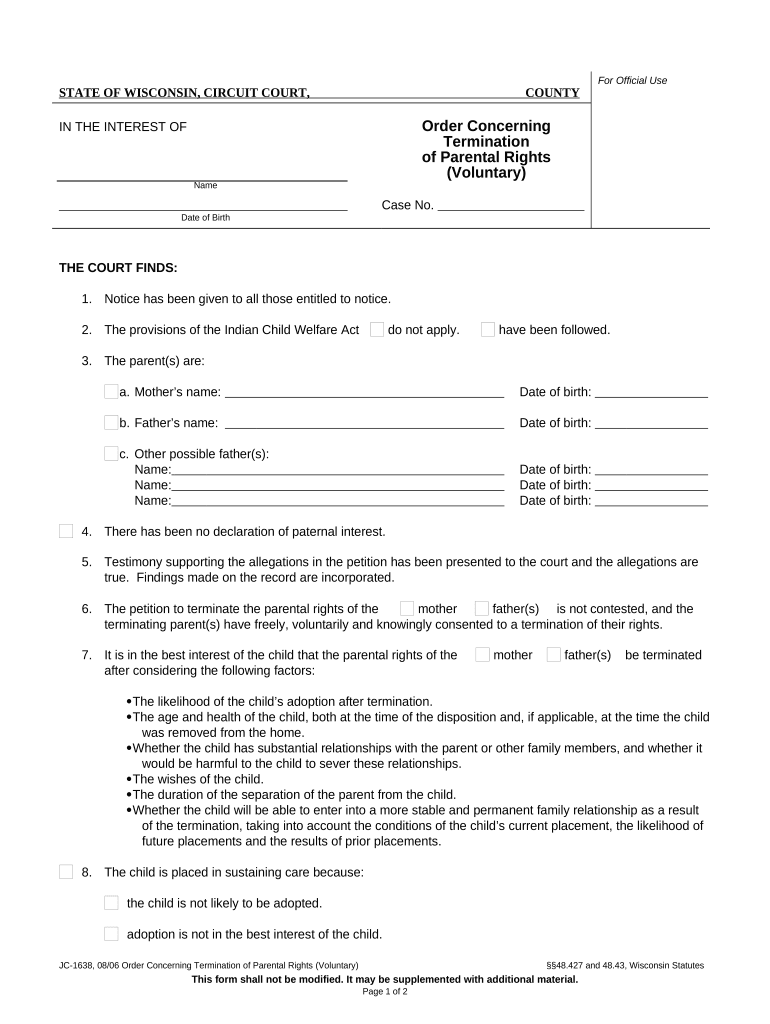
Caption

Court name, case number, and full party names to ensure the document is filed under the correct docket and routed to the appropriate judge.
Jurisdictional Allegations

Statements establishing court authority over the child and parties, including residence, prior orders, and any dependency findings that support subject matter jurisdiction.

Statutory Grounds

Specific, coded allegations tied to the state statute (e.g., abandonment, neglect, failure to support) with factual summaries that the court can evaluate.

Requested Relief

Clear demand for termination of parental rights and related orders, such as termination of custody, termination of visitation, and suitability for adoption or guardianship.

Affidavits and Exhibits

Sworn statements, agency reports, school or medical records, and other documents supporting the facts alleged in the petition.

Service and Notice Proof

Completed proof of service, certified mail receipts, or return of process documents establishing that required parties received notice.

Typical timeline milestones to track

Track filing, service, hearing scheduling, and post-order deadlines closely; local rules set specific days and notice periods.

Filing Date and Case Open:

Petition filed and case number issued; starts the court timeline

Service and Proof:

Respondent must be served per statute and proof filed with the clerk

Initial Hearing:

Court schedules a first hearing to set dates and status

Adjudicatory Hearing:

Evidentiary hearing where termination facts are evaluated

Final Order and Appeal Window:

Court issues final order; appeal periods vary by state and statute

Digital signing, formats, and integrations to consider

Ensure the court accepts electronic filings and that your vendor can produce admissible audit logs and tamper-evident signed PDFs.

  • File Formats: PDF | DOCX supported
  • Integrations: Works with NetSuite, Google Workspace, Salesforce
  • Security: TLS 1.2/1.3 and AES-256 encryption

How Termination of Parental Rights differs from related filings

Compare similar family law documents to avoid using the wrong filing type; the consequences and standards of proof differ significantly.

Document Type TPR Petition Guardianship Petition
Legal Standard higher burden lower burden
Permanence permanent often revocable
Required Evidence extensive factual proof less extensive
Typical Outcome rights terminated custody assigned

Pricing and vendor feature comparison for eSignature use in legal filing workflows

Compare starting price, trial availability, bulk send, audit trail, HIPAA support, and any envelope caps; signNow is listed first per comparison convention.

signNow DocuSign Adobe Sign PandaDoc HelloSign
Starting Price $8/user/mo $15/user/mo $14/user/mo $19/user/mo $15/user/mo
Free Trial Yes, 7-day free trial No No Yes, limited Yes, limited
Bulk Send Yes Yes Yes Yes No
Audit Trail Yes Yes Yes Yes Yes
HIPAA Compliant Yes Yes Yes No No
Envelope Cap No cap 100 envelopes/user/yr Varies Varies Varies

Representative use cases where termination petitions arise

These short examples show how agencies and private parties commonly use termination pleadings in practice.

Agency-Initiated Termination

A child welfare agency files a petition after repeated safety violations

  • Agency documents foster care placement history
  • The court reviews agency reports, parental services offered, and whether reunification efforts were exhausted before ordering termination.

Private Guardian Petition

A relative petitions to terminate a noncustodial parent for abandonment

  • Allegations focus on noncontact and lack of support
  • The judge weighs evidence of abandonment, service compliance, and the child’s best interests before issuing an order.

Practical tips for accurate and efficient completion

Follow these proven practices to reduce errors and speed court processing while protecting parties’ rights and court requirements.

Match court captions
Use exact party names and prior case numbers; mismatches trigger administrative returns.
Label exhibits clearly
Number exhibits and cross-reference them in the petition to simplify evidentiary review.
File proof of service
File timely and complete proofs of service to avoid jurisdictional challenges.
Confirm local rules
Check local family court rules for electronic filing, signature, and sealing requirements before submission.

Common questions and practical answers about Termination of Parental Rights

Answers address signature, filing, and procedural concerns often encountered when preparing termination petitions.


Need help? Contact support

be ready to get more
Join over 28 million airSlate SignNow users