Establishing secure connection…Loading editor…Preparing document…

Texas Acknowledgment of Oath or Affirmation

This template is fully customizable. Edit the text, fill out the fields, and send it for signature. Give it a try!
Texas Acknowledgment of Oath or Affirmation

What the Texas Acknowledgment of Oath or Affirmation Is

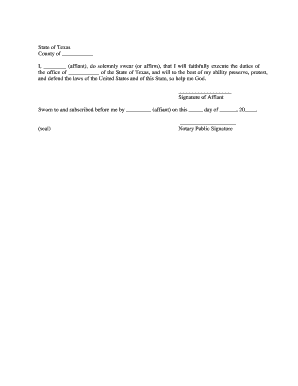
The Texas Acknowledgment of Oath or Affirmation is a short notarization entry used to record that a person swore or affirmed a truth under penalty of perjury before an authorized official. It typically appears on affidavits, sworn statements, or judicial and administrative filings where the signer must declare facts under oath. The form documents the identity of the signer, the verbal oath or affirmation, the notary or official who administered it, and the date and location of the act. It creates a formal record for courts, agencies, and third parties.

Why this Acknowledgment Matters

Recording an oath or affirmation creates a contemporaneous legal record that supports admissibility and weight in proceedings, documents chain of custody for sworn statements, and helps meet procedural requirements for courts and agencies. Properly completed acknowledgments also reduce later challenges about signer identity or the voluntariness of the statement.

Why this Acknowledgment Matters

Who typically completes and relies on this acknowledgment

Acknowledgments are completed at the point where a sworn statement is needed and are used by both private and public sector parties.

  • Attorneys preparing affidavits and court filings for civil or administrative matters, ensuring the sworn facts are officially recorded.
  • Notaries public and court clerks who administer oaths or affirmations and certify the act for record purposes.
  • Agency staff and licensing authorities that require sworn attestations as part of applications or regulatory reporting.

The acknowledgment supports evidentiary use, agency acceptance, and downstream recordkeeping; complete it accurately to avoid processing delays.

Typical Signers and Process Owners

Notary Public

A commissioned notary or authorized official administers the oath or affirmation, verifies identity, records the act, and completes the acknowledgment entry with commission or badge information, jurisdiction, and date.

Affiant or Declarant

The individual making the sworn statement must appear, present acceptable identification, state the oath or affirmation, and sign in the notary's presence so the notary can attest to the voluntariness and identity of the signer.

Required information typically recorded on the form

Signer Name: Full legal name
Signer Address: Street, city, state, ZIP
Date and Time: MM/DD/YYYY and time
Oath Statement: Language sworn or affirmed
Official Details: Notary name and commission
Jurisdiction: County and state

Step-by-step: completing the Texas Acknowledgment of Oath or Affirmation

Follow these steps when administering or completing the acknowledgment to ensure the record is valid and usable.

  • 01
    Verify identity: Check government-issued ID and confirm signer details.
  • 02
    Administer oath: Ask the signer to swear or affirm the stated facts.
  • 03
    Record particulars: Complete date, jurisdiction, and notary commission fields.
  • 04
    Sign and seal: Notary signs, dates, and affixes seal or electronic equivalent.

Where the acknowledgment fits in document processing

The acknowledgement is a discrete authentication event that precedes filing, recording, or agency submission for sworn materials.

  • Document preparation: Affidavit or sworn statement is finalized and presented to signer.
  • Notarization event: Notary administers oath and completes acknowledgement wording.
  • Electronic capture: If RON, audio-video and audit trail are recorded.
  • Submission or filing: Signed document is delivered to court, agency, or counterparty.

Typical online workflow settings for digital completion

Configure workflows to secure signer identity, capture the oath event, and retain an audit trail for legal compliance.

Field Configuration
Signer Authentication Email link or SMS code verification
RON Recording Enable A/V capture and secure storage
Retention Policy Encrypted storage for minimum required years
Audit Certificate Include timestamp, IP, and action log

Technical and security considerations for eSubmission

Ensure platforms used for digital acknowledgments support secure identity proofing, tamper-evident storage, and exportable audit trails.

  • Authentication: Multi-factor options available
  • Encryption: TLS in transit; AES-256 at rest
  • Integrations: CRM and cloud storage connections

For regulated workflows consider vendors with HIPAA BAA options and 21 CFR Part 11 or SOC 2 controls; retain recordings and logs according to your policy and applicable law.

How eSignature vendors compare for oath acknowledgments

Platform choice affects authentication options, audit trails, and cost. The table compares common vendor attributes important for sworn documents.

signNow DocuSign Adobe Sign PandaDoc HelloSign
Starting Price $8/user/mo $15/user/mo $14/user/mo $19/user/mo $15/user/mo
Free Trial 7-day free trial Varies Varies Varies Varies
Bulk Send Yes Yes Yes Yes No
Audit Trail Yes Yes Yes Yes Yes
HIPAA Compliant Yes Yes Yes No No

Consequences of incorrect or incomplete acknowledgments

Document Invalidity: Court or agency rejection
Perjury Exposure: Criminal risk for false oath
Recording Delay: Processing or escrow holdups
Tax Consequences: Reporting or withholding impacts
Civil Liability: Claims for false statements
Operational Disruption: Rework and administrative cost

Practical tips to avoid common defects

Follow these practices to reduce rejections, protect legal effect, and preserve auditability for sworn acknowledgments.

Verify and record identity documents
Confirm and log the government-issued identification used to verify the signer, noting document type, issuing state, and ID number when permitted; this reduces later identity disputes.
Use exact name matching
Enter the signer's full legal name exactly as shown on ID and other legal documents to avoid inconsistencies that can lead to re-execution or administrative rejection.
Capture the oath language verbatim
Record the precise words of the oath or affirmation or use the standard statutory phrasing; paraphrasing can create evidentiary issues in court or agency reviews.
Retain audit trail and recordings for RON
If you use remote notarization, preserve the audio-video recording, identity proofing logs, and tamper-evident audit trail for the period required by your state.

How organizations use acknowledgments in practice

Real-world examples illustrate how acknowledgments support online and offline sworn workflows across industries.

Martin Properties — Mobile Closings

When completing lease affidavits remotely Martin Properties needed a reliable oath capture process.

  • They used mobile notarization to preserve signer identity.
  • "I can process and execute all of these documents online with 100% compliance and built-in security. Whether on mobile or working offline, I can get forms back to their necessary parties efficiently."

BIS — Compliance and Audit Trails

BIS required detailed audit records for sworn supplier declarations.

  • The workflow combined identity checks and retained logs.
  • "We felt most comfortable with airSlate SignNow given their SOC 2 certification and strict focus on ESIGN and UETA act compliance."

Frequently asked questions and troubleshooting

Answers to common questions about completing and preserving the Texas Acknowledgment of Oath or Affirmation.


Need help? Contact support

be ready to get more
Join over 28 million airSlate SignNow users