Establishing secure connection…Loading editor…Preparing document…

Trial Diversion Agreement

This template is fully customizable. Edit the text, fill out the fields, and send it for signature. Give it a try!
Trial Diversion Agreement

What a Trial Diversion Agreement Is and when it applies

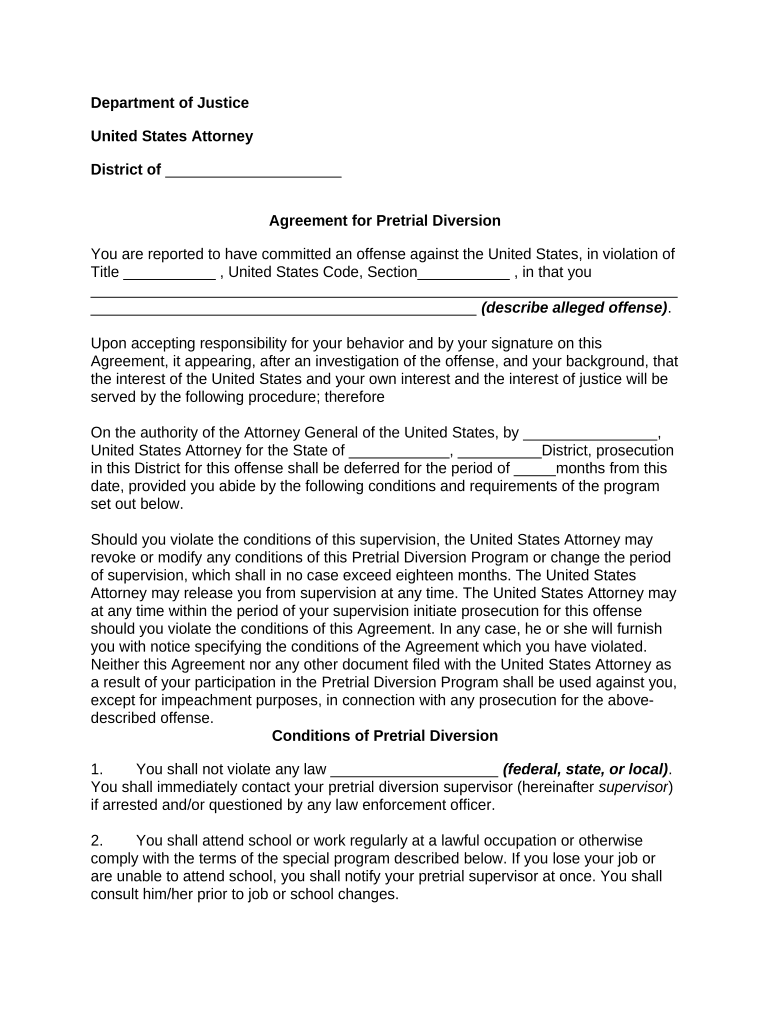
A Trial Diversion Agreement is a formal, written arrangement that allows a defendant to avoid a criminal trial by completing specified conditions such as counseling, community service, restitution, or program participation. The agreement typically suspends prosecution or defers charges while the defendant meets obligations within a set timeframe. Successful completion often results in dismissal or reduction of charges; failure can reinstate prosecution. These agreements are governed by state law and court rules and are used to reduce case loads, address rehabilitation, and resolve eligible misdemeanor or low-level felony matters without a contested trial.

Why a clear Trial Diversion Agreement matters

A concise, legally defensible agreement protects the defendant’s rights, clarifies obligations, and documents the court’s conditions to avoid later disputes or reinstatements of charges.

Why a clear Trial Diversion Agreement matters

Who prepares and who signs a Trial Diversion Agreement

The agreement is typically prepared by prosecuting counsel or court staff and is signed by the defendant, defense counsel, and a judicial officer or prosecutor where required.

  • Defense attorneys and defendants — to accept diversion terms and record consent.
  • Prosecutors and court clerks — to set conditions and enter the deferred status.
  • Treatment providers or program coordinators — to certify completion of obligations.

Typical signatories and their roles

Defendant — Party

The defendant signs to indicate voluntary consent, acceptance of conditions, and understanding that failure to comply may resume prosecution; accurate legal name and date are required for record matching.

Prosecutor / Judge

The prosecutor or judicial officer signs to approve terms on behalf of the state and to document the official diversion disposition; this signature establishes the court-ordered conditions and enforcement mechanism.

Core elements to include in a professional Trial Diversion Agreement

A complete agreement lists parties, a clear statement of charges, conditions to be satisfied, timelines, reporting requirements, monitoring methods, remedies for noncompliance, record-retention and privacy provisions, and signature blocks for all required parties.

Parties

Full legal names and identifiers for defendant, prosecuting agency, and any program provider.
Charges

Specific statute citations, charge descriptions, and docket or case numbers.

Conditions

Program tasks such as counseling, drug testing, restitution, community service, or education with measurable completion criteria.

Timeline

Start and end dates, check-in schedule, and deadlines for each condition.

Consequences

Stepwise remedies for noncompliance, including notice, cure period, and potential reinstatement of charges.

Signatures

Signature blocks for defendant, counsel, prosecutor, and judge with printed names and dates.

Step-by-step: completing a Trial Diversion Agreement

Follow these steps in sequence to prepare, approve, and execute the agreement with clear evidence of consent and timeline.

  • 01
    Draft Agreement: Populate parties, charges, and proposed conditions.
  • 02
    Review Terms: Defense and prosecution confirm fairness and legality.
  • 03
    Obtain Signatures: Collect signature from defendant, counsel, and approval by prosecutor or judge.
  • 04
    File or Record: Place the executed agreement in the court file and notify program coordinators.

Typical workflow from offer to resolution

This overview describes the route a diversion agreement typically follows from initial offer to case disposition.

  • Offer Extended: Prosecutor offers diversion in lieu of trial.
  • Agreement Drafted: Terms are written and reviewed by counsel.
  • Monitoring: Program providers report compliance to the court.
  • Disposition: Successful completion leads to dismissal or reduction per terms.

How to set up a diversion workflow for courts or agencies

Configure an administrative workflow so offers, forms, and completion records route automatically to the court file and program providers.

Field Configuration
Offer Template Standardized form populated from case management system.
Approval Step Prosecutor sign-off required before execution.
Monitoring Report Weekly or monthly status updates from provider.
Disposition Entry Court clerk records completion and disposes case.

Digital signing and submission considerations

Ensure your platform supports secure eSignature, audit trails, and the authentication levels your jurisdiction requires.

  • File formats: PDF and DOCX accepted for preservation and redaction.
  • Authentication: Email link, SMS code, or stronger multi-factor methods.
  • Audit Trail: Timestamps, IP addresses, and action logs recorded.

Retain signed records in tamper-evident format and ensure access controls meet court and privacy obligations.

Common timelines and deadlines to document

Record and communicate all key dates in the agreement: when the program starts, checkpoints, completion date, and the date by which failure leads to reinstatement.

Program Start:

Enter as MM/DD/YYYY — marks obligations' commencement.

Interim Check-ins:

Weekly or monthly reporting dates for monitoring.

Completion Deadline:

Final date when conditions must be fulfilled.

Cure Period:

Short window for remedial compliance before reinstatement.

Reinstatement Notice:

Date when the prosecutor may refile charges if breached.

Key milestones from offer through case disposition

Track these sequential milestones to ensure timely execution, monitoring, and final disposition of the diversion matter.

01

Offer Issued

Prosecutor proposes diversion and notifies defense and court.

02

Agreement Executed

All required parties sign and dates are entered.

03

Monitoring Period

Defendant completes conditions with periodic reporting.

04

Final Review

Court or prosecutor certifies completion and records disposition.

Common preparation errors to avoid

  • Ambiguous conditions without measurable criteria lead to disputes and enforcement delays.
  • Mismatched names or case numbers can prevent proper recording and create administrative rejection.
  • Missing signature dates or incomplete signature blocks may render the agreement unenforceable.
  • Failing to document monitoring or completion reports undermines the ability to confirm compliance.

Consequences and enforcement risks of improper or incomplete agreements

Reinstatement: Prosecutor may resume prosecution if conditions are not met.
Loss of Benefits: Defendant forfeits agreed dismissal or reduced charges on breach.
Administrative Rejection: Court clerks may refuse to file agreements with errors.
Privacy Exposure: Improper handling of records may violate confidentiality rules.
Record Inconsistency: Conflicting documents create litigation risk over terms.
Statutory Noncompliance: Failure to follow state diversion statutes can invalidate disposition.

Essential compliance and security considerations

Encryption: TLS 1.2/1.3 and AES-256 used in transit and at rest
Audit Trail: Record timestamps, IP, and signer actions for evidentiary support
HIPAA: BAA required if health information is included
Authentication: Use multi-factor for higher-risk signers
Retention: Preserve original executed record in tamper-evident format
Access Controls: Role-based access and logging are recommended

Sample eSignature vendor comparison for Trial Diversion workflows

Compare cost and core features relevant to diversion agreement signing. Prices reflect standard annual-per-user tiers or usage-based plans; feature availability and compliance options vary by vendor and plan.

signNow DocuSign Adobe Sign PandaDoc HelloSign
Starting Price $8/user/mo $15/user/mo $14/user/mo $19/user/mo $15/user/mo
Free Trial 7-day trial Varies by plan Varies by plan Varies by plan Varies by plan
Bulk Send Yes Yes Yes Yes Yes
Audit Trail Yes Yes Yes Yes Yes
HIPAA Compliant Yes Yes Yes No No

Frequently asked questions about Trial Diversion Agreements

Answers to common questions about execution, enforceability, and electronic processing of diversion agreements.


Need help? Contact support

be ready to get more
Join over 28 million airSlate SignNow users