Establishing secure connection…Loading editor…Preparing document…

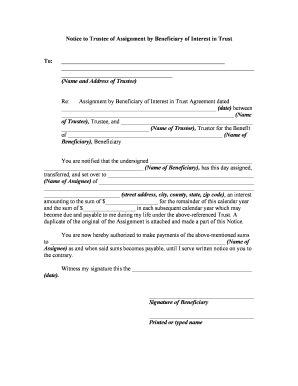
Trustee Notice to Beneficiaries

This template is fully customizable. Edit the text, fill out the fields, and send it for signature. Give it a try!
Trustee Notice to Beneficiaries

What a Trustee Notice to Beneficiaries Is and when it’s used

A Trustee Notice to Beneficiaries is a formal written communication from a trustee to the trust’s beneficiaries that explains the trust’s existence, the trustee’s acceptance or change in trusteeship, and key trust details. The notice typically identifies the trust by name and date, lists qualified beneficiaries or how to obtain beneficiary information, and explains the trustee’s contact information and where to request copies of trust documents. Trustees send this notice to satisfy fiduciary duties and many state trust statutes, and it creates a clear record of disclosure to reduce future disputes.

Why issuing a clear Trustee Notice matters legally and practically

A properly drafted Trustee Notice protects beneficiaries’ rights, documents the trustee’s performance of statutory duties, and reduces litigation risk. Under the Uniform Trust Code (see UTC §813), prompt notice to qualified beneficiaries is often required; ESIGN (15 U.S.C. §7001) and UETA govern whether and how electronic delivery and signatures satisfy legal requirements.

Why issuing a clear Trustee Notice matters legally and practically

Who typically prepares and receives these notices

Trustees, trust administrators, and estate attorneys prepare notices; beneficiaries and co-trustees are typical recipients.

  • Corporate trustees and trust officers — Prepare standardized notices and maintain compliance records.
  • Individual or successor trustees — Issue notices when accepting trusteeship or when requested by beneficiaries.
  • Beneficiaries and heirs — Receive notice to learn their rights and request accountings or documents.

Essential sections to include in a professional Trustee Notice

A professional notice organizes core information so beneficiaries can identify the trust, contact the trustee, and request records efficiently.

Trust identity

Full trust name and original date, plus any amendment dates to uniquely identify the trust instrument for recipients and counsel.
Trustee details

Trustee name, business or mailing address, phone number, and email so beneficiaries know who to contact for questions or requests.

Beneficiary notice

A clear statement that the recipient is a beneficiary or how to confirm beneficiary status, with instructions to request an accounting or trust copy.

Trust powers

Short summary of trustee powers and limitations that may affect distributions, investments, or beneficiary rights under the governing instrument.

Delivery and records

How copies of trust documents may be obtained, reasonable costs, and the format (paper, electronic) available on request.

Effective date

Date the notice is sent and any deadline for beneficiary responses or claims, if applicable, to establish a clear timeline.

Required data fields in the Trustee Notice

Trust name: Full legal trust title
Trust date: Original signing date
Trustee name: Individual or corporate trustee
Beneficiary list: Named and qualified beneficiaries
Contact info: Mailing address and email
Signature block: Trustee signature and date

Step-by-step: preparing and sending a Trustee Notice

Follow a consistent checklist to ensure accuracy, legal compliance, and a verifiable delivery record when issuing a Trustee Notice.

  • 01
    Gather documents: Collect the trust instrument, amendments, and beneficiary list.
  • 02
    Draft notice: Populate trust name, trustee contact, and beneficiary details.
  • 03
    Select delivery: Choose mail, certified mail, or eDelivery with audit trail.
  • 04
    Record retention: Retain a signed copy and delivery proof in the trust file.

Configuring an online workflow for issuing notices

Set up a repeatable digital workflow to standardize notices, track delivery, and capture signatures and audit trails.

Field Configuration
Upload document Use PDF/A or DOCX input for consistency
Place fields Add signature, date, and optional initials fields
Authentication Enable email or SMS codes for signer verification
Delivery method Choose bulk send or individual links

Where to send the Trustee Notice and how it gets routed

Choose recipients and a delivery method that provide verifiable proof of receipt and satisfy statutory requirements for disclosure.

  • Primary beneficiaries: Directly to named beneficiaries or their counsel
  • Co-trustees: Send copies to co-trustees for recordkeeping
  • Trust counsel: Provide an attorney copy to document legal advice
  • Fiduciary records: Keep a trustee file with signed notices and delivery proof

Delivery channels, file formats, and technical requirements

Use delivery channels and file formats that preserve the signed record and support later reproduction for audits or disputes.

  • File formats: PDF and DOCX widely accepted
  • Authentication: Email, SMS, or KBA where required
  • Integrations: CRM and cloud storage connectors

Key timing rules and recommended deadlines

Timing obligations depend on statute and the trust instrument; follow UTC §813 when applicable and document the delivery date precisely.

Statutory notice window:

UTC §813: provide notice within 60 days of accepting trusteeship

Accounting requests:

Respond to beneficiary accounting requests per state timing rules

Record date:

Date the notice on the sending date for retention and dispute purposes

Beneficiary response:

Allow a reasonable reply period; specify it if required

Electronic consent:

Secure ESIGN consent before e-delivery in consumer contexts

Common preparation mistakes to avoid

  • Using inconsistent trust names or dates, which creates ambiguity in beneficiary claims and record searches.
  • Failing to include complete contact details for the trustee, delaying beneficiary communications and requests.
  • Delivering notices without a verifiable audit trail, which weakens proof of compliance in disputes.
  • Neglecting to confirm whether the trust instrument or state law requires notarization or witness signatures.

Risks and legal consequences of improper notice

Breach of duty: Trustee removal risk
Surcharge claims: Monetary liability for losses
Accounting litigation: Expensive court proceedings
Delay in distributions: Beneficiary financial harm
Tax issues: Incorrect reporting consequences
Reputational risk: Loss of beneficiary trust

How a Trustee Notice differs from related trust documents

Compare Trustee Notices with related documents to choose the correct form and delivery method for each beneficiary communication need.

Criteria Trustee Notice Trust Accounting
Purpose inform beneficiaries provide financial detail
Timing on acceptance or change periodic or upon request
Required content identification info detailed transactions
Typical recipient all qualified beneficiaries requesting beneficiaries

Real-world examples of issuing notices with digital workflows

Organizations use standard templates and authenticated delivery to reduce processing time and maintain compliance records.

Martin Properties example

A property manager centralized trust notices to beneficiaries using a digital workflow to reduce turnaround time.

  • The process replaced paper mailings.
  • "I can process and execute all of these documents online with 100% compliance and built-in security. Whether on mobile or working offline, I can get forms back to their necessary parties efficiently." — Tim Martin, Founder

Fertility Centers example

A clinical operator used authenticated delivery to provide trust-related beneficiary disclosures tied to patient funds.

  • Legal counsel reviewed templates annually.
  • "The airSlate SignNow team has been exceptional, responsive, the API has been great, and we're extremely happy that we chose airSlate SignNow as a company." — John Butler, Founder

How to update or amend a previously sent Trustee Notice

Follow a documented process for revisions to ensure beneficiaries receive corrected information and the trustee’s records are current.

01

Review trust:

Confirm changes required by amendment or new facts
02

Draft amendment:

Prepare corrected notice language and cite instrument sections
03

Notify beneficiaries:

Send corrected notice with explanation
04

Sign and date:

Trustee signs updated notice and records date
05

Notarize if needed:

Obtain notarization when instrument or state demands
06

Archive copy:

Keep both original and revised notices in file

Typical signer and recipient roles

Trustee — Corporate Trustee

A corporate trustee issues notices as a regular administrative function and maintains centralized records, compliance workflows, and standard operating procedures to document delivery, acknowledgment, and any beneficiary communications.

Beneficiary — Individual

Individual beneficiaries receive notices to learn their rights and may request accountings or copies; their responses and requests should be logged and preserved for the trust record.

How to save and export the signed Trustee Notice

Preserve signed notices in durable formats that support long-term storage, reproduction, and admissibility in court.

PDF/A export

Export signed notices as PDF/A to preserve format and ensure long-term readability and archival compliance.

Signed package

Include the signed PDF plus an attached audit trail report with timestamps, IPs, and signer authentication data.

DOCX source

Keep an editable DOCX master in a secure vault for controlled updates and template versioning.

Supplemental files

Attach supporting exhibits such as the trust instrument, amendments, and identification records as needed.

Notarization, witness, and remote online notarization (RON) considerations

Notarization and witness rules vary; follow state notary regulations and consider RON requirements where available and permitted.

01

Identity proofing

RON requires KBA, ID credential analysis, or multi-factor identity verification

02

Audio-video recording

Permanent RON workflows usually mandate recorded AV sessions retained 5–10 years

03

Notary journal

Notaries must record journal entries for each notarization per state rules

04

Witness counts

Witness requirements differ by document and state; check state law before relying on witnesses

05

State approval

RON is authorized permanently in most states but confirm state-level rules

06

Tamper-evidence

Use tamper-evident signed PDFs for notarized electronic documents

07

Retention

AV recordings for RON typically retained 5–10 years under state rules

08

In-person option

If state prohibits RON, use in-person notarization or IPEN where allowed

Compare eSignature vendors for delivering Trustee Notices

Vendor pricing and feature availability vary; the table below shows common plan starting prices and feature presence for mainstream eSignature providers.

signNow DocuSign Adobe Sign PandaDoc HelloSign
Starting Price $8/user/mo $15/user/mo $14/user/mo $19/user/mo $15/user/mo
Free Trial 7-day free trial Trial varies Trial varies Trial varies Trial varies
Bulk Send Yes Yes Yes Yes No
Audit Trail Yes Yes Yes Yes Yes
HIPAA Compliant Yes Yes Yes No No
Envelope Cap No envelope cap 100 envelopes/user/year Varies by plan Varies by plan Varies by plan

Frequently asked questions about Trustee Notices and electronic delivery

Answers to common questions about legal validity, signatures, delivery proof, and next steps when beneficiaries respond.


Need help? Contact support

be ready to get more
Join over 28 million airSlate SignNow users