Establishing secure connection…Loading editor…Preparing document…

Texas Waiver

This template is fully customizable. Edit the text, fill out the fields, and send it for signature. Give it a try!
Texas Waiver

What the Texas Waiver Is and When it Applies

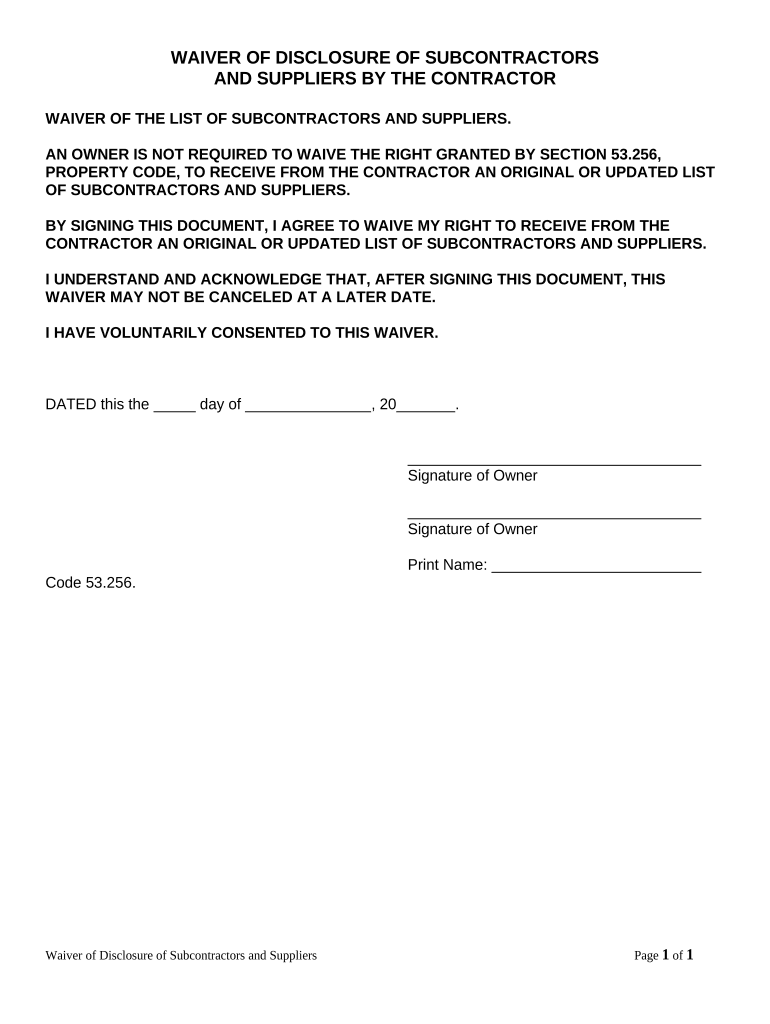
A Texas Waiver is a written release or disclaimer used to document that one party relinquishes a legal right, claim, or obligation under Texas law. Typical uses include liability waivers for events or activities, administrative fee waivers, or contractual carve-outs where a party agrees not to pursue a claim. The form records parties, scope of the waiver, effective date, and any limits or conditions. Properly completed, it creates enforceable evidence of consent and allocation of risk under applicable federal and Texas statutes.

Why a Clear Texas Waiver Matters

A clearly drafted waiver reduces ambiguity about consent and risk allocation and creates a written record that supports enforcement. It can limit exposure, streamline dispute resolution, and document informed consent for activities with inherent risks.

Why a Clear Texas Waiver Matters

Who Commonly Uses a Texas Waiver

Organizations and individuals use waivers in contexts where voluntary assumption of risk or administrative relief must be recorded in writing.

  • Event organizers and recreation providers use waivers to document participant assumption of risk and consent to safety rules.
  • Schools and youth programs use parental or guardian waivers for permission and liability allocation during off-campus activities.
  • Healthcare offices and social services may use narrow waivers for payments or release of non-critical claims where permitted by law.

Determine whether a waiver is appropriate for your facts and whether statutory exceptions (for example certain consumer protections or public benefit disallowances) limit enforceability.

Step-by-step: Completing a Texas Waiver

Follow these sequential steps to prepare and execute a waiver to reduce the chance of disputes.

  • 01
    Prepare: Describe parties, scope of rights waived, effective date, and any limits.
  • 02
    Review: Confirm statutory exceptions do not invalidate the waiver for this matter.
  • 03
    Sign: Obtain signatures from authorized signers and any required witnesses or notarization.
  • 04
    Retain: Store signed copies per retention rules and provide a copy to each signer.

Key elements to include in a professional Texas Waiver

A comprehensive waiver should combine clear parties, defined scope, express consent, and appropriate execution details to improve enforceability in Texas courts.

Parties

Identify each party by full legal name and capacity to establish who is granting and who is receiving the waiver.
Clear Scope

Define precisely the acts, dates, or claims covered by the waiver to avoid overbroad or ambiguous releases that courts may construe narrowly.

Consideration

Document the specific benefit exchanged for the waiver, which supports contractual validity under Texas contract law.

Voluntary Consent

Include language affirming signer’s voluntary, informed consent and, for consumer-facing matters, any required consumer disclosures.

Execution Details

Specify signature blocks, dates, and any witness or notary requirements to meet procedural formality expectations.

Limitations

State any scope exclusions such as gross negligence, willful misconduct, or statutory rights that cannot be waived.

Required information checklist

Signer Identity: Full legal name
Date: MM/DD/YYYY format
Scope: Specific activities/claims
Consideration: Monetary or non-monetary
Signature: Handwritten or e-signature
Authority: Title or parental status

Customizing and completing the waiver online

Configure a digital workflow that collects the required fields, authenticates signers, and preserves an audit trail for enforceability.

Field Configuration
Signature Field Required; capture timestamp and signer IP address
Date Field Auto-populate or require MM/DD/YYYY entry
Identity Check Email verification, SMS code, or higher authentication
Copy Distribution Auto-send signed PDF to all parties

Digital signing and platform needs

Choose a platform that supports reliable signer authentication, audit trails, and record retention consistent with legal requirements.

  • Authentication: Email, SMS, or KBA options
  • Audit Trail: IP, timestamp, and action log
  • Integrations: CRM and cloud storage

For high-risk waivers or regulated industries, select software that supports HIPAA BAAs, 21 CFR Part 11 controls, and enterprise integrations such as Salesforce, NetSuite, or Google Workspace.

Where to send and how the signed waiver is processed

Routing depends on the waiver type: internal retention, external filing, or distribution to third parties such as insurers or program managers.

  • Upload: Add PDF or DOCX to the signing platform
  • Assign: Place signature, initials, and date fields
  • Authenticate: Use chosen verification method for each signer
  • Distribute: Send copies to signers and designated recipients

Timing considerations and statutory checkpoints

Some waivers are time-sensitive: effective dates, statute of limitations impacts, and any filing window for administrative fee waivers must be observed.

Effective Date:

Use MM/DD/YYYY; governs when waiver takes effect

Program Deadlines:

Comply with program or event registration cutoffs

Statute of Limitations:

Waiver language can affect limitation calculations

Retention Trigger:

Record retention starts on execution date

Notarization Timing:

If required, notarize before filing or distribution

Common mistakes to avoid when preparing a Texas Waiver

  • Using overly broad or ambiguous release language that a court could construe against the drafter
  • Failing to identify the signer’s authority when an entity signs, which can void the agreement
  • Neglecting required consumer disclosures where federal ESIGN consent rules apply to consumer-facing waivers
  • Skipping authentication or audit logging when relying on electronic signatures in contested matters

Consequences of an incorrect or improperly executed waiver

Invalidation: Waiver may be unenforceable
Liability: Increased exposure to claims
Regulatory Risk: Possible agency sanctions
Tax Consequences: Incorrect reporting obligations
Evidence Loss: Missing audit trail weakens proof
Contract Disputes: Higher litigation costs

Real-world examples of Texas Waiver use

These short case descriptions show typical waiver scenarios and practical considerations when executing them.

Community Race Event

An organizer used a participant waiver with activity scope and medical acknowledgement

  • The waiver required signatures from adults and parental consent for minors
  • The signed, time-stamped PDF and audit trail helped resolve a subsequent medical claim without litigation by demonstrating informed consent and disclosed risks.

University Field Trip

A university distributed a travel waiver to parents via secure e-signature

  • The form captured parent identity and emergency contact info
  • Retained copies met institutional retention rules and supported timely insurer reporting when an incident occurred.

Who can sign on behalf of an entity

Authorized Officer

An officer or authorized representative of a company may sign if the signature block shows title and the organization’s internal authority rules permit the action. Include the signer’s printed name, title, and a corporate name to clarify capacity and reduce later challenges.

Parent/Guardian

For minors, a parent or legal guardian must sign. Include printed name, relationship to minor, and contact information to verify authority and enable follow-up if needed.

eSignature vendor comparison for signing and storing Texas Waivers

Basic vendor features and starting prices for common eSignature solutions; signNow is listed first for comparison consistency.

signNow DocuSign Adobe Sign PandaDoc HelloSign
Starting Price $8/user/mo $15/user/mo $14/user/mo $19/user/mo $15/user/mo
Free Trial 7-day free trial Varies Varies Varies Varies
Bulk Send Yes Yes Yes Yes No
Audit Trail Yes Yes Yes Yes Yes
HIPAA Compliant Yes Yes Yes No No

Frequently asked questions about a Texas Waiver

Answers to common legal and practical questions when creating, signing, or relying on a Texas Waiver.


Need help? Contact support

be ready to get more
Join over 28 million airSlate SignNow users