Establishing secure connection…Loading editor…Preparing document…

Unanimous Written Consent

This template is fully customizable. Edit the text, fill out the fields, and send it for signature. Give it a try!
Unanimous Written Consent

What an Unanimous Written Consent Is and When it’s Used

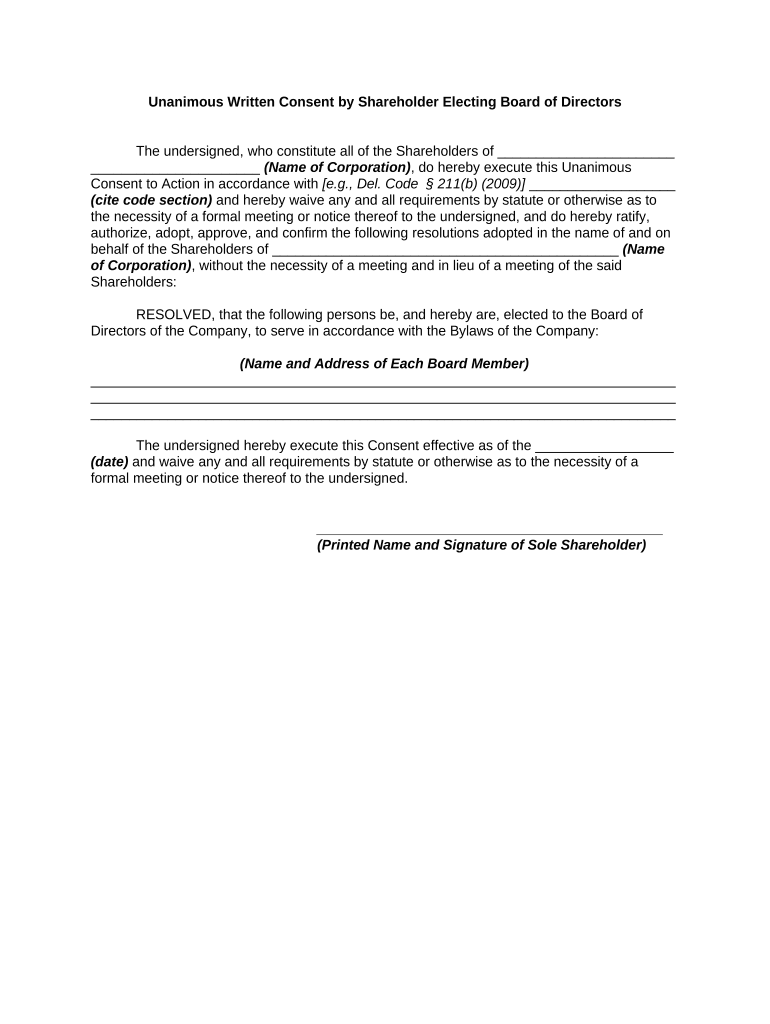
An Unanimous Written Consent is a corporate record showing that all board members or shareholders have agreed in writing to a specific action without holding a formal meeting. It documents unanimous approval for actions such as officer appointments, mergers, bylaw amendments, stock issuances, or the adoption of resolutions. Because the consent is unanimous, it carries the same corporate effect as an in-person vote but should be drafted to match the corporation’s bylaws and state law requirements. Properly executed consents become part of the corporate minute book and provide a clear audit trail for governance and compliance purposes.

Why Use a Unanimous Written Consent

A Unanimous Written Consent speeds decision-making, creates a clear paper trail for corporate governance, and avoids scheduling delays associated with meetings, while preserving legal effectiveness when executed under applicable corporate law and bylaws.

Why Use a Unanimous Written Consent

Who Typically Prepares and Signs This Consent

Companies of all sizes and their legal or corporate secretarial teams prepare Unanimous Written Consents to record joint approvals when all decision-makers agree in writing.

  • Boards of Directors: Executives and corporate secretaries use consents to document board-level approvals without convening a meeting.
  • Shareholders: Small corporations and closely held companies use unanimous consents to approve shareholder actions that would otherwise require a meeting.
  • General Counsel / Outside Counsel: Lawyers prepare and review consents to ensure compliance with bylaws and state corporate statutes.

Typical Signers and Preparers

Corporate Secretary

The corporate secretary or designated governance lead usually prepares the consent, verifies that wording aligns with bylaws, and records execution details in the minute book. They confirm that signers are authorized and that the action is permitted by state corporate law.

Board Members

All board members (or all shareholders, as required) must sign to achieve unanimity. Each signer should review the resolution language, sign and date the consent, and receive a final executed copy to maintain an audit trail for potential audits or litigation.

Essential Parts of a Professional Unanimous Written Consent

A well-structured consent should be concise, reference the governing document and statute, state the action clearly, identify parties, include signature blocks, and note the effective date and recordkeeping instructions.

Caption

Identify the company, state of incorporation, and indicate whether the document is a Board or Shareholder Unanimous Written Consent to avoid confusion with other corporate records.
Recitals

Briefly describe the context and authority for the action, citing relevant bylaws or charter provisions that permit action by written consent.

Resolved Clauses

State each corporate decision as a clear, affirmative resolution (for example, appoint Jane Doe as CEO effective MM/DD/YYYY) and use numbered clauses for multi-item actions.

Unanimous Statement

Include an explicit statement that all required directors or shareholders consent in writing and waive any notice or meeting requirements under bylaws or state law.

Signature Blocks

Provide printed name, title, signature line, and date field for each consenting party; ensure name matches official corporate records or ID where required.

Recordkeeping Note

Add a statement directing the corporate secretary to file the consent in the minute book and retain the original in accordance with the company’s retention policy.

Step-by-Step: Completing and Recording a Unanimous Written Consent

Follow these four steps to prepare, obtain signatures, and file the consent in the corporate records to preserve legal and audit readiness.

  • 01
    Draft Resolution: Draft clear recitals and resolved clauses consistent with bylaws and the action authorized.
  • 02
    Confirm Authority: Verify that the signers are all required directors or shareholders and that bylaws permit action by consent.
  • 03
    Collect Signatures: Obtain dated signatures from every required party; consider secure eSignature with audit trail if permitted.
  • 04
    File Minute Book: Record the final executed consent with minutes and corporate records; note retention and distribution details.

How to Configure an Online Consent Workflow

When using an eSignature platform, set fields, authentication, and routing to match signer roles and preserve an auditable trail.

Field Configuration
Signature Block Require name, title, signature, and date fields for each signer
Authentication Use email plus SMS or access code for signer identity verification
Routing Set signer order or allow parallel signing if bylaws permit
Audit Trail Enable full audit recording (IP, timestamp, device) for each action

Digital Signing and eSubmission Considerations

Choose an eSignature platform that provides a tamper-evident audit trail, appropriate signer authentication, and records retention to meet legal and corporate needs.

  • File Formats: PDF and DOCX supported
  • Authentication Options: Email, SMS, or KBA
  • Integrations: CRM and cloud-storage connectors

Where the Finished Consent Should Go

After execution, route the signed consent to the corporate secretary, retain the original in the minute book, and provide copies to relevant officers and advisors.

  • Corporate Minute Book: File the signed original in the official minute book
  • Chief Legal Officer: Provide a copy for legal and compliance records
  • Accounting Department: Send copies if resolutions have tax or financial impact
  • External Counsel: Deliver a copy when lawyer review or opinion is required

Risks if the Consent Is Flawed or Incomplete

Invalid Action: Board or shareholder action may be voidable
Personal Liability: Directors may face fiduciary exposure
Tax Consequences: Missing documentation can trigger IRS scrutiny
Contract Challenges: Third parties may dispute authority
Regulatory Penalties: Industry regulators may impose fines
Loss of Benefits: Corporate protections might be compromised

Common Preparation Errors to Avoid

  • Using informal language or vague resolutions that fail to specify authority, amounts, or effective dates, which creates ambiguity for enforcement or future audits.
  • Mismatched signer names or titles that don’t match corporate records, leading to questions about authority and possible rejection by banks or counterparties.
  • Failing to confirm that bylaws permit written consent for the specific action, which can render the consent ineffective under state corporate law.
  • Not preserving a verifiable audit trail—missing dates, unsigned pages, or lack of notarization where required can expose the company to legal risk.

Supporting Documents and Export Options

Attach exhibits and export signed records in multiple formats so the consent and its supporting materials remain accessible and tamper-evident.

Exhibits

Attach schedules, share allocation tables, or approval forms as labeled exhibits to the consent to ensure resolution context and evidentiary completeness.

Signed PDF

Export a tamper-evident PDF/A with embedded audit trail and signing certificate for long-term archival in the minute book.

DOCX Export

Keep an editable DOCX copy for future amendment drafts, but store the signed PDF as the authoritative record.

Cloud Archive

Store copies in secure cloud repositories with access controls and versioning for retrieval and regulatory review.

Timing Considerations and Typical Deadlines

Unanimous Written Consents often have immediate effect but require prompt recording and distribution to minimize governance risk.

Execution Date:

Signers should date consent consistently; effective date governs when the action takes effect

Record Filing:

File the signed consent in the minute book immediately after final signature

Notice to Parties:

Provide copies to officers and relevant departments within 5 business days

Tax Reporting:

If the action triggers reporting, coordinate with accounting for applicable IRS deadlines

Notarization Timeline:

If notarization is required, obtain acknowledgements at signing or within a short, documented timeframe

How This Document Differs from Minutes or Board Resolutions

Compare Unanimous Written Consent with meeting minutes and formal resolutions to choose the right governance record for your needs.

Criteria Unanimous Written Consent Minutes / Resolution
Formality high (written signatures) high (formal meeting record)
Meeting Required
Record Location minute book minute book
Use Case when all agree in writing when deliberation or voting occurred

eSignature Platform Pricing and Feature Snapshot

Basic pricing and feature availability for common eSignature vendors. signNow appears first; verify plan details with each vendor for production use.

signNow DocuSign Adobe Sign PandaDoc HelloSign
Starting Price $8/user/mo $15/user/mo $14/user/mo $19/user/mo $15/user/mo
Free Trial Yes, 7-day free trial Varies by plan Varies by plan Varies by plan Varies by plan
Bulk Send Yes Yes Yes Yes No
Audit Trail Yes Yes Yes Yes Yes
HIPAA Compliant Yes Yes Yes No No

Real-World Examples of Using Unanimous Written Consents

Two brief examples show how small and mid-size companies use consents to accelerate governance without sacrificing compliance.

Optica Ventures (COO)

Optica used a written consent to appoint an interim CFO quickly, avoiding scheduling delays.

  • The consent was signed by all directors in two days.
  • The company filed the executed consent in the minute book and provided copies to finance and external auditors to support the change.

Martin Properties (Founder)

A real estate firm used unanimous consent to approve a property sale and related distribution policy.

  • All shareholders signed while remote.
  • The executed consent, signed PDFs, and exhibit schedules were retained in the corporate records to document authority for closing and tax reporting.

FAQs and Troubleshooting for Unanimous Written Consents

Answers to common questions about validity, execution, notarization, amendments, storage, and when to use a consent instead of a meeting.


Need help? Contact support

be ready to get more
Join over 28 million airSlate SignNow users