Establishing secure connection…Loading editor…Preparing document…

Notice Fixing Price of Goods

This template is fully customizable. Edit the text, fill out the fields, and send it for signature. Give it a try!
Notice Fixing Price of Goods

What a Notice Fixing Price of Goods Is and When it’s Used

Notice Fixing Price of Goods is a written notice used to establish and communicate a firm, non-adjustable price for specified goods between contracting parties. It typically appears in purchase agreements, supply contracts, or procurement solicitations where price certainty is required despite market fluctuations, futures clauses, or escalation language. The notice identifies the goods, quantities, effective dates, pricing calculation or fixed amount, and any conditions or contingencies that affect enforceability. Properly drafted, it reduces billing disputes and supports contract administration by creating clear evidence of agreed pricing and timing for invoicing and delivery.

Why a Clear Price-Fixing Notice Matters

A Notice Fixing Price of Goods clarifies price terms, minimizes disputes, and preserves remedies when market conditions change. It provides enforceable documentation for purchasers, sellers, and third parties such as lenders, carriers, and auditors, streamlining invoicing and contract performance oversight.

Why a Clear Price-Fixing Notice Matters

Who Typically Prepares and Relies on This Notice

Common users include procurement teams, suppliers, contract managers, purchasing officers, and in-house legal counsel responsible for contract administration.

  • Procurement teams: Issue notices to lock pricing and coordinate supplier acceptance and purchase orders.
  • Suppliers: Use notices to confirm price offers, shipment terms, and invoicing procedures for each delivery.
  • Legal and contract managers: Review language for enforceability, conditions, and alignment with governing law.

Step-by-Step: Create, Send, and Confirm the Notice

Step-by-step completion guide for issuing, reviewing, and accepting a Notice Fixing Price of Goods accurately.

  • 01
    Prepare Notice: Identify goods, quantities, and proposed fixed price.
  • 02
    Specify Terms: State delivery, payment, and adjustment exceptions clearly.
  • 03
    Send to Counterparty: Transmit via signed letter, email, or eSignature platform.
  • 04
    Obtain Acceptance: Receive written acceptance or signed acknowledgment before performance.

Where to Send and How Notices Are Routed

Typical routing, submission, and recording options for a Notice Fixing Price of Goods electronically.

  • Direct Delivery: Send to supplier or purchaser contact by email or courier.
  • Contract File: Attach to master purchase order or contract repository.
  • Accounting: Provide copies to AP and receivables for invoicing setup.
  • Regulatory Filing: File copies if required by procurement or government contracts.

Online Workflow Settings to Automate Notices

Recommended online workflow settings to automate notice creation, approval routing, and signature collection for price-fixing notices.

Form Field and Workflow Configuration Workflow Action | Default Setting
Auto-Calculate Line Item and Totals Auto-calc per unit; validate total before signing.
Conditional Discount and Price Adjustment Rules Apply only if acceptance signed; flag exceptions.
Approval Routing and Notification Sequence Route to procurement then legal; notify finance.
Signature Collection and Audit Trail Capture Collect eSignature; store audit record with timestamp.

Platform and Security Requirements for Electronic Submission

Basic platform requirements for e-signing, authentication, and storage when submitting Notices Fixing Price of Goods.

  • Signed PDF: PDF/A export with embedded audit trail.
  • Authentication: Email or SMS OTP; stronger KBA optional.
  • Storage: AES-256 at rest; TLS 1.2/1.3 in transit.

Essential Elements to Include in the Notice

Core components to include in a professional Notice Fixing Price of Goods to ensure clarity, enforceability, and contract alignment across procurement and supply chain processes.

Identification

Clear identification of buyer, seller, contract number, purchase order, and contact details so the notice can be matched to existing agreements and processed by accounting and logistics teams without ambiguity.
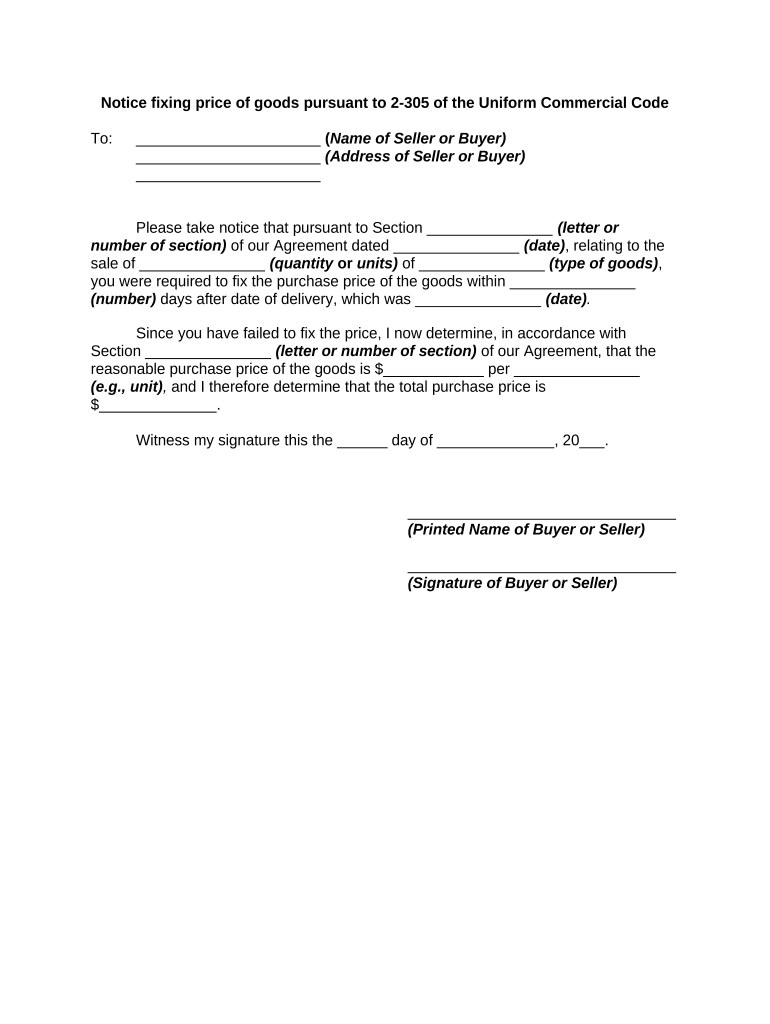
Goods Description

Detailed specification including model, SKU, grade, and any serial numbers. Precise descriptions prevent delivery disputes and support customs, quality inspection, or warranty claims.

Quantity and Units

Exact quantities and unit measurements with tolerance levels if applicable. State whether shipments may be partial and how shortages are reconciled to the fixed price.

Fixed Price Terms

State unit price, total price, currency (USD), and whether price includes taxes, duties, freight, or insurance. Note any exclusions or capped escalation mechanisms.

Effective Period

Specify effective date and expiration or review milestones. Include conditions that suspend or terminate the fixed price, such as force majeure or regulatory changes.

Acceptance and Signature

Include space for counterparty acceptance, signature block, printed name, title, and date. Define acceptable signing methods, including electronic signatures per ESIGN and UETA.

Key Risks and Potential Consequences

Payment Disputes: Delayed payments or withholding.
Contract Breach: Damages and cure costs.
Tax Reporting: Mismatched names can trigger withholding.
Regulatory Noncompliance: Procurement rule violations.
Reputational Risk: Supplier relationship damage.
Enforceability Issues: Ambiguous terms may void notice.

Common Preparation Errors to Avoid

  • Using vague descriptions or quantities that make matching deliveries to the notice difficult, increasing disputes and reconciliation effort between logistics and finance.
  • Failing to state currency, taxes, or shipping inclusion leads to price interpretation differences and invoice disputes requiring resolution.
  • Not obtaining explicit written acceptance or signature before performance creates ambiguity about whether the fixed price was agreed.
  • Mixing adjustable escalation clauses with 'fixed' language without clear priority rules undermines enforceability and creates litigation risk.

Quick Reference: Required Information at a Glance

Buyer: Full legal name and contact details.
Seller: Full legal name and contact details.
Goods: Precise description and SKU numbers.
Quantity: Numeric amount and unit of measure.
Price: Unit and total price in USD.
Effective Date: MM/DD/YYYY format; binding start date.

Who May Legally Sign on Behalf of a Party

Authorized Signatory — Seller

An individual with corporate authority to bind the seller (executive officer, procurement manager, or authorized agent). Verify delegated signature authority, include title and date, and ensure the signatory's capacity is documented to avoid later challenge of enforceability.

Authorized Signatory — Buyer

An individual authorized to accept and bind the buyer (purchasing officer, authorized agent, or officer). Confirm internal approval, include title and signing date, and retain evidence of delegation to support enforcement and payment instructions.

Vendor Pricing and Feature Snapshot for eSignature Support

Comparative vendor pricing and feature summary for executing Notices Fixing Price of Goods, with signNow listed first for reference.

signNow DocuSign Adobe Sign PandaDoc HelloSign
Starting Price $8/user/mo $15/user/mo $14/user/mo $19/user/mo $15/user/mo
Free Trial 7-day free trial Varies by plan Varies by plan Varies by plan Varies by plan
Bulk Send Yes (Business Premium+) Varies by plan Varies by plan Varies by plan Varies by plan
Audit Trail Yes Yes Yes Yes Yes
HIPAA Compliant Yes Varies by plan Varies by plan Varies by plan Varies by plan
Envelope Cap No cap 100 envelopes/user/year Varies by plan Varies by plan Varies by plan

Key Deadlines and Timing to Specify

Key timing elements and typical deadlines to include and monitor when issuing a Notice Fixing Price of Goods.

Effective Date:

Date when the fixed price becomes binding.

Acceptance Deadline:

Final date for counterparty to sign acceptance.

Delivery Window:

Shipment schedule or delivery cutoff dates.

Invoice Submission:

Deadline for supplier invoicing to qualify for fixed price.

Dispute Window:

Timeframe to raise pricing disputes post-delivery.

Frequently Asked Questions About Price-Fixing Notices

Answers to common questions about drafting, signing, enforcing, and correcting a Notice Fixing Price of Goods in U.S. commercial practice.


Need help? Contact support

be ready to get more
Join over 28 million airSlate SignNow users