Establishing secure connection…Loading editor…Preparing document…

Charitable Lead Inter Vivos Unitrust

This template is fully customizable. Edit the text, fill out the fields, and send it for signature. Give it a try!
Charitable Lead Inter Vivos Unitrust

What a Charitable Lead Inter Vivos Unitrust Is

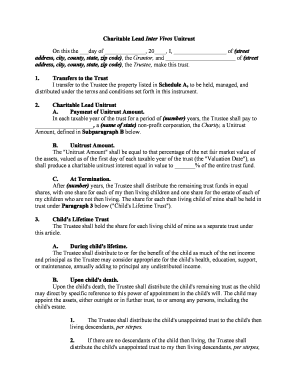
A Charitable Lead Inter Vivos Unitrust is an irrevocable estate-planning vehicle funded during the grantor's life that pays a fixed percentage of the trust's annual fair market value to one or more charities for a set term or the grantor's lifetime. At the end of the lead term the remaining trust principal passes to noncharitable remainder beneficiaries such as family members or other heirs. The trust type can provide an immediate charitable deduction under federal tax rules, shift future appreciation out of the taxable estate, and support philanthropic objectives while retaining a remainder interest for designated beneficiaries.

Why a Charitable Lead Inter Vivos Unitrust Matters for Estate Planning

This trust can reduce estate and gift tax exposure, produce current charitable tax benefits, and move future appreciation out of your taxable estate while providing predictable annual support to charities.

Why a Charitable Lead Inter Vivos Unitrust Matters for Estate Planning

Who Typically Establishes a Charitable Lead Inter Vivos Unitrust

Parties should consult tax and trust counsel to confirm objectives, valuation methods, and the trust's effects on gift and estate taxation.

  • High-net-worth individuals balancing family inheritances with charitable goals.
  • Founders or business owners transferring company equity while funding causes.
  • Advisors structuring multi-generation wealth transfer strategies that include charities.

Core Components Found in a Professional Charitable Lead Inter Vivos Unitrust

A well-drafted Charitable Lead Inter Vivos Unitrust specifies the lead payment, remainder beneficiaries, trustee authority, term, valuation method, and investment policy to ensure clarity and tax compliance.

Lead Interest

Defines the annual payout as a fixed percentage of trust value (unitrust percentage) payable to specified charities each year under the trust terms.
Remainder Beneficiaries

Names individuals or entities who receive remaining trust assets after the charitable term, including contingent remainder provisions if primary beneficiaries predecease the term.

Term and Trigger

Specifies the duration of charitable payments: a fixed number of years or for the grantor's lifetime, and conditions that can modify or terminate payments.

Trustee Powers

Grants authority to manage investments, make distributions, substitute assets, and delegate duties; includes successor trustee appointment procedures.

Valuation Method

Sets the annual valuation date and methodology for computing the unitrust payout to avoid disputes and ensure consistency.

Investment Policy

Outlines permissible investments, risk tolerance, and allocation goals so the trustee can balance income to charity with preservation of remainder value.

Step-by-Step: How to Complete the Charitable Lead Inter Vivos Unitrust Form

Follow these core steps to assemble, review, and execute the trust document correctly.

  • 01
    Gather Documents: Collect IDs, beneficiary details, charity EINs, and asset descriptions.
  • 02
    Choose Trustee: Select a trustee with fiduciary experience and confirm successor trustees.
  • 03
    Set Terms: Specify unitrust percentage, valuation date, and the exact term.
  • 04
    Execute: Sign with required witnesses/notary and fund the trust assets.

How a Charitable Lead Inter Vivos Unitrust Operates Over Time

This sequence explains the fundamental cashflow and governance steps from funding to remainder distribution.

  • Fund the Trust: Transfer assets into the trust to establish principal.
  • Annual Payouts: Trust pays charities the unitrust percentage annually.
  • Investment Growth: Trust assets appreciate or decline based on policy, affecting future payouts.
  • Remainder Distribution: At term end the remaining principal transfers to remainder beneficiaries.

Typical Digital Workflow Settings for Creating and Executing the Trust

Recommended workflow settings help standardize data capture, trustee approvals, and secure signature collection when using an e-signature platform.

Field Configuration
Beneficiary Inputs Required fields with validation for SSN/EIN format
Signature Order Set grantor then trustee then witness order
Authentication Use email + SMS code or stronger KBA for identity
Audit Trail Enable full timestamped logging of all actions

Digital Signing and Technical Considerations

Ensure the chosen platform can meet legal, privacy, and retention obligations and supports any required witness or notarization workflows.

  • Audit Trail: Record IP, timestamps, and signer actions
  • Authentication: Offer multi-factor or KBA where required
  • Integrations: Support PDF, DOCX, and cloud storage connectors

Security and Compliance Features to Protect Trust Documents

In-transit Encryption: TLS 1.2/1.3
At-rest Encryption: AES-256
Regulatory Certifications: SOC 2 Type II available
HIPAA Support: BAA required for PHI
Audit Trail: Full timestamped history
Access Controls: Role-based user permissions

Penalties and Risks of Errors in a Charitable Lead Inter Vivos Unitrust

Incorrect Reporting: Incorrect reporting — IRC §6721 penalties apply
Gift/Estate Tax: Improper valuation triggers gift or estate tax adjustments
Loss of Deduction: Nonqualifying charity or timing errors void deduction
Trustee Breach: Breach of fiduciary duty can produce litigation
Valuation Disputes: Asset valuation disagreements may lead to IRS challenges
Operational Risk: Unfunded trust or funding delays nullify intended transfers

Common Mistakes to Avoid When Preparing This Unitrust

  • Failing to fund the trust promptly after execution, leaving the trust empty and undermining tax and charitable objectives.
  • Using ambiguous beneficiary descriptions that create ambiguity when distributing the remainder interest to family or contingent heirs.
  • Neglecting to specify valuation dates or methods, which can produce inconsistent annual payout calculations and disputes.
  • Skipping professional valuation for noncash assets such as closely held business interests, increasing audit and penalty risk.

eSignature Vendor Comparison for Executing Trust Documents

Compare basic pricing and essential capabilities for common eSignature vendors. signNow is listed first per standard vendor comparisons.

signNow DocuSign Adobe Sign PandaDoc HelloSign
Starting Price $8/user/mo $15/user/mo $14/user/mo $19/user/mo $15/user/mo
Free Trial 7-day free trial Varies by plan Varies by plan Varies by plan Varies by plan
Bulk Send Yes (select plans) Available on plans Available on plans Available on plans Available on plans
Audit Trail Yes Yes Yes Yes Yes
HIPAA Compliant Yes Yes Yes No No
Envelope Cap No cap 100 envelopes/user/year Varies by plan Varies by plan Varies by plan

Key Timing Considerations and Deadlines

Certain dates affect tax reporting, valuation, and distribution timing; track these deadlines to preserve tax benefits and compliance.

Effective Date Entry:

Use MM/DD/YYYY; this date starts the payout schedule and valuation cycle.

Annual Valuation:

Perform valuation on the date specified each year to compute unitrust payments.

Tax Reporting:

File required trust returns and information returns according to IRS schedules and deadlines.

Gift Tax Return:

If a gift is created at funding, consider Form 709 timing and filing obligations.

Funding Window:

Fund trust promptly after signing to avoid losing intended tax outcomes.

Frequently Asked Questions About the Charitable Lead Inter Vivos Unitrust

Answers to common questions about structure, tax treatment, signatures, and post-execution administration for Charitable Lead Inter Vivos Unitrusts.


Need help? Contact support

be ready to get more
Join over 28 million airSlate SignNow users