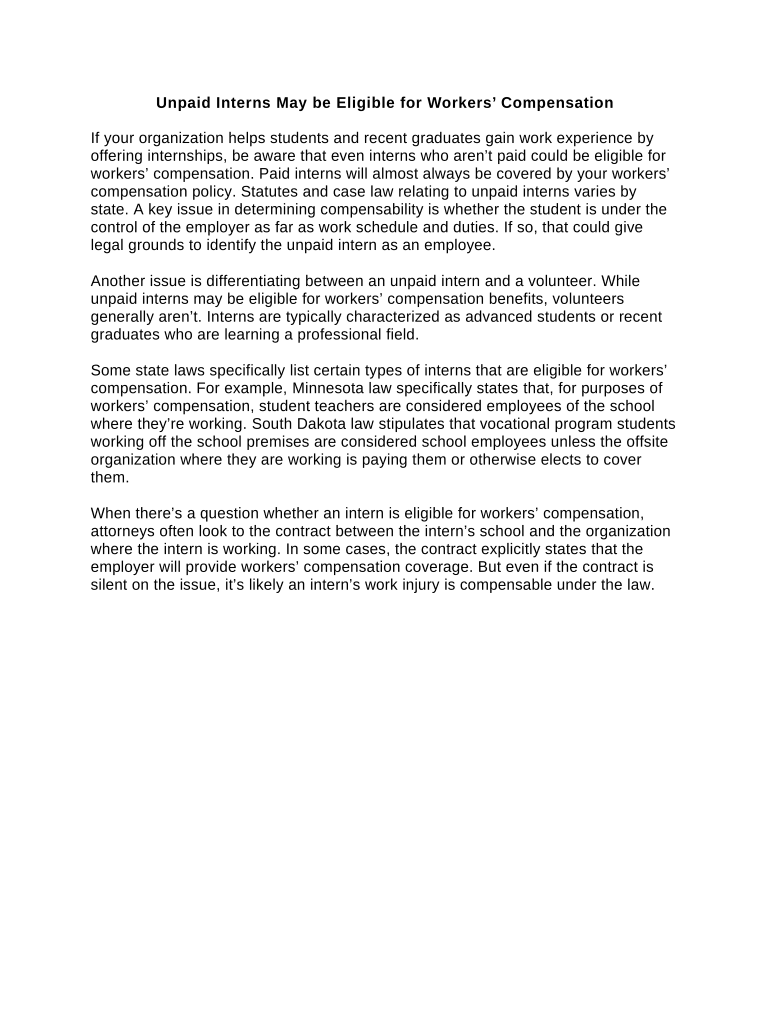
Unpaid Interns Eligibility for Workers’ Compensation
What the Unpaid Interns Eligibility for Workers’ Compensation document is
Why completing an eligibility form matters
A clear eligibility determination reduces legal uncertainty, documents the internship arrangement for insurers and regulators, and helps protect both the organization and the individual by showing whether workers’ compensation applies under applicable state law.
Who typically fills and relies on this eligibility form
Employers, human resources, internships coordinators, and risk managers use the form to document status and support claims handling.
- HR and Talent Teams: Create and store determinations, integrate into onboarding and training records.
- Supervisors and Managers: Confirm daily duties, supervision levels, and educational linkage.
- Risk/Compliance Officers: Use records for insurer reporting, audits, and legal defense.
Maintain completed forms with personnel and claims files so determinations are available if an injury occurs or a regulatory inquiry arises.
Step-by-step: How to complete and finalize the eligibility form
-
01Prepare records: Gather offer letters, academic agreements, and supervision plans.
-
02Complete fields: Enter identification, role, dates, and affiliation information accurately.
-
03Obtain approvals: Have supervisor and HR sign to confirm oversight and terms.
-
04Store securely: Save in personnel and claims systems with access controls.
How the eligibility determination flows in practice
-
Recruitment stage: Identify role objectives and educational linkages.
-
Onboarding review: HR verifies that duties match internship criteria.
-
Documentation: Complete the eligibility form and attach supporting docs.
-
Retention and audit: Store form with access logs for insurer and regulator review.
Recommended digital workflow settings for online completion
| Field | Configuration |
|---|---|
| Required fields | Make name, date, supervisor, and status mandatory. |
| Authentication | Use email link or SMS code for signer attribution. |
| Attachments | Allow PDF uploads for academic agreements and offer letters. |
| Retention | Enable audit trail and long-term storage for 6+ years. |
Technical considerations for e-signing and storage
Choose a platform that supports secure signing, audit trails, and the retention policies you require.
- Authentication: Email, SMS, or multi-factor
- Document formats: PDF and DOCX supported
- Retention controls: Audit trail and export
Ensure the platform can issue an audit certificate and export signed records in compliant formats for insurer or regulator requests.
Key penalties and risks of incorrect determinations
Common mistakes when preparing the eligibility form
- Incomplete supervision details — failing to document direct oversight and daily reporting lines can undermine the internship classification.
- Missing educational tie — not attaching course enrollment or instructor confirmation when required by the program’s terms.
- Vague duty descriptions — using generic job titles without tasks makes it hard to defend non-employee status in claims.
- Improper signatures — accepting initials or unsigned PDFs without an auditable signature event increases legal risk.
Timing and common deadlines to track
Eligibility completion:
Complete before internship start date
Injury reporting:
Report injuries promptly; state deadlines vary
Claims filing:
File claim as insurer and state rules require
Record retention:
Retain records per regulatory retention timelines
Review cadence:
Reassess determinations annually or upon role change
Key milestones from onboarding to claim readiness
Stage 1 — Onboarding
Collect offer, academic info, and role description.
Stage 2 — Eligibility Review
HR and supervisor evaluate duties against internship criteria.
Stage 3 — Documentation
Execute form, secure signatures, attach supporting documents.
Stage 4 — Retention
Store record with audit trail for required retention period.
Practical examples of use and documentation outcomes
University Internship Program
A university and employer document course credit and faculty oversight
- Supervisor confirms structured tasks and feedback schedule
- The completed form plus transcript evidence helped the employer demonstrate a training relationship during a post-injury insurer review, avoiding disputed coverage.
Hospital Clinical Internship
A hospital documents supervised clinical observation and limits on patient contact
- Program coordinator provides faculty agreement
- Clear supervision notes and signed HIPAA-aware acknowledgements expedited claims triage and protected patient confidentiality while the intern recovered.
Pricing and capability comparison for e-sign solutions when handling eligibility forms
| signNow | DocuSign | Adobe Sign | PandaDoc | HelloSign | |
|---|---|---|---|---|---|
| Starting Price | $8/user/mo | $15/user/mo | $14/user/mo | $19/user/mo | $15/user/mo |
| Free Trial | 7-day trial | Varies by plan | Varies by plan | Varies by plan | Varies by plan |
| Bulk Send | Yes | Yes | Yes | Yes | No |
| Audit Trail | Yes | Yes | Yes | Yes | Yes |
| HIPAA Compliant | Yes | Yes | Yes | No | No |
| Envelope Cap | No cap | 100 envelopes/user/year | Varies | Varies | Varies |
Frequently asked questions about unpaid intern eligibility and e-signing
-
Are unpaid interns automatically excluded from workers’ comp?
No. Coverage depends on state law and a facts-based employment test. The form records supervision, training intent, and educational ties to support classification decisions.
-
Who should sign the eligibility form?
The intern (or applicant), the supervising manager, and an authorized HR representative should sign to confirm facts and consent to recordkeeping.
-
Can the form be signed electronically?
Yes. Electronic signatures that meet ESIGN (15 U.S.C. ch. 96) and the applicable state UETA standards are generally enforceable, provided intent, consent, attribution, and retention are demonstrable.
-
What supporting documents should be attached?
Attach offer letters, academic affiliation letters, training schedules, and any supervision plans. These attachments substantiate the determination if challenged.
-
How long must these records be kept?
Retain per federal and industry rules — at least 3 years for tax-related records and 6 years for HIPAA-covered healthcare records; some states require longer retention.
-
What if an injury occurs despite an unpaid intern status?
Report the injury per employer policy and state law. The completed form and attachments will be reviewed by the insurer and may be used in coverage determinations.