Establishing secure connection…Loading editor…Preparing document…

Virginia Divorce Separation

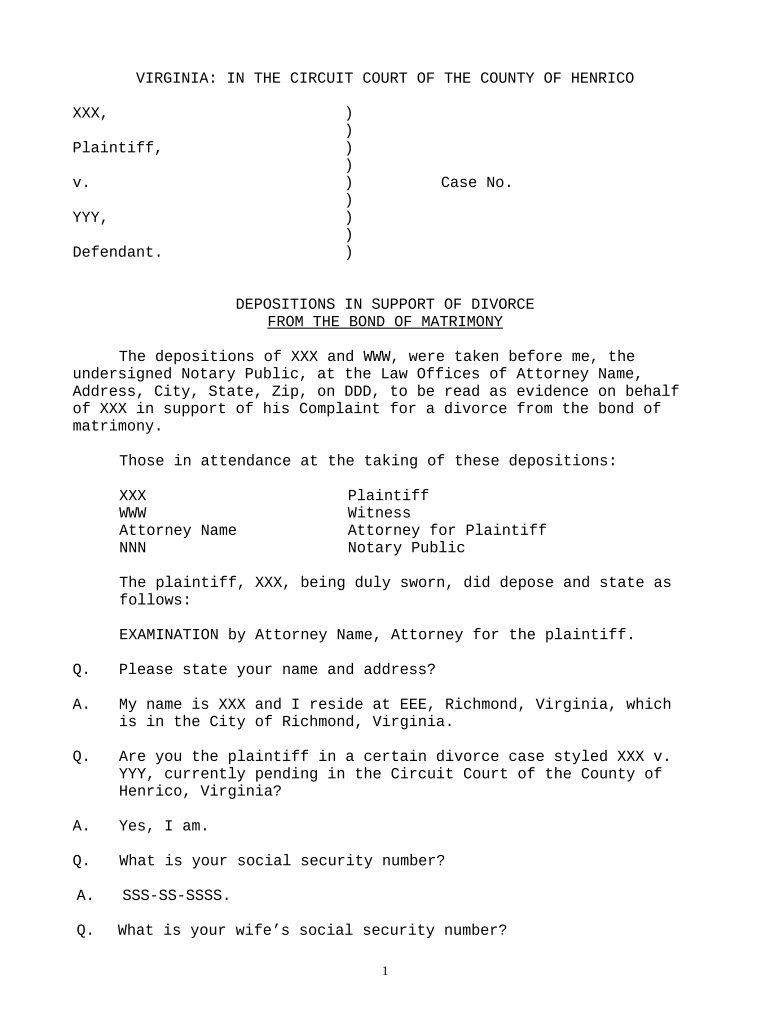
This template is fully customizable. Edit the text, fill out the fields, and send it for signature. Give it a try!
Virginia Divorce Separation

What a Virginia Separation Agreement Is and When It Matters

A Virginia Separation Agreement is a written contract between spouses that documents each party's rights and obligations while living separate and before or instead of seeking an absolute divorce. It typically covers property division, debt allocation, spousal support, custody and visitation for children, and temporary use of residences. While many separation agreements are privately negotiated and signed by the parties, court approval may be required to convert terms into an enforceable divorce decree; electronic signing may be permitted under ESIGN and state law except where a particular court or statute requires in-person execution.

Why a Clear Separation Agreement Benefits Both Parties

A well-drafted separation agreement reduces uncertainty, documents financial responsibilities, and creates a clear basis for later divorce proceedings or enforcement if disputes arise.

Why a Clear Separation Agreement Benefits Both Parties

Who Commonly Prepares and Signs These Agreements

Several parties and professionals are typically involved in creating and executing a Virginia separation agreement.

  • Spouses negotiating terms directly or through counsel, often during mediation or informal settlement talks.
  • Family law attorneys preparing, reviewing, and advising on enforceability and court filing implications.
  • Mediators and collaborative law professionals facilitating settlement and ensuring the agreement reflects mutual intent.

In practice, a combination of legal counsel and neutral facilitation improves clarity and reduces enforcement risk.

Primary signers and professionals involved

Spouses

Two parties to the marital relationship who must review and sign the agreement. Each spouse should confirm identity, full legal name, and intent to be bound; signatures should match identification to reduce later disputes and permit court enforcement.

Family Attorney

A licensed Virginia family law attorney or mediator who drafts or reviews the agreement, advises on statutory requirements, and, when needed, assists with submitting terms to the circuit court or preparing a marital settlement incorporated into a divorce decree.

Key information fields every Virginia agreement should contain

Full Legal Names: Exact names as on government ID
Date of Separation: MM/DD/YYYY format
Property Schedule: List major assets and values
Debt Allocation: Identify creditors and responsibilities
Child Custody Terms: Custody, visitation, support summary
Signature Blocks: Signed and dated by each party

Consequences of an incomplete or incorrect agreement

Enforceability Risk: Court may refuse to enforce
Tax Implications: Incorrect reporting consequences
Support Liability: Unresolved support arrears arise
Property Disputes: Title transfer complications occur
Perjury Risk: False statements carry penalties
Court Rejection: Filing may be rejected or delayed

Common preparation pitfalls to avoid

  • Using informal language: ambiguous terms create disputes and invite litigation over intent and scope of obligations.
  • Missing financial disclosures: incomplete asset or debt lists can later invalidate parts of the agreement or prompt court correction.
  • Name mismatches: signatures or names that do not match legal identification complicate enforcement and may trigger challenges.
  • Ignoring notarization rules: failing to notarize where required or using invalid remote notarization can render the document less persuasive in court.

Step-by-step: Preparing and executing a Virginia separation agreement

Follow a clear sequence to prepare, sign, and (if needed) present the agreement to the court for incorporation into divorce proceedings.

  • 01
    Gather Records: Collect financial records and asset lists
  • 02
    Draft Terms: Document property, support, custody provisions
  • 03
    Review with Counsel: Have an attorney verify legal completeness
  • 04
    Sign and Notarize: Execute with proper signatures and notarization

Where to file, serve, and record a separation agreement in Virginia

Know the typical routing steps: local filing, service to the other party, and optional court submission to incorporate terms into a divorce decree.

  • Local Circuit Court: File pleadings or proposed decree with clerk
  • Serve Parties: Provide copies to the other spouse per court rules
  • Financial Affidavit: Submit required financial disclosures with court
  • Hearing Submission: Present agreement at final hearing if needed

Electronic signing and file formats to use

Use common, court-compatible formats and ensure the signing method meets legal and court acceptance standards.

  • Accepted Formats: PDF, DOCX
  • Authentication: Email, SMS code, or stronger
  • Audit Trail: Time stamp and IP logging

When using eSign tools, confirm the court will accept electronically signed agreements and whether notarization or remote online notarization (RON) is permitted in your county.

Timing to expect during negotiation and filing

Timelines depend on negotiation speed, court schedules, and whether you seek to incorporate the agreement into a divorce decree.

Negotiation Period:

No set deadline; depends on parties' willingness to settle

Response Deadline:

Court service rules set answer/response time when filed

Financial Disclosures:

Submit with initial filing or as ordered by court

Hearing Scheduling:

Court calendars determine final hearing timing

Statutory Separation:

State law separation periods may affect absolute divorce eligibility

Practical best practices for accurate and efficient completion

Adopt clear practices to reduce risk, improve enforceability, and speed court processing.

Use Clear Defined Terms
Define all key terms (e.g., 'marital property', 'support period') to avoid later interpretive disputes; consistent terminology aids courts and counsel in enforcement proceedings.
Full Financial Disclosure
Provide complete asset and debt schedules supported by documentation; courts may set aside agreements tainted by incomplete or misleading financial statements.
Confirm Identity and Consent
Verify signer identity with government ID or multi-factor authentication for eSign events; clear evidence of intent and consent supports ESIGN/UETA enforceability.
Obtain Proper Notarization
Where required or advisable, notarize signatures in accordance with state rules or use an authorized RON provider; document the notarial act in the record.

How different professionals use a Virginia separation agreement

Realistic scenarios show how the agreement functions in mediation, counsel review, and court incorporation.

Mediation Example

A mediator helps spouses negotiate property division and parenting time to avoid litigation.

  • Parties sign a mutual separation agreement at session close.
  • The mediator provides a clean, dated agreement the parties can present to counsel or file with the clerk to expedite an uncontested divorce.

Attorney Drafted Example

An attorney prepares a comprehensive agreement after full financial disclosure by both sides.

  • Counsel reviews tax and support implications with clients.
  • The agreement is signed, notarized, and supplied to the court for inclusion in a final decree, reducing post-divorce litigation risk.

Typical eSignature pricing and capability snapshot for signing needs

Compare basic starting prices and core capabilities for commonly used eSignature vendors; signNow is listed first per vendor comparison conventions.

signNow DocuSign Adobe Sign PandaDoc HelloSign
Starting Price $8/user/mo $15/user/mo $14/user/mo $19/user/mo $15/user/mo
Free Trial 7-day trial No No Yes, limited Yes, limited
Bulk Send Yes Yes Yes Yes No
Audit Trail Yes Yes Yes Yes Yes
HIPAA Compliant Yes Yes Yes No No

Frequently asked questions about Virginia separation agreements and eSigning

Answers to common questions about execution, notarization, court filing, and electronic signature legality in family law contexts.


Need help? Contact support

be ready to get more
Join over 28 million airSlate SignNow users