Establishing secure connection…Loading editor…Preparing document…

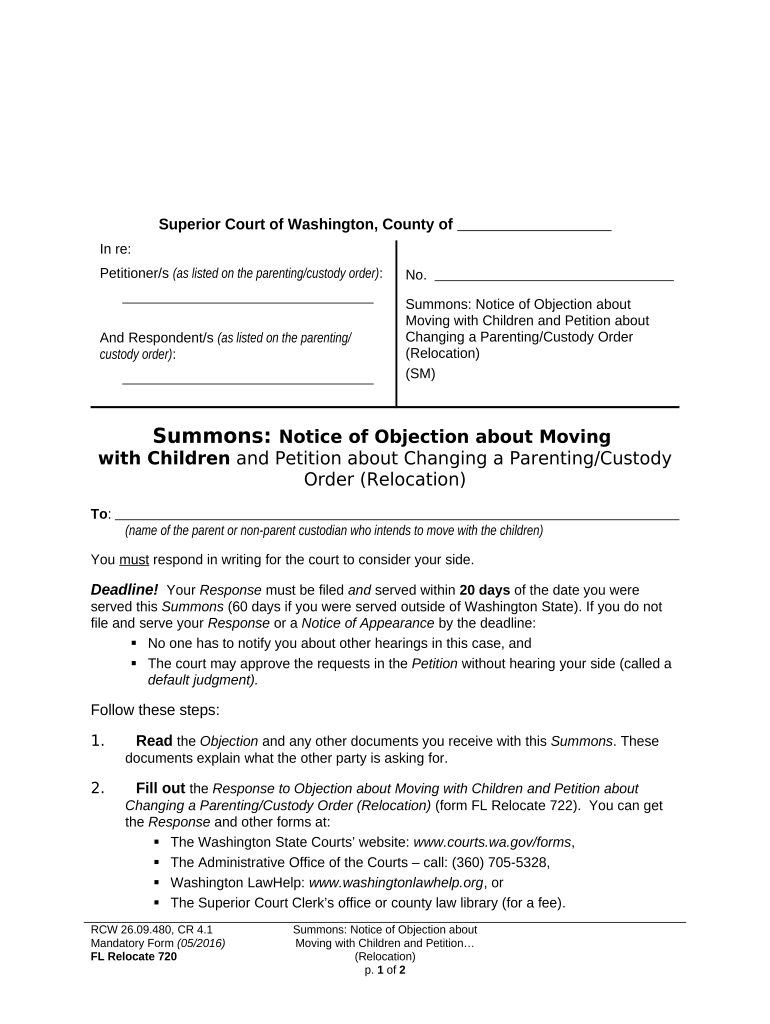
Washington Summons: Notice of Objection about Moving with Children and Petition about Changing a Parenting/Custody Order

This template is fully customizable. Edit the text, fill out the fields, and send it for signature. Give it a try!
Washington Summons: Notice of Objection about Moving with Children and Petition about Changing a Parenting/Custody Order

What this Washington summons and petition document is

The Washington Summons: Notice of Objection about Moving with Children and Petition about Changing a Parenting/Custody Order is a combined family-law filing used when a parent objects to a proposed relocation with a child and also seeks modification of an existing parenting or custody order. It notifies the other party of the objection, explains requested changes to parenting time or custody, and asks the court to set procedures and hearings. The form gathers facts about proposed move, parenting plan changes, jurisdiction, and relief sought so the court can schedule a response and hearing under state family law procedures.

Why this filing matters in custody and relocation disputes

This combined summons and petition provides formal notice and establishes a court record for objections to relocation with a child while requesting a parenting order change.

Why this filing matters in custody and relocation disputes

Who typically completes and responds to this document

Courts, mediators, and guardians ad litem also consult the filing when scheduling hearings or recommending temporary parenting plans.

  • Objecting parent asserting relocation harms child stability or custody arrangement
  • Responding parent proposing relocation and requesting parenting plan modification
  • Family law attorneys representing either parent in contested relocation and custody proceedings

Step-by-step: completing the summons and petition

Follow these steps in order to assemble a clear, court-ready filing and to avoid common procedural delays when objecting to a proposed move and requesting custody changes.

  • 01
    Identify parties: Enter full legal names and contact information for each party.
  • 02
    Describe move: State the proposed new residence and reasons for relocation.
  • 03
    Request relief: Specify the custody and parenting adjustments you seek.
  • 04
    Sign and date: Sign where required and date the petition before filing.

Core sections included in the summons and petition

The form is structured to present jurisdictional facts, relocation details, the legal basis for objection, requested parenting order changes, temporary arrangements, and supporting attachments.

Jurisdiction

Facts establishing the court's authority over the child and parties including residency, prior orders, and any emergency jurisdiction considerations where applicable.
Relocation Details

Precise description of the proposed move, distance from current residence, anticipated timeline, and practical effects on parenting time and schooling.

Objection Basis

Concise factual and legal grounds for opposing the move — child stability, educational disruption, safety concerns, or other best-interests factors.

Requested Modifications

Specific amendments to the parenting plan or custody order sought, including supervised visits, schedule changes, or revised decision-making authority.

Temporary Relief

Proposed interim arrangements while the court considers the petition, such as emergency custody, supervised exchanges, or travel restrictions.

Attachments

Supporting documents such as existing parenting plans, school records, relocation notices, declarations, and proposed orders for the judge to sign.

Key legal and privacy facts to note

ESIGN / UETA: Electronic filings generally enforceable under ESIGN and UETA.
Court filings: Local court rules govern acceptable e-filing formats.
Sensitive data: Limit personal identifiers on public filings; file sealed when required.
HIPAA caution: Health records require HIPAA-compliant handling when attached.
Retention: Keep original signed records per applicable retention rules.
Notary / RON: Remote notarization may be accepted where state law allows.

Consequences and risks of incomplete or incorrect filings

Dismissal risk: Court may reject or dismiss a defective filing.
Service defects: Improper service can delay hearings or void proceedings.
Custody outcomes: Incomplete evidence weakens your position on best interests.
Sanctions: Court may impose fees or sanctions for bad-faith filings.
Contempt exposure: Violating existing orders can lead to contempt findings.
Privacy breaches: Publicly filed sensitive data can harm the child or family.

Common preparation mistakes to avoid

  • Failing to attach the existing parenting plan or custody order, which impedes the court's ability to compare requested changes with current terms.
  • Vague relocation descriptions that omit exact destination, timing, or the proposed custodial schedule after the move, creating evidentiary gaps.
  • Not serving the other party correctly under Washington civil procedure, leading to delayed hearings or dismissal for improper service.
  • Neglecting to propose interim arrangements can leave temporary custody unresolved and increase conflict during the pendency of the case.

How the filing typically moves through the court process

This sequence outlines typical operational steps from filing to hearing and post-order implementation in a relocation and custody modification case.

  • File petition: Submit the summons, petition, and attachments to the appropriate family law clerk.
  • Serve opposing party: Provide proof of service according to Washington rules before hearings.
  • Temporary orders: Court may issue interim parenting arrangements pending final decision.
  • Final hearing: Judge evaluates best-interest factors and issues a modified order.

Checklist for an efficient e-filing and preparation workflow

Configure a consistent process for drafting, authenticating, and filing to reduce rejection risk and speed courtroom review.

Task Recommended setting
Document format PDF/A with embedded signatures where allowed
Authentication Use multi-factor or court-approved methods
Attachments Label exhibits and include index
Proof of service File statutory declaration or affidavit

Digital submission and signature considerations

When using an e-signature solution, ensure it meets ESIGN/UETA requirements and any local court rules for affidavits or notarized statements.

  • Accepted formats: Most courts accept PDF; some require court-specific e-filing portal submissions.
  • Signature types: Both simple e-signatures and PKI-based signatures may be accepted per court policy.
  • Authentication: Higher-assurance signer ID may be required for declarations or notarizations.

Typical timing and response expectations

Timing for responses and hearings varies by county and the court's calendar; follow local family law rules and calendar instructions to avoid default outcomes.

Service deadline:

Serve opposing party promptly to allow statutory response time.

Response window:

Local rules typically set a response period; check superior court civil rules.

Hearing schedule:

Court will set a temporary or final hearing date after filing.

Temporary orders:

Judge may set interim parenting time effective immediately.

Appeal timing:

Appeal deadlines follow state appellate timelines after final order.

Key milestones from filing to final order

A high-level sequence helps you track progress and prepare evidence and witness availability ahead of each stage.

01

Filing

Clerk accepts petition and assigns a case number, enabling service and scheduling.

02

Service and proof

Opposing party is served and proof of service is filed with the court.

03

Interim orders

Court may issue temporary parenting arrangements pending final resolution.

04

Final hearing and order

Judge conducts hearing on best-interest factors and issues a written order.

Two practical scenarios illustrating use of the form

These short examples show how the petition and objection are typically used in relocation and custody disputes.

Contested Move Case

A parent files an objection after receiving written notice of a proposed move

  • The petition requests a custody modification and temporary travel restrictions
  • The court schedules an expedited hearing, reviews school and stability evidence, and issues an interim parenting schedule while evaluating the final order.

Modification plus Objection

A relocating parent files to change shared custody, while the other parent objects based on child welfare concerns

  • Each side submits declarations and exhibits
  • The judge considers best-interest factors and issues a revised parenting plan with specific exchanges and decision-making allocations.

Representative e-signature vendor pricing and capability comparison

Basic pricing and capability differences can affect cost and compliance choices when preparing and serving signed family law filings electronically.

signNow DocuSign Adobe Sign PandaDoc HelloSign
Starting Price $8/user/mo $15/user/mo $14/user/mo $19/user/mo $15/user/mo
Free Trial 7-day free trial Yes Yes Yes Yes
Bulk Send Yes Yes Yes Yes No
Audit Trail Yes Yes Yes Yes Yes
HIPAA Compliant Yes Yes Yes No No

Answers to common questions about this summons and petition

Practical answers to frequent user questions about e-signing, filing, service, and evidentiary issues for relocation and custody petitions.


Need help? Contact support

be ready to get more
Join over 28 million airSlate SignNow users