Establishing secure connection…Loading editor…Preparing document…

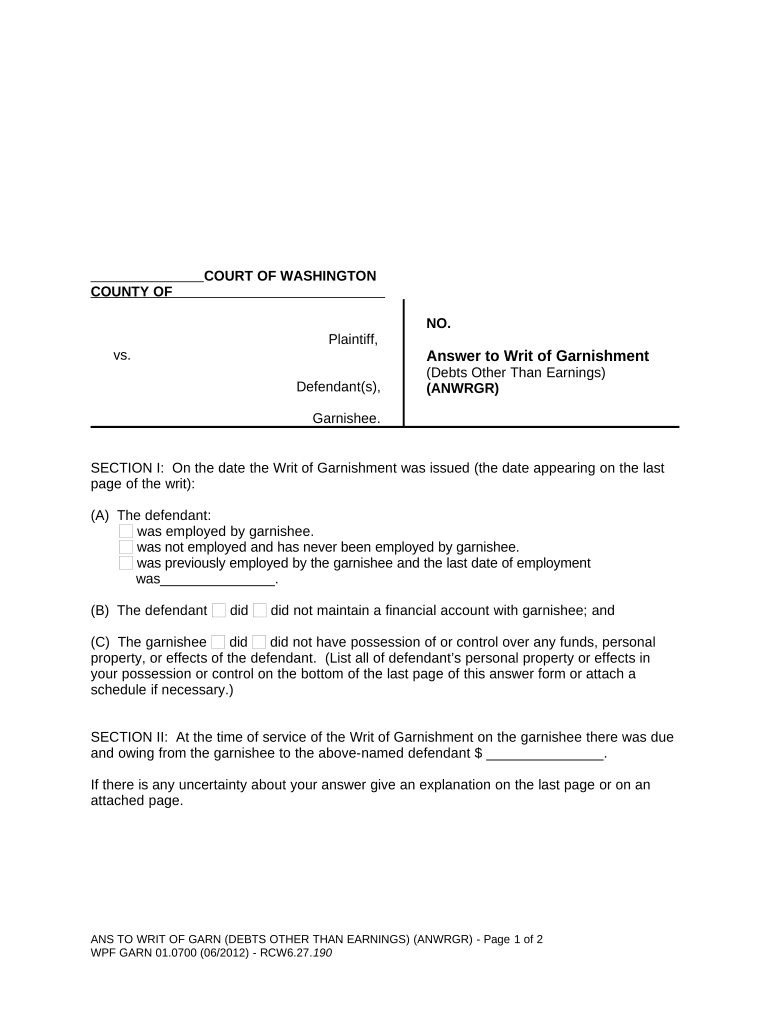
Answer to Writ of Garnishment

This template is fully customizable. Edit the text, fill out the fields, and send it for signature. Give it a try!
Answer to Writ of Garnishment

What an Answer to Writ of Garnishment Is and When it Matters

An Answer to Writ of Garnishment is the formal written response a garnishee or defendant files with the court after receiving a writ instructing a third party to withhold funds or property. The Answer explains whether the garnishee holds funds, asserts exemptions, and identifies amounts subject to garnishment. It preserves the respondent's rights by creating a record, triggers any required hearings, and establishes the factual and legal basis for contesting garnishment actions under applicable state court rules and local practice.

Why a Proper Answer Protects Your Rights

Filing a timely, accurate Answer prevents default judgments, preserves exemption claims, and starts a process where the court can adjudicate disputed claims to funds or wages.

Why a Proper Answer Protects Your Rights

Who Typically Prepares and Files an Answer

Choose the filer and signer consistent with court rules and any corporate authorization requirements to ensure the Answer is accepted.

  • Garnishee payors who hold debtor funds and must report status to the court.
  • Debtors who want to assert exemptions or dispute the debt amount claimed.
  • Plaintiff/creditor representatives monitoring enforcement and distribution of collected funds.

Step-by-step: Completing the Answer to Writ of Garnishment

Follow this sequence to prepare a compliant Answer that notifies the court and other parties of the garnishee status and any claimed exemptions.

  • 01
    Review Writ: Confirm the writ's demands, deadlines, and court identification.
  • 02
    Identify Funds: Determine whether you hold wages, bank funds, or other property.
  • 03
    Assert Exemptions: List statutory exemptions and supporting facts or documentation.
  • 04
    File and Serve: File with clerk, then serve plaintiff/defendant per local rules.

How to Configure an Online Answer Workflow

Set up the document as a template with key fields, signer roles, and required authentication to speed repeat filings and maintain auditability.

Field Configuration
Required Fields Court caption, amount, exemptions
Signer Role Garnishee officer or authorized representative
Authentication Email + SMS code or advanced auth
Delivery File/print copy for clerk and serve parties

Technical Considerations for eFiling and eSubmission

Prepare both an electronically signed copy and any clerk-required printed or notarized materials; keep certified copies and the audit trail for your records.

  • Integrations: Salesforce, NetSuite, Microsoft 365, Google Workspace
  • File Formats: PDF, Word DOCX, HTML, Excel
  • Authentication: Email, SMS, KBA, advanced signer auth

Where to File and How Notices Are Routed

The Answer is filed with the issuing court and copies are served on the plaintiff and debtor according to the court's service rules.

  • File with Clerk: Submit to the court that issued the writ per local rules.
  • Serve Parties: Serve plaintiff and debtor by method required by court rules.
  • Record Delivery: Keep proof of filing and proof of service for the court file.
  • Attend Hearing: Prepare to appear at any scheduled garnishment hearing if required.

Common Deadlines and Processing Expectations

Deadlines vary by jurisdiction; respond promptly and verify the writ for the specific response period and service requirements.

Response Period:

Often 20–30 days; verify local rule

Serve Plaintiff:

Within the time set by court rules

File Proofs:

File proof of service promptly after serving

Request Hearing:

Ask the court for a hearing if disputing exemptions

Clerk Processing:

Processing times vary by county and court

Key Milestones from Writ Receipt to Resolution

Track these sequential milestones to avoid default and to preserve exemption claims during garnishment processing.

01

Receipt of Writ

Recognize the date and note response deadline.

02

Internal Review

Identify holdings and confirm debtor information.

03

File Answer

Submit the Answer and serve required parties.

04

Court Determination

Attend hearing or wait for court ruling on exemptions.

Common Mistakes to Avoid

  • Missing the court's response deadline and inviting default judgment.
  • Failing to list account details precisely, causing misallocation of funds.
  • Neglecting to assert available statutory exemptions in the Answer.
  • Serving parties incorrectly or failing to file proof of service.

Consequences of an Incorrect or Late Answer

Default Judgment: Court may enter default judgment.
Monetary Liability: You may be ordered to pay claimed amounts.
Contempt Risk: Court sanctions or contempt proceedings possible.
Loss of Exemptions: Failure to assert exemptions forfeits protections.
Service Fees: Statutory costs and clerk fees may be assessed.
Reputational Harm: Business disruption and record discrepancies.

Security and Compliance for Electronically Executed Answers

Transport Encryption: TLS 1.2/1.3 in transit
Data at Rest: AES-256 encryption at rest
Regulatory Certifications: SOC 2 Type II available
Healthcare Support: HIPAA compliance (BAA required)
E-signature Law: ESIGN and UETA compliant
International Standards: ISO 27001 and WCAG 2.0 AA

Real-world Examples of Answer Use

These short examples show how organizations used a formal Answer to protect assets and assert exemptions.

Optica Ventures LLC

When served with a writ, Optica reviewed accounts, asserted statutory exemptions, and filed an Answer promptly to avoid default.

  • The firm used a templated response to speed review.
  • Timely filing preserved client funds, prevented an erroneous levy, and allowed the court to schedule a hearing to resolve competing claims without impairing operations.

Fertility Centers of Illinois

The clinic identified segregated patient trust accounts and filed an Answer asserting exempt trust funds.

  • Segregated accounting supported the claim.
  • The court recognized the separation, denied garnishment of protected funds, and returned funds to their intended purpose, minimizing administrative disruption and legal exposure.

Practical Tips for an Accurate and Efficient Answer

Follow consistent procedures to reduce errors, meet deadlines, and preserve exemption claims when responding to garnishment writs.

Centralize intake
Route writs to a single point of contact to ensure consistent review, timely deadlines tracking, and coordinated responses across departments.
Use templates
Maintain court-ready templates with required fields and boilerplate exemption language to reduce drafting time and improve consistency.
Document supporting facts
Attach account statements, payroll records, or affidavits to substantiate exemption claims and reduce the likelihood of contested hearings.
Retain audit trails
Keep signed copies, audit logs, and proof of service to support filings and to comply with record retention requirements.

eSignature Vendor Comparison for Filing and Serving Answers

Compare typical vendor features and starting prices for eSignature platforms that can secure and route signed Answers and supporting documents.

signNow DocuSign Adobe Sign PandaDoc HelloSign
Starting Price $8/user/mo $15/user/mo $14/user/mo $19/user/mo $15/user/mo
Free Trial 7-day free trial Free trial available Free trial available Free trial available Free trial available
Bulk Send Yes Yes Yes Yes No
Audit Trail Yes Yes Yes Yes Yes
HIPAA Compliant Yes Yes Yes No No
Envelope Cap No cap 100 envelopes/user/year Varied by plan Varied by plan Varied by plan

Frequently Asked Questions About Answers to Writs of Garnishment

Answers to common procedural, timing, and evidentiary questions help avoid filing errors and preserve rights under state and federal rules.


Need help? Contact support

be ready to get more
Join over 28 million airSlate SignNow users