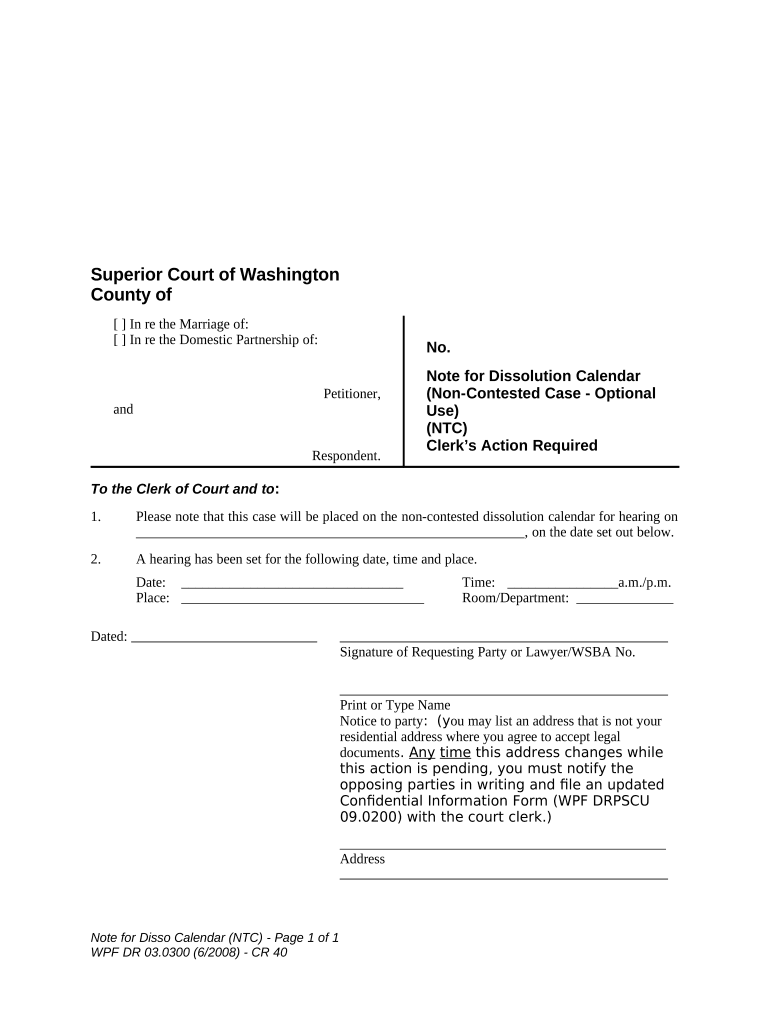
Washington Notice of Dissolution
What the Washington Notice of Dissolution Is
Why Filing a Notice of Dissolution Matters
Filing and distributing a clear Notice of Dissolution helps protect the dissolving entity by alerting claimants and partners to submit claims timely and by documenting the termination timeline under state law and commercial practice.
Who Typically Prepares and Receives This Notice
The notice is prepared by company officers, managers, or authorized representatives and is sent to creditors, contracting parties, and regulatory offices.
- Company officers or managing members
- Registered agents and corporate counsel
- Creditors, vendors, and key contract counterparties
Step-by-Step: Filling Out the Notice
-
01Gather entity records: Locate formation documents and registration number.
-
02Set the effective date: Choose MM/DD/YYYY for the dissolution effective date.
-
03Designate contact: Provide a claims contact and mailing address.
-
04Authorize and sign: Have an authorized officer sign and date the notice.
How to Customize and Complete the Notice Online
| Field | Configuration |
|---|---|
| Entity Name Field | Required, single-line text; enable Magic detection for name matching. |
| Effective Date Field | Date picker, MM/DD/YYYY enforced, required validation. |
| Claims Contact Block | Multi-line address + phone + email; make mandatory for public notices. |
| Signature Block | Require signer role validation and date stamp on completion. |
Where to File, Send, and Archive the Notice
-
State Filing: File with the Washington Secretary of State when required for formal dissolution.
-
Registered Agent: Send a copy to the registered agent for service of process.
-
Creditors & Vendors: Mail or email notices to known creditors and key vendors.
-
Internal Records: Store an executed copy in corporate records and accounting archives.
Digital Signing and eSubmission Considerations
Use an eSignature workflow that supports audit trails, record retention, and signer authentication appropriate to the document's sensitivity.
- Authentication: Email, SMS OTP, or stronger KBA for signer verification.
- Audit Trail: Capture IP, timestamps, and signer actions.
- Formats: PDF/A export and long-term storage support.
Timing: When to Serve and File Notices
Board/Member Approval:
Follow internal approval timelines before notice issuance.
Statutory Filing:
File dissolution documents with WA Secretary of State where required.
Creditors' Claims:
Set a clear deadline for submitting claims in the notice.
Final Tax Filings:
Coordinate federal and state tax close-out dates.
Record Retention:
Retain executed notices per legal retention rules.
Key Milestones in the Dissolution Process
Decision and Authorization
Board or members adopt a resolution to dissolve and set an effective date.
State Filing
File articles of dissolution or a similar form with the Secretary of State if required.
Notice Distribution
Send the Notice of Dissolution to creditors, vendors, and contract counterparties.
Claims Resolution
Address submitted claims, settle obligations, and finalize asset distribution.
Common Mistakes to Avoid
- Using an incorrect registered entity name that doesn’t match state records.
- Failing to provide a clear claims contact or deadline in the notice.
- Neglecting required state filings for formal dissolution.
- Not preserving an audit trail or signed copy for corporate records.
Legal Risks and Potential Consequences
Real-World Examples and Practical Uses
Optica Ventures LLC
Optica announced dissolution to creditors and provided a claims contact
- Issued a 90-day deadline for submissions
- The clear timeline reduced disputed claims and supported final asset distribution without litigation.
Martin Properties
A property manager used a formal notice when an LLC closed operations
- Attached final lease assignments
- The notice ensured tenants and contractors had a single point of contact for security deposit and lien questions.
Practical Tips for Accurate and Efficient Completion
eSignature Pricing and Feature Comparison for Notice Workflows
| signNow | DocuSign | Adobe Sign | PandaDoc | HelloSign | |
|---|---|---|---|---|---|
| Starting Price | $8/user/mo | $15/user/mo | $14/user/mo | $19/user/mo | $15/user/mo |
| Free Trial | 7-day free trial | Trial available | Trial available | Trial available | Trial available |
| Bulk Send | Yes (Business Premium) | Yes | Yes | Yes | No |
| Audit Trail | Yes | Yes | Yes | Yes | Yes |
| HIPAA Compliant | Yes | Yes | Yes | No | No |
Frequently Asked Questions About Washington Notices of Dissolution
-
Do I need to notarize the notice?
Generally, a notice to creditors does not require notarization in Washington; however, certain statutory dissolution filings or related conveyances (deeds) may require notarization. Check the Washington Secretary of State instructions and any instrument-specific rules.
-
Who can sign the notice?
An authorized officer, manager, or agent may sign. Ensure the signer has authority under the entity’s articles, bylaws, or operating agreement to avoid challenges to the notice’s validity.
-
Can the notice be signed electronically?
Yes. Electronic signatures are generally enforceable under the ESIGN Act (15 U.S.C. ch. 96) and UETA where applicable, provided intent, consent, attribution, and retention requirements are met.
-
How long should I keep records after dissolution?
Retain dissolution notices and related records at least three years for tax purposes, and longer for industry-specific obligations (e.g., six years for HIPAA under 45 CFR §164.530(j)); consult counsel for specific retention periods.
-
What if a creditor files a late claim?
Late claims may still be enforceable depending on statute and how the notice defined claim deadlines; document your distribution efforts and consult legal counsel to assess exposure and defenses.
-
Does filing the notice end all business obligations?
No. Filing or distributing a notice begins wind‑up but does not automatically extinguish obligations. The entity must resolve claims, taxes, and contractual duties before final distribution and termination.