Establishing secure connection…Loading editor…Preparing document…

West Virginia Lien

This template is fully customizable. Edit the text, fill out the fields, and send it for signature. Give it a try!
West Virginia Lien

What a West Virginia Lien Is and when it applies

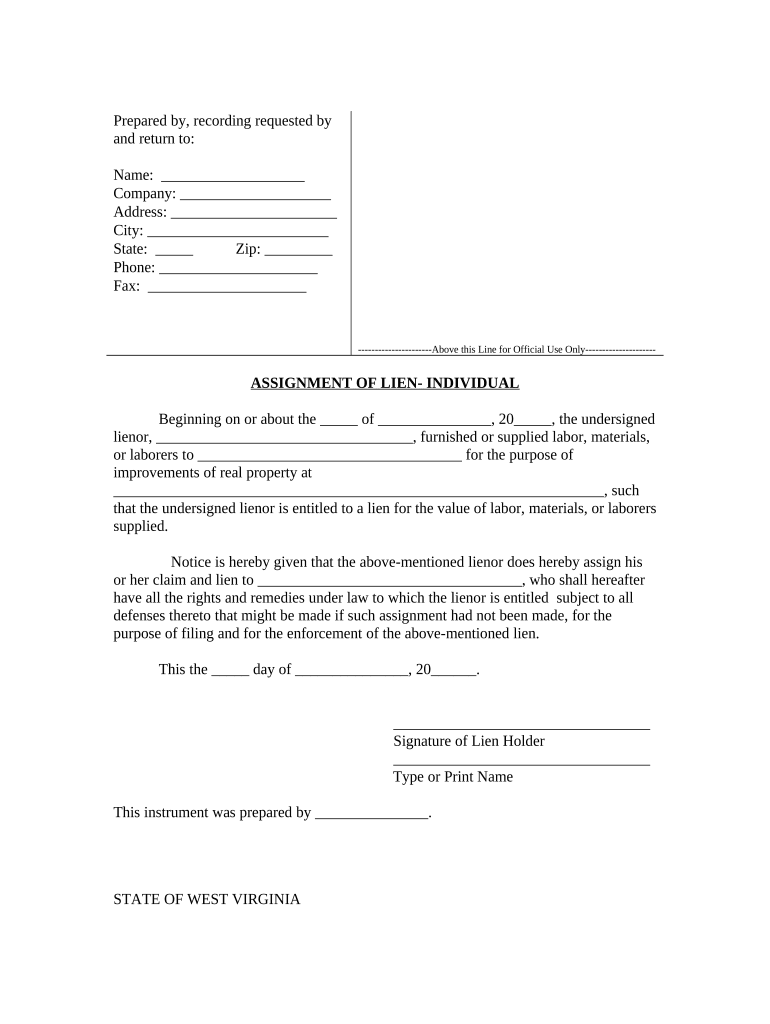
A West Virginia Lien is a recorded legal claim against real property or personal property used to secure payment for work, labor, materials, or other obligations. Commonly used in construction and contractor disputes, the lien creates an encumbrance that can block sale or refinancing until satisfied or released. Filing requirements, form names, and enforcement steps are set by state statute and county practice; the claim typically begins as a notice or verified statement filed with the appropriate county clerk or recorder and must follow procedural timelines to preserve enforcement rights.

Why filing a properly prepared lien matters

A correctly prepared lien protects payment rights by creating a public encumbrance and enabling enforcement remedies, including judicial foreclosure. Proper form, timely service, and accurate records preserve priority and reduce exposure to counterclaims or penalties under state law and related statutes.

Why filing a properly prepared lien matters

Who commonly prepares and files West Virginia Liens

Each party has different documentation needs, and who signs or files depends on statutory standing and chain-of-contract evidence.

  • Contractors and subcontractors asserting unpaid construction claims against project property.
  • Suppliers and material providers seeking to secure invoices for goods delivered to a jobsite.
  • Title companies, lenders, and property owners managing encumbrances during sale or refinance.

Core elements included in a professional West Virginia Lien

A complete lien form and package make enforcement possible: clear claimant identity, legal description, contract details, amount claimed, dates, and proper verification or notarization where required.

Claimant

Full legal name and contact information for the person or business asserting the lien, including business entity type.
Property Description

Precise legal description or street address and parcel identifiers so the county recorder can attach the claim to the correct record.

Basis of Claim

Clear statement of work, materials, or obligations giving rise to the lien and associated contract or purchase order references.

Amount Claimed

Specific dollar amount due, itemized where possible, with dates for the period of work or deliveries.

Verification

Signed verification or affidavit attesting to the accuracy of the claim; include notarization if state or county rules require it.

Service Proof

Evidence of delivery or service of required notices to owners and prime contractors as required by statute.

Step-by-step filing sequence for a West Virginia Lien

Follow a standard sequence: prepare claim, provide notices, file with county, serve parties, and preserve evidence for enforcement.

  • 01
    Prepare Claim: Assemble documents, itemize amounts, and verify legal description.
  • 02
    Provide Notices: Send any required preliminary notices or notices of intent per contract/state rules.
  • 03
    File Claim: Record the lien or claimant statement with the county clerk or recorder.
  • 04
    Serve Parties: Serve owner, prime contractor, and others with filed claim proof of service.

How to configure a digital workflow for lien preparation

A reliable digital workflow reduces errors: template the form, apply conditional fields, include signer authentication, and archive signed copies.

Field Configuration
Template Create reusable form with locked legal description and required fields.
Conditional Fields Show additional breakdowns when claimant itemizes retainage or multiple subs.
Signer Authentication Use email + SMS or stronger KBA for corporate signers.
Archive Store signed PDF + audit trail in secure records retention system.

Digital signing and platform requirements

Ensure the chosen platform supports required authentication, notarization workflows (if RON used), and long-term retention for legal defensibility.

  • File Formats: PDF and DOCX supported
  • Integrations: Connectors: NetSuite, Salesforce, Google Workspace
  • Security: TLS in transit; AES-256 at rest

Typical online signing flow for lien documents

Online signing follows a predictable eight-step path; automating these reduces turnaround and improves auditability.

  • Upload: Upload the completed lien form to the signing platform.
  • Tag Fields: Place signature, date, and initials where required.
  • Authenticate: Select signer verification method (email, SMS, KBA).
  • Complete: Signer reviews, signs, and receives signed PDF with audit trail.

Time-sensitive actions and typical deadlines

Preserve lien rights by tracking preliminary notice and filing deadlines; missing a statutory deadline can forfeit enforcement rights.

Preliminary Notice Timing:

State and contract deadlines vary; deliver notices as early as contract requires.

File-to-Record Deadline:

County filing deadlines vary by state and project type — verify local code.

Service Requirements:

Some statutes require service on property owner within a specific period after filing.

Enforcement Period:

Court action to foreclose lien must be filed within statutory limitation period.

Retention:

Keep originals and proof of service for the full enforcement window and beyond.

Key milestones from first unpaid invoice to enforcement

Track milestones as a sequential timeline to protect priority and prepare evidence for potential foreclosure.

01

Invoice & Notice

Issue invoice and send any required preliminary notice to owner and contractor.

02

Prepare Claim

Gather contracts, delivery tickets, and dates to support the claim.

03

Record Lien

File the lien statement with the county recorder to create a public encumbrance.

04

Enforce or Release

File suit to foreclose or record lien release after payment; preserve evidence.

Common pitfalls to avoid when preparing a lien

  • Using an incorrect legal description that misidentifies the parcel, causing rejection or mis-indexing by the recorder.
  • Failing to serve required notices to the owner or prime contractor, which can void lien rights under state statute.
  • Claiming amounts without itemized support or failing to reconcile retainage and previous payments, inviting disputes or offsets.
  • Missing filing deadlines or statutory windows for enforcement, which can permanently extinguish lien remedies.

Security and compliance considerations for electronic lien workflows

In-Transit Encryption: TLS 1.2/1.3
At-Rest Encryption: AES-256
Audit Trail: IP, timestamps, action history
Regulatory Standards: ESIGN and UETA compliance
HIPAA Support: BAA available if needed
Certificates: 21 CFR Part 11 support options

Penalties and legal risks for incorrect or late lien filings

Forfeited Rights: Loss of lien remedy
Civil Liability: Damages for wrongful claim
Filing Penalties: County fines or administrative rejection
Court Costs: Costs if suit improperly brought
Escrow Delays: Sale or refinance holds
Reputational Risk: Contractor credit and bonding impacts

How a West Virginia mechanic's lien compares to a UCC-1 financing statement

Mechanic's liens and UCC-1s secure different types of interests and follow different filing and enforcement regimes.

Criteria WV Lien UCC-1
Collateral Type real property encumbrance personal property security
Filing Office county recorder secretary of state
Typical Duration statutory enforcement window renewal-based perfection
Enforcement Remedy judicial foreclosure repossession or foreclosure on personal property

eSignature vendor comparison for completing and filing lien documents

Use a vendor that supports secure signing, audit trails, and required compliance. The table compares starting prices and key capabilities across major vendors.

signNow DocuSign Adobe Sign PandaDoc HelloSign
Starting Price $8/user/mo $15/user/mo $14/user/mo $19/user/mo $15/user/mo
Free Trial 7-day trial Varies Varies Varies Varies
Bulk Send Yes Yes Yes Yes Varies
Audit Trail Yes Yes Yes Yes Yes
HIPAA Compliant Yes Yes Yes No No
Envelope Cap No cap 100 envelopes/user/year Varies Varies Varies

Real-world examples of digital signing in property and construction workflows

Organizations combine secure eSignatures with document templates and integrations to close administrative gaps during projects.

Martin Properties

Tim Martin, Founder at Martin Properties, used digital signing to process lien-related documents efficiently

  • Equipped team to sign on mobile
  • He reported consistent compliance and faster turnaround on contract and lien packages, reducing delays at closing and easing coordination with title agents.

BIS

Dan Rotelli, CEO at BIS, chose a secure eSignature workflow for legal and title documents

  • Integrated audit trails for defense
  • The result improved internal controls for claim documentation and gave counsel reliable evidence for enforcement actions when disputes arose.

Practical tips to ensure an accurate and enforceable lien filing

Follow consistent procedures for documentation, verification, and service to reduce risk and preserve priority.

Verify Legal Names
Confirm the claimant and owner legal names against formation documents and deed records to avoid misidentification that can invalidate a recorded claim.
Itemize Claims
Provide a clear, itemized statement of labor, materials, and unpaid amounts; attach delivery tickets, contracts, and change order records.
Confirm Local Rules
Check county clerk procedures for acceptable file formats, fee amounts, notarization, and any local forms required before submitting.
Preserve Proof
Retain signed originals, proof of service, and platform audit trails to support enforcement or title clearance.

Frequently asked questions about West Virginia Liens

Answers below address common procedural, timing, and technical questions when preparing and filing lien claims in West Virginia.


Need help? Contact support

be ready to get more
Join over 28 million airSlate SignNow users