Establishing secure connection…Loading editor…Preparing document…

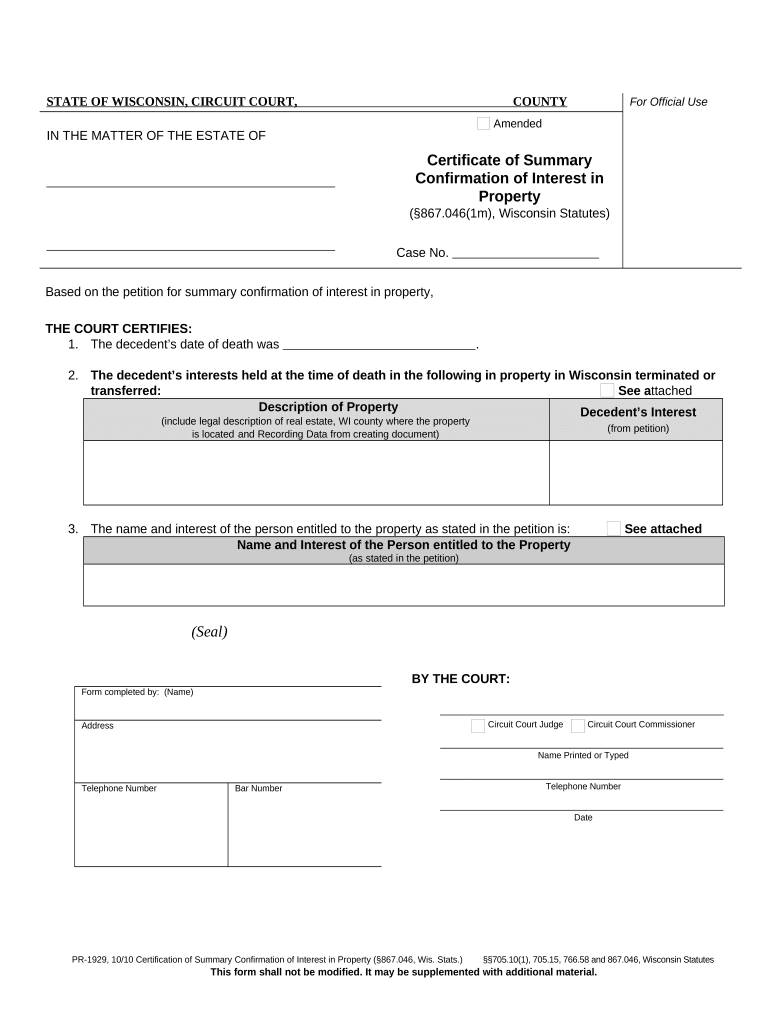
Wisconsin Certificate of Summary Confirmation of Interest in Property

This template is fully customizable. Edit the text, fill out the fields, and send it for signature. Give it a try!
Wisconsin Certificate of Summary Confirmation of Interest in Property

What this certificate is and when it’s used

The Wisconsin Certificate of Summary Confirmation of Interest in Property is a concise written instrument used to record and summarize existing interests that affect a specific parcel of real property in Wisconsin. It lists the party names, type of interest (for example, easement, mortgage, lien), recording references or document numbers, and an effective date. The certificate is used by title professionals, closing agents, lenders, and attorneys to aggregate key title information, support closing packages, and assist county recorders or abstracters in verifying recorded encumbrances and ownership-related claims.

Why a clear summary certificate matters

A concise certificate reduces ambiguity in title review, speeds due diligence, and centralizes recorded references so parties and recorders can confirm interests without reexamining all underlying instruments.

Why a clear summary certificate matters

Who prepares and relies on this certificate

Typical preparers and primary users of the certificate include professionals who manage or verify title and encumbrances.

  • Title companies — prepare concise summaries for underwriting and closing files.
  • Lenders and servicers — confirm liens and recorded security interests before funding.
  • Real estate attorneys — compile document references for opinions and closing bundles.

Stepwise process to complete the certificate

Use this sequence to collect, verify, and finalize a Wisconsin Certificate of Summary Confirmation of Interest in Property.

  • 01
    Gather records: Collect deeds, recorded liens, easements, and surveys.
  • 02
    Extract details: Pull exact names, document numbers, and recording dates.
  • 03
    Complete form: Enter fields verbatim and attach references.
  • 04
    Sign and notarize: Obtain required signatures and notary acknowledgment.

Configuring an electronic workflow for this certificate

Set up fields, signer order, and authentication to match your closing and recording requirements.

Field Configuration
Signer Order Set role order: preparer, property owner, notary.
Authentication Use email plus SMS code or stronger ID verification if required.
Conditional Fields Show notary block only when signature type requires notarization.
File Format Use PDF/A for final archival and compatibility with recording systems.

Typical routing from preparation to recording

A standard digital routing streamlines preparation, signature, notarization, and submission to the recorder or closing agent.

  • Upload document: Attach draft certificate and source instruments.
  • Place fields: Add signature, date, and notary acknowledgment fields.
  • Invite signers: Send via email link or secure signing portal.
  • Archive copy: Store signed PDF with audit trail and attachments.

Platform capabilities to support eCompletion and notarization

Ensure the chosen platform supports required file formats, signer authentication, audit trails, and RON if you intend to notarize online.

  • File formats: PDF, DOCX, and PDF/A are commonly supported.
  • Integrations: Link to title systems, NetSuite, Salesforce, or cloud storage.
  • Authentication: Email, SMS, KBA, and SSO options may be available.

Essential elements to include in a professional certificate

A clear certificate contains standardized sections so readers can immediately identify parties, interest types, and recording details without parsing multiple instruments.

Parties

Full legal names of grantors and grantees or lienholders as shown on source documents. Use exact name spellings to prevent title mismatches and support searches.
Property

Complete legal description derived from the deed, lot and block, or survey. The property description anchors the certificate to a uniquely identifiable parcel for record searches.

Interest detail

Concise statement of the type and scope of interest (e.g., mortgage, easement, judgment). Include any limitations or territorial scope where relevant.

Recording citations

Instrument number, book/page, county, and recording date for each referenced document to allow rapid retrieval from the public record.

Effective date

A specific MM/DD/YYYY effective date indicating when the certificate reflects the recorded interests and priority positions.

Certification

A signed certification clause stating that the preparer reviewed the recorded instruments and that the information is accurate to the preparer’s knowledge.

Typical timelines and processing expectations

Processing times depend on how the certificate is delivered, whether notarization is required, and county recording backlogs.

Pre-closing verification:

Allow 1–3 business days for title search confirmation.

Signature and notarization:

Same-day completion if signers are local; longer for remote notarization scheduling.

County recording:

Expect 1–10 business days depending on county backlog and filing method.

Electronic submission:

E-recording often shortens processing to 1–3 business days.

Correction requests:

Plan 3–14 days for amendments and re-recording.

Key milestones from draft to recorded certificate

Track these numbered milestones to manage responsibilities and confirm completion dates across parties.

01

Drafting and source collection

Prepare the certificate after gathering deeds, liens, and surveys.

02

Internal review

Title or counsel reviews accuracy and cross-references recordings.

03

Signing and notarization

Obtain signatures and notary acknowledgment as required.

04

Recording

Submit to county recorder or e-recording provider and archive returned instrument.

Common preparation errors to avoid

  • Using abbreviated or informal party names that do not match recorded instruments, causing title search discrepancies and delays.
  • Failing to include precise recording references (instrument number, book/page) which prevents quick retrieval from county records.
  • Omitting the correct legal description and instead using a street address only, which can lead to ambiguous parcel identification.
  • Neglecting notarization requirements or using an improper notary block for the jurisdiction, resulting in rejected filings.

Security and legal compliance points to document and store this certificate

Encryption: TLS 1.2/1.3 in transit; AES-256 at rest
Audit trail: Timestamped actions with signer attribution
Regulatory compliance: ESIGN and UETA legal recognition
HIPAA support: BAA available for protected health data
21 CFR readiness: Support for regulated workflows
Accessibility: WCAG 2.0 Level AA support

Risks and potential penalties of incorrect certificates

Title delays: Incorrect entries delay closings and underwriting
Recording rejection: Missing notary or wrong format may be rejected
Liability exposure: Inaccurate certification can create legal disputes
Tax penalties: Related tax reporting errors may trigger fines
I-9 / employment fines: Clerical errors can result in government penalties
Intentional misstatement: Fraud allegations carry civil and criminal risk

Real-world examples of digital certificate use

Two customer examples illustrate practical benefits when certificates and supporting documents are executed digitally and archived.

Martin Properties — Tim Martin

Martin Properties shifted closings online to process documents remotely and reduce turnaround.

  • The approach emphasized mobile signing and offline capabilities for field agents.
  • As a result, the company reported more consistent compliance, faster closing cycles, and reliable archive copies for each transaction, supporting remote notarizations and easier retrieval for audits.

Fertility Centers of Illinois — John Butler

The clinic standardized document formats for recordkeeping and signature capture.

  • Templates and audit trails were central to the change.
  • Standardized certificates and digital archives improved internal compliance checks, reduced manual transcription errors, and supported secure access controls tied to clinical workflows.

Practical tips for accurate and efficient completion

Adopt consistent templates, verify source instruments, and confirm authentication methods before sending for signature.

Use exact recorded data
Always transcribe party names and recording citations verbatim from recorded instruments to avoid title mismatches and rework during underwriting.
Preserve supporting documents
Attach or link to certified copies of deeds, lien instruments, and surveys so reviewers can quickly validate the certificate’s assertions.
Match authentication to risk
Choose signer authentication strength (email, SMS, KBA) based on transaction value and filing requirements to maintain evidentiary weight.
Maintain audit trails
Store completed PDFs with timestamps, IP addresses, and signer attribution to support future title disputes or regulatory requests.

Frequently asked questions and quick answers

Answers to common questions about signing, notarization, corrections, and electronic submission for this certificate.


Need help? Contact support

Sample eSignature vendor comparison for executing certificates

Below is a concise feature and pricing snapshot comparing signNow with several established vendors; verify vendor plans directly for the latest details.

signNow DocuSign Adobe Sign PandaDoc HelloSign
Starting Price $8/user/mo $15/user/mo $14/user/mo $19/user/mo $15/user/mo
Free Trial 7-day free trial Varies by vendor Varies by vendor Varies by vendor Varies by vendor
Bulk Send Yes (Business Premium) Yes Yes Yes No
Audit Trail Yes Yes Yes Yes Yes
HIPAA Compliant Yes Yes Yes No No
be ready to get more
Join over 28 million airSlate SignNow users