Establishing secure connection…Loading editor…Preparing document…

Wisconsin Post-Conviction Relief Petition

This template is fully customizable. Edit the text, fill out the fields, and send it for signature. Give it a try!
Wisconsin Post-Conviction Relief Petition

What the Wisconsin Post-Conviction Relief Petition Is

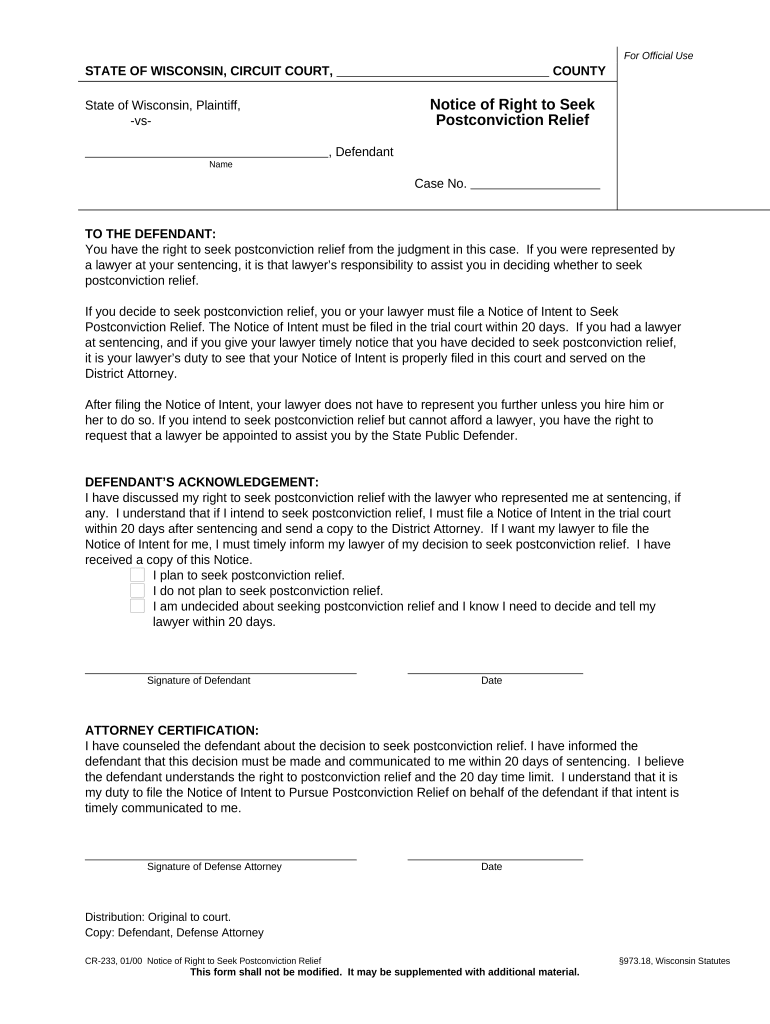
A Wisconsin Post-Conviction Relief Petition is a formal court filing a convicted person (or their counsel) uses to challenge the validity of a conviction or sentence after direct appeal has ended. Typical claims assert constitutional violations, ineffective assistance of counsel, newly discovered evidence, or changes in law. The petition asks a circuit court to review the earlier proceedings and, where appropriate, grant relief such as a new trial, sentence modification, or vacatur. Procedures and available remedies differ from direct appeal and are governed by state criminal procedure and Wisconsin case law.

Why a Post-Conviction Petition Matters in Wisconsin

Filing a Wisconsin Post-Conviction Relief Petition allows a convicted person to raise collateral attacks on constitutional errors, ineffective counsel claims, or newly discovered evidence when direct appeal is exhausted; it can result in new trials, sentence changes, or other corrective relief.

Why a Post-Conviction Petition Matters in Wisconsin

Who Typically Prepares or Submits These Petitions

The petition is most often prepared by criminal defense attorneys, public defenders, or by incarcerated individuals who represent themselves (pro se).

  • Criminal defense attorneys preparing detailed legal claims and supporting records.
  • Public defenders handling indigent client petitions and fee-waiver requests.
  • Self-represented petitioners submitting pro se briefs and supporting exhibits.

Who Signs and Who Represents

Petitioner

The petitioner is the convicted person seeking relief. If detained, the petitioner must ensure filings include current contact and custody information and may sign declarations or verification pages as required by court rules.

Attorney

A licensed attorney files on behalf of a petitioner with a signed notice of appearance. Counsel typically certifies necessary factual support, prepares legal argument, and coordinates record requests from the clerk of court.

Step-by-Step: Prepare and File the Petition

Follow a consistent sequence: assemble the record, draft claims, attach exhibits, sign, then file or e-file with the clerk.

  • 01
    Assemble Record: Obtain trial transcripts and judgment entries before drafting.
  • 02
    Draft Petition: State facts, legal basis, and requested relief clearly.
  • 03
    Attach Evidence: Include affidavits, transcripts, and relevant exhibits in order.
  • 04
    File and Serve: File with the clerk and serve the prosecutor per rules.

Filing Workflow Overview

A concise overview of the typical flow from drafting to court decision, including service and potential hearings.

  • Drafting: Prepare petition, citations, and exhibits in sequence.
  • Filing: Submit via e-file or paper with clerk; obtain stamped copy.
  • Service: Serve district attorney and other required parties as rules dictate.
  • Response and Hearing: Prosecutor may respond; court may order briefing or a hearing.

Digital Filing and eSubmission Settings

When e-filing or e-signing, configure authentication, document format, and routing to satisfy court local rules.

Field Configuration
File Format PDF/A recommended for court compatibility
Signer Authentication Email + optional SMS or ID verification
Document Naming Include case number and petitioner name
Service Method E-service or certified mail per court rules

Digital Signing and Submission Considerations

Courts accept electronically filed petitions where local e-filing rules permit; confirm clerk preferences before e-filing or e-signing.

  • Audit Trail: Timestamp, IP, and signer log
  • Authentication: Email, SMS, or ID verification
  • File Types: PDF, PDF/A preferred

Timing: When to File and What to Expect

Timing rules for post-conviction petitions vary by claim and jurisdiction; some claims are time-barred while others permit late filing for constitutional issues.

Statute of Limitations:

Varies by claim; consult counsel for specific limits

New Evidence Claims:

File promptly after discovery of evidence

Ineffective Counsel:

Claim timing may depend on appellate record exhaustion

Fee Waiver Timing:

Request indigent status at filing if eligible

Response Period:

Prosecutor typically has court-set time to respond

Key Milestones in a Post-Conviction Proceeding

A sequential view of important stages from filing through decision and potential appeal.

01

Filing the Petition

Petitioner submits petition to the circuit court clerk with required attachments.

02

Service on Prosecutor

Proof of service must be filed and served on the district attorney.

03

Prosecutor Response

Court sets a deadline for the state to answer or move to dismiss.

04

Hearing or Decision

Court may hold an evidentiary hearing before ruling on relief sought.

Common Filing Pitfalls to Avoid

  • Failing to attach essential transcripts or records delays review and can prompt dismissal for lack of evidence.
  • Using inconsistent names or case numbers causes misdocketing and may prevent service being recognized by the clerk.
  • Omitting a clear statement of relief leaves the court without a remedy to grant even when claims have merit.
  • Relying on unsigned or unverified affidavits undermines credibility and may be disregarded at hearing.

Risks and Consequences of Errors

Dismissal Risk: Late filing or procedural defects
Waiver: Failure to preserve issues for review
Sanctions: Frivolous claims may trigger court sanctions
Delay: Incomplete records prolong resolution
Lost Opportunities: Missed evidence deadlines
Service Errors: Improper service can void proceedings

What a Complete Petition Should Include

A professional petition organizes facts, grounds, legal argument, and supporting exhibits so the court can evaluate relief without supplemental requests.

Caption

Full court caption with case number and county to ensure correct docketing.
Statement of Facts

Chronological, concise factual recitation tied to the trial record and exhibits.

Legal Grounds

Clear identification of constitutional or statutory bases for relief and supporting authorities.

Exhibits

Indexed transcripts, affidavits, and records with exhibit tabs for easy reference.

Relief Requested

Precise statement of remedies sought, such as new trial or sentence modification.

Certificate of Service

Proof that the petition was served on the prosecutor and other required parties.

Illustrative Use Cases

Real-world examples show how petitions are used to correct legal or factual errors after conviction.

Counsel-Led Success

A defense team found a constitutional error in jury instructions and filed a focused petition

  • Issue identified after appeal
  • The court granted a new trial after reviewing the petition, supporting transcripts, and briefing.

Pro Se Filing

An incarcerated petitioner discovered new evidence and submitted a petition without counsel

  • Evidence arose post-appeal
  • The court ordered an evidentiary hearing that led to reconsideration of the sentence.

eSignature Pricing Snapshot (comparison)

Vendor pricing and feature availability vary by plan and billing cycle; signNow is shown first for comparison across typical entry-level plans and common compliance features.

signNow DocuSign Adobe Sign PandaDoc HelloSign
Starting Price $8/user/mo $15/user/mo $14/user/mo $19/user/mo $15/user/mo
Free Trial 7-day free trial Varies Varies Varies Varies
Bulk Send Yes Yes Yes Yes Varies
Audit Trail Yes Yes Yes Yes Yes
HIPAA Compliant Yes Yes Yes No No
Envelope Cap No envelope cap 100 envelopes/user/year Varies Varies Varies

Practical Tips for Accurate Petitions

Small compliance and formatting choices reduce risk and speed court acceptance.

Use Exact Case Identifiers
Always include the full case caption and docket number to ensure the clerk correctly files and routes your petition.
Attach Indexed Exhibits
Number and tab exhibits and reference them in the petition to make review efficient for the judge and opposing counsel.
Confirm Service Methods
Verify the prosecutor's service address and method; file proof of service in the same filing.
Preserve Originals
Keep original affidavits and signed documents available for evidentiary hearings and potential appeals.

Frequently Asked Questions

Answers to common questions about filing, timing, electronic signing, notarization, and appeal options for Wisconsin post-conviction petitions.


Need help? Contact support

be ready to get more
Join over 28 million airSlate SignNow users