Establishing secure connection…Loading editor…Preparing document…

West Virginia Renunciation and Disclaimer of Property

This template is fully customizable. Edit the text, fill out the fields, and send it for signature. Give it a try!
West Virginia Renunciation and Disclaimer of Property

What the West Virginia Renunciation and Disclaimer of Property is

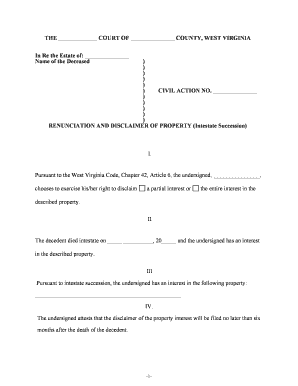
The West Virginia Renunciation and Disclaimer of Property is a legal instrument used to decline an interest in real or personal property that would otherwise pass to a person by will, intestacy, trust, or transfer. It enables an individual (the disclaimant) to refuse all or part of an inheritance so the asset passes as if the disclaimant predeceased the decedent. Effect depends on meeting statutory and, for tax purposes, federal requirements for a qualified disclaimer under the Internal Revenue Code. Proper execution, timing, and filing with probate or the transferor’s estate records are essential.

Why a formal renunciation or disclaimer matters

A properly executed disclaimer preserves estate taxation objectives, avoids unintended ownership or creditor exposure, and redirects property according to the transferor’s plan or statutory order. It is strictly time-sensitive and must satisfy state and federal formality requirements to be effective.

Why a formal renunciation or disclaimer matters

Who typically completes this form

Consult counsel when the beneficiary’s rights intersect with tax planning, creditors’ claims, or multiple overlapping transfers.

  • Heirs and beneficiaries who decline an inheritance to affect downstream distribution
  • Estate attorneys and probate administrators preparing or filing the disclaimer
  • Personal representatives, trustees, or fiduciaries documenting a renunciation

Core elements of a professional West Virginia Renunciation and Disclaimer of Property

A complete disclaimer form clearly identifies the disclaimant, the transfer giving rise to the interest, the property being disclaimed, the effective date, any conditions or limitations, and a notarized signature. Attach supporting records such as a copy of the will, death certificate, or probate case number when available.

Disclaimant identity

Full legal name, mailing address, and relationship to decedent or transferor; necessary for attribution and probate records.
Property description

Clear description of the interest being renounced (account numbers, parcel ID, percentage interest) to avoid ambiguity.

Effective date

Date the disclaimer is signed and delivered; timing affects whether it qualifies under IRC §2518 for tax purposes.

Statement of intent

Unambiguous language that the disclaimant refuses the interest and accepts no benefits from it.

Filing instructions

Directions for where the executed form should be filed — probate court, trustee, or corporate transfer agent.

Notarization

Acknowledgement or notarized signature as required by state probate practice to verify authenticity.

Step-by-step: completing and filing the disclaimer

Follow these core steps to prepare a clear, enforceable renunciation or disclaimer.

  • 01
    Gather documentation: Collect death certificate, will/trust, and account deeds.
  • 02
    Complete form: Fill each field per the fillable-fields guidance above.
  • 03
    Notarize or authenticate: Obtain required notarization or follow state RON processes.
  • 04
    File and serve: Submit to probate court, trustee, or transfer agent and serve interested parties.

How to set up a digital workflow for this document

Configure your e-signature workflow to capture identity, notarization, and record retention consistent with West Virginia and federal requirements.

Field Configuration
Authentication Email plus optional SMS code; consider higher assurance for fiduciary signers
Notarization Support RON where permitted, otherwise in-person notarization
File Format PDF/A or flattened PDF for long-term retention
Retention Save signed PDF with audit trail for statutory retention periods

Typical e-submission flow for a disclaimer

A concise sequence for electronic completion, verification, and delivery.

  • Upload document: Sender uploads finalized form to the e-sign platform.
  • Apply fields: Place signature, date, and notarization fields as required.
  • Authenticate signer: Signer verifies identity via chosen method.
  • Distribute signed copy: System delivers signed PDF and audit trail to parties.

Platform and technical considerations for delivery

Verify the receiving court, trustee, or transfer agent accepts the chosen eSignature method and file format before relying on electronic submission.

  • Authentication options: Email, SMS, KBA where available
  • Notary support: Remote Online Notarization or in-person notarization
  • File types: PDF/A and DOCX accepted

eSignature vendor pricing snapshot for executing disclaimers

Compare core pricing and capability points when selecting an eSignature provider for legal forms; signNow is listed first per comparison conventions.

signNow DocuSign Adobe Sign PandaDoc HelloSign
Starting Price $8/user/mo $15/user/mo $14/user/mo $19/user/mo $15/user/mo
Free Trial 7-day free trial Varies by vendor Varies by vendor Varies by vendor Varies by vendor
Bulk Send Yes Yes Yes Yes No
Audit Trail Yes Yes Yes Yes Yes
HIPAA Compliant Yes Yes Yes No No
Envelope Cap No cap 100 envelopes/user/year Varies Varies Varies

Security and compliance features to look for

Encryption: TLS 1.2/1.3 in transit; AES-256 at rest
Audit Trail: Tamper-evident log with timestamps and IP addresses
Certifications: SOC 2 Type II and ISO 27001 available
HIPAA Support: BAA available where PHI is present
21 CFR Part 11: Support for FDA-regulated workflows where required
Accessibility: WCAG 2.0 Level AA controls

Key risks and legal consequences of an incorrect disclaimer

Tax disqualification: May fail IRC §2518 requirements and create gift or estate tax consequences
Creditor claims: Disclaimed assets may still be reachable by creditors depending on timing
Probate delay: Ambiguous language can require court interpretation, delaying distribution
Loss of benefits: Disclaimant may forfeit incidental benefits tied to the interest
Invalid execution: Missing notarization or improper delivery can void the disclaimer
Unintended transfer: Poorly described interests can transfer unintended property portions

Common errors to avoid when preparing a renunciation or disclaimer

  • Failing to describe the interest precisely, which leads to disputes over what was disclaimed and may require court clarification.
  • Missing statutory timing windows for a qualified disclaimer under federal tax rules, which can convert a disclaimer into a taxable gift.
  • Using ambiguous language that implies acceptance of benefits or control, undermining the disclaimer’s effectiveness.
  • Not verifying whether the receiving probate court, trustee, or transfer agent accepts electronic signatures or remote notarization.

Practical tips for an accurate and defensible disclaimer

Adopt clear drafting and administrative practices to minimize disputes and meet tax-formalities.

Use precise descriptions
Describe the property with identifiers such as deed book and page, parcel ID, account numbers, or trust exhibit references so the instrument cannot be misapplied or partially enforced.
Confirm timing rules
Verify deadlines that affect qualification under IRC §2518 and any state statutes; when in doubt, act promptly and document the date of delivery and sign-off.
Record supporting documents
Attach a copy of the decedent’s death certificate, will excerpt, or trust schedule and record the probate case number to link the disclaimer to the estate file.
Coordinate with professionals
When tax or creditor issues may arise, obtain targeted legal or tax advice and consider minimal attorney review to confirm formality and wording.

Important timing rules and deadlines to watch

Certain federal and state time limits determine whether a disclaimer qualifies for preferred tax treatment and when it must be delivered or filed.

Qualified disclaimer period:

Generally must be made within 9 months of the transfer or death under IRC §2518

Probate filing:

File the executed disclaimer with the probate court or estate records as required by local practice

Delivery to fiduciary:

Deliver the disclaimer to the executor, trustee, or transfer agent promptly upon execution

Tax reporting:

Retain records in case of IRS inquiries regarding estate or gift tax treatment

Revocation window:

State-specific rules may limit revocation; verify West Virginia statutes or court rules

Realistic scenarios showing how disclaimers are used

Two common scenarios illustrate practical uses and administrative steps for a renunciation or disclaimer.

Estate Redistribution by Beneficiary

A beneficiary declines a share to allow property to pass to younger heirs

  • The disclaimer names the specific parcel and trustee
  • The court records the instrument and the asset follows the decedent's residual distribution.

Creditor and Tax Risk Management

A potential heir renounces to avoid creating a taxable gift or triggering creditor claims

  • The form is dated and delivered within statutory timing
  • Counsel verifies tax qualification and files with the probate record.

Frequently asked questions about renunciation and disclaimer of property

Answers to common practical and legal questions when preparing or filing a West Virginia renunciation or disclaimer.


Need help? Contact support

be ready to get more
Join over 28 million airSlate SignNow users