Establishing secure connection…Loading editor…Preparing document…

Temporary Restraining Order

This template is fully customizable. Edit the text, fill out the fields, and send it for signature. Give it a try!
Temporary Restraining Order

What a Temporary Restraining Order Is and when it applies

A Temporary Restraining Order (TRO) is a short-term court order designed to preserve the status quo and prevent immediate harm before a full hearing can occur. A TRO is typically sought ex parte or on emergency notice when there is a credible threat of irreparable injury, harassment, property loss, or imminent danger. It can impose prohibitions (no contact, stay-away directives) or require specific actions (surrender of property, return of children). A TRO remains in force for a limited period set by the court, often until a preliminary or hearing on permanent relief.

Why a Temporary Restraining Order matters

A TRO provides immediate legal protection when delay would cause irreparable harm. It creates a court-enforceable barrier that can pause dangerous conduct, preserve evidence, or keep parties apart while a judge considers longer-term relief.

Why a Temporary Restraining Order matters

Who commonly files or responds to a Temporary Restraining Order

TROs are used by individuals, attorneys, and organizations when urgent, short-term court protection is necessary.

  • Private individuals seeking protection from harassment, domestic violence, stalking, or threats; often accompanied by affidavit evidence.
  • Attorneys representing plaintiffs or defendants in civil disputes who need immediate injunctive relief ahead of a hearing.
  • Organizations or institutions (schools, employers, landlords) seeking protection for property, safety, or to prevent immediate disruption.

The filing party requests relief; the court evaluates immediate risk and, where appropriate, issues a TRO while scheduling a follow-up hearing for longer-term orders.

Core parts of a professional Temporary Restraining Order filing

A complete TRO filing combines a written application, supporting affidavit(s), a proposed order, and proof of service planning. Courts expect clear factual statements and precise, narrowly tailored relief.

Caption

Court name, docket number, parties, and case caption formatted per local rules to ensure the document is accepted by the clerk’s office and linked to the correct case file.
Application

A concise motion or verified application stating the specific relief requested and the legal basis for emergency relief under the governing statute or rule.

Affidavit

A sworn statement of facts demonstrating imminent harm, including dates, witnesses, physical evidence, or threats; must establish grounds for ex parte relief when claimed.

Proposed Order

A clear, limited draft order for the judge to sign containing start and end dates, specific prohibitions, and any required bond or conditions.

Service Plan

A certified plan describing how the defendant will be served with the TRO and supporting papers, including timelines consistent with local rules.

Certificate of Service

A short declaration confirming how and when service was accomplished or attempted, required for the court record and enforceability.

Essential information to include on the TRO form

Party Names: Full legal names
Case Caption: Court and docket
Relief Requested: Specific prohibitions
Supporting Facts: Date/time details
Requested Duration: Start and end date
Signature: Signer and date

Step-by-step: filing a Temporary Restraining Order

Follow these steps in order to prepare and submit a TRO so the court can act quickly and the order can be enforced.

  • 01
    Draft Motion: Prepare a short, fact-based emergency application.
  • 02
    Prepare Affidavit: Swear facts under penalty of perjury with dates and evidence.
  • 03
    Request Ex Parte Status: Explain why notice would cause harm or be impracticable.
  • 04
    Submit to Court: File papers, supply proposed order, and arrange service.

Configure an online TRO workflow

When preparing a TRO online, set fields, signer roles, and service steps so the document is complete and auditable at filing.

Field Configuration
Document Upload Settings Accept PDF/DOCX, require mandatory fields be filled.
Signer Authentication Use email verification or SMS codes for signer attribution.
Conditional Fields Show exhibits or bond fields only if selected.
Notifications and Routing Auto-notify filing attorney and designated clerk upon signature.

Where to file and how the court handles a TRO

TROs are filed in the appropriate trial court (civil, family, or probate) following local filing rules; emergency ex parte requests may be presented to an on-call judge.

  • File with Clerk: Submit original and required copies to the court clerk.
  • Judge Review: Judge evaluates papers and may sign a TRO same day.
  • Service Required: Successful enforcement requires timely service on the other party.
  • Return Hearing: Court schedules a follow-up hearing for longer-term orders.

Digital signing and eSubmission considerations

Electronic filing and signing are often allowed, but must satisfy legal authentication and retention requirements for court evidence.

  • File Formats: PDF or DOCX preferred
  • Authentication: Audit trail and signer identity
  • Retention: Preserve signed record and metadata

Use an e-signature workflow that provides secure storage, a clear audit trail, and exportable files for court submission and service; check local court e-filing rules before relying on electronic methods.

Typical timeframes and hearing deadlines for a TRO

TRO timelines vary by jurisdiction; below are common scheduling milestones to expect after filing an emergency request.

Immediate Review:

Judge may rule same day in emergencies

Duration of TRO:

Often short — typically 7 to 14 days until hearing

Preliminary Hearing:

Scheduled within days to weeks after TRO issuance

Service Deadline:

Service normally required promptly after issuance

Request for Extension:

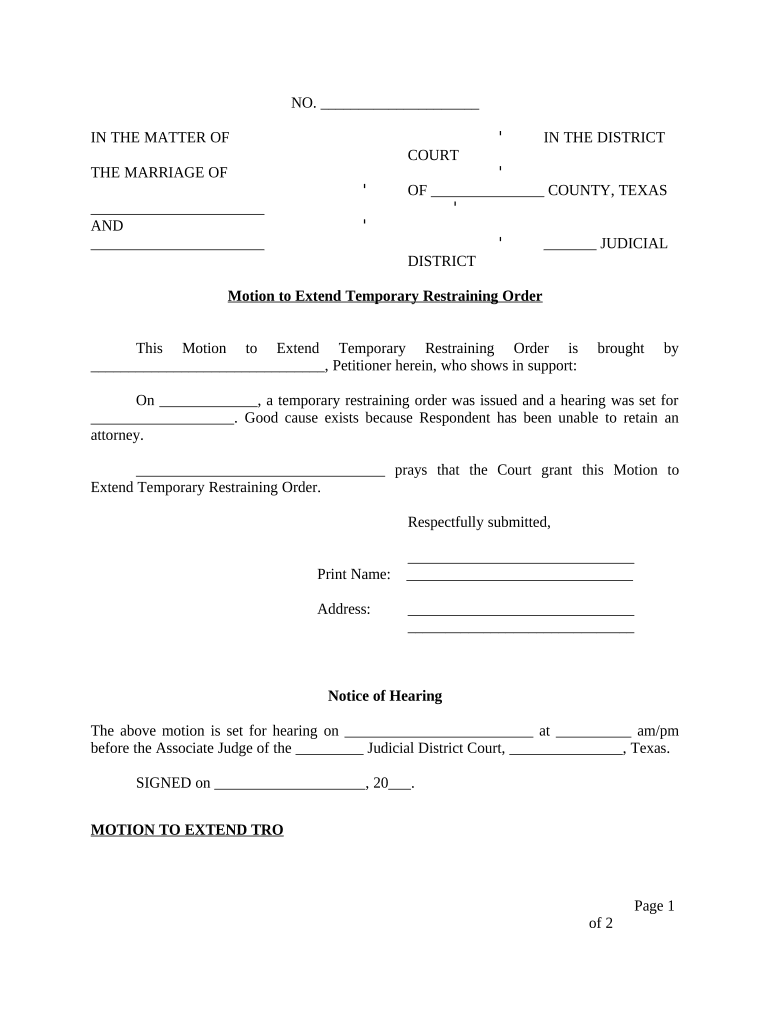
Extensions require additional evidence and court approval

Common mistakes to avoid when preparing a TRO

  • Submitting unsworn or vague allegations without dates and corroborating facts — courts require specific, credible statements of imminent harm.
  • Requesting overly broad or indefinite relief that is not narrowly tailored to prevent immediate injury, which can lead to denial or modification.
  • Failing to provide a clear plan for service or ignoring local rules on ex parte procedures, which can make the order unenforceable.
  • Neglecting to attach key exhibits or witness statements; missing evidence weakens the factual showing needed for emergency relief.

Penalties and legal risks tied to TRO filings

Contempt: Civil or criminal contempt can follow violations
Fines: Monetary sanctions may be imposed
Bond Forfeiture: If bond required, it may be forfeited
Perjury Exposure: False sworn statements risk criminal charges
Civil Liability: Wrongful or malicious filings may invite suits
Enforcement Costs: Costs for service or police assistance may apply

Practical tips for accurate and efficient TRO filings

Follow local rules, keep submissions narrowly focused, and document all supporting evidence to improve the chance of favorable and enforceable emergency relief.

Be Factual and Specific
State clear dates, times, locations, and concrete examples of harm; avoid conjecture and conclusory language that courts may find insufficient.
Attach Key Evidence
Include exhibits, such as photos, texts, or police reports, and reference them in the affidavit to strengthen the immediate showing of harm.
Plan for Service
Describe how the respondent will be served immediately after issuance; courts expect a practical service plan for enforcement.
Limit the Scope
Request narrowly tailored relief for the shortest necessary duration to reduce the risk of denial or later modification.

Realistic scenarios where a Temporary Restraining Order is used

Two anonymized examples illustrate typical TRO facts and court outcomes to guide proper preparation and expected timelines.

Scenario A

A tenant reports escalating threats from a neighbor

  • The affidavit cites three dated incidents and two witnesses
  • The court issued a short-term TRO the same day and scheduled a hearing within ten days, enabling safe separation while the dispute proceeded.

Scenario B

A small business sought to prevent theft of trade materials by a departing contractor

  • The affidavit included photos, contract excerpts, and emails demonstrating imminent diversion
  • The judge granted narrowly drawn restrictions and set an early hearing for permanent injunctive relief.

Comparing eSignature providers for TRO documents

TRO filings often use e-signatures for affidavits or counsel signatures; compare common vendor pricing and compliance characteristics when selecting a platform.

signNow DocuSign Adobe Sign PandaDoc HelloSign
Starting Price $8/user/mo $15/user/mo $14/user/mo $19/user/mo $15/user/mo
Free Trial 7-day free trial Varies by vendor Varies by vendor Varies by vendor Varies by vendor
Bulk Send Yes (Premium plan) Yes Yes Yes Yes
Audit Trail Yes Yes Yes Yes Yes
HIPAA Compliant Yes Yes Yes No No
Envelope Cap No envelope cap 100 envelopes/user/year Varies by plan Varies by plan Varies by plan

Frequently asked questions about Temporary Restraining Orders

Answers to common TRO questions about timing, service, enforceability, and recordkeeping to help avoid procedural pitfalls.


Need help? Contact support

be ready to get more
Join over 28 million airSlate SignNow users