Establishing secure connection…Loading editor…Preparing document…

Wyoming Petition for Change of Name

This template is fully customizable. Edit the text, fill out the fields, and send it for signature. Give it a try!
Wyoming Petition for Change of Name

What the Wyoming Petition for Change of Name Is

The Wyoming Petition for Change of Name is a court filing used to request a legal change of an individual’s name within Wyoming jurisdiction. The petition initiates a civil court process where the petitioner supplies identification, current name, proposed new name, and a reason for the change; the court reviews the filing, may set a hearing, and may require notice or publication depending on local rules. Once the court issues a decree, the order serves as the legal basis to update records such as driver’s licenses, Social Security, financial accounts, and educational and medical records.

Why a Formal Petition Matters for Legal Name Changes

Filing a petition creates a court record and a judicial order that establishes your new name for government, financial, and private records; this reduces ambiguity and facilitates consistent updates across agencies.

Why a Formal Petition Matters for Legal Name Changes

Who Typically Files a Wyoming Petition for Change of Name

Individuals, parents, and authorized guardians commonly file petitions to change an adult or minor’s legal name for personal, marital, or administrative reasons.

  • Adults changing names for personal or gender-affirming reasons, ensuring official records match identity documents.
  • Parents or guardians seeking to change a minor’s surname after marriage, adoption, or custody changes.
  • Attorneys or court-appointed guardians filing on behalf of incapacitated persons with court approval.

Eligibility, required documentation, and whether publication or a hearing is necessary vary by county and case type; check local court rules or consult counsel when in doubt.

Step-by-Step: Filing a Wyoming Petition for Change of Name

Complete the petition carefully, attach required documents, file with the appropriate court, and follow notice or hearing requirements if applicable.

  • 01
    Prepare Petition: Complete the court form with accurate personal and petition details.
  • 02
    Attach Documents: Include ID, birth certificate, and any required proof of residency.
  • 03
    File with Court: Submit to the county clerk and pay filing fees or seek fee waiver.
  • 04
    Attend Hearing: Appear if a hearing is set; obtain the signed court order.

How to Set Up an Online Workflow for the Petition

Configure an electronic workflow to collect signatures, supporting files, and notarizations securely, reducing manual steps and paper handling.

Field Configuration
Authentication Use email or SMS code verification for signer attribution.
Notarization Enable RON where allowed or plan for in-person notarization.
Templates Save petition and attachments as reusable templates for future filings.
Notifications Configure email alerts for signer completion and clerk receipt.

Where and How to Submit the Petition in Wyoming

Most name-change petitions are filed at the county district or circuit court; procedures vary by county so confirm the local clerk’s office requirements before filing.

  • Local District Court: Primary filing location for adult and minor petitions.
  • Clerk's Office: Clerk accepts filings, assesses fees, and sets hearing dates.
  • Mail or In-Person: Some courts accept mailed filings; others require in-person submission.
  • Court Hearing: Judge issues final order after review or hearing.

Digital Filing and eSubmission: Technical Considerations

Electronic submission requires PDF-compatible forms, secure signer authentication, and storage that meets legal retention standards.

  • Browser Support: Modern browsers and up-to-date OS recommended
  • Document Formats: PDF and DOCX supported for uploads
  • Integrations: Connect with cloud storage and court e-filing systems

Confirm local court e-filing acceptance and any required signature or notarization format before relying solely on electronic submission.

Key Components to Include in a Professional Petition

A complete petition anticipates clerk and judicial review by including identity verification, reason for the change, notice steps, and a clear signature and verification section.

Caption

Court name, county, case number placeholder, and parties identified consistent with local form requirements.
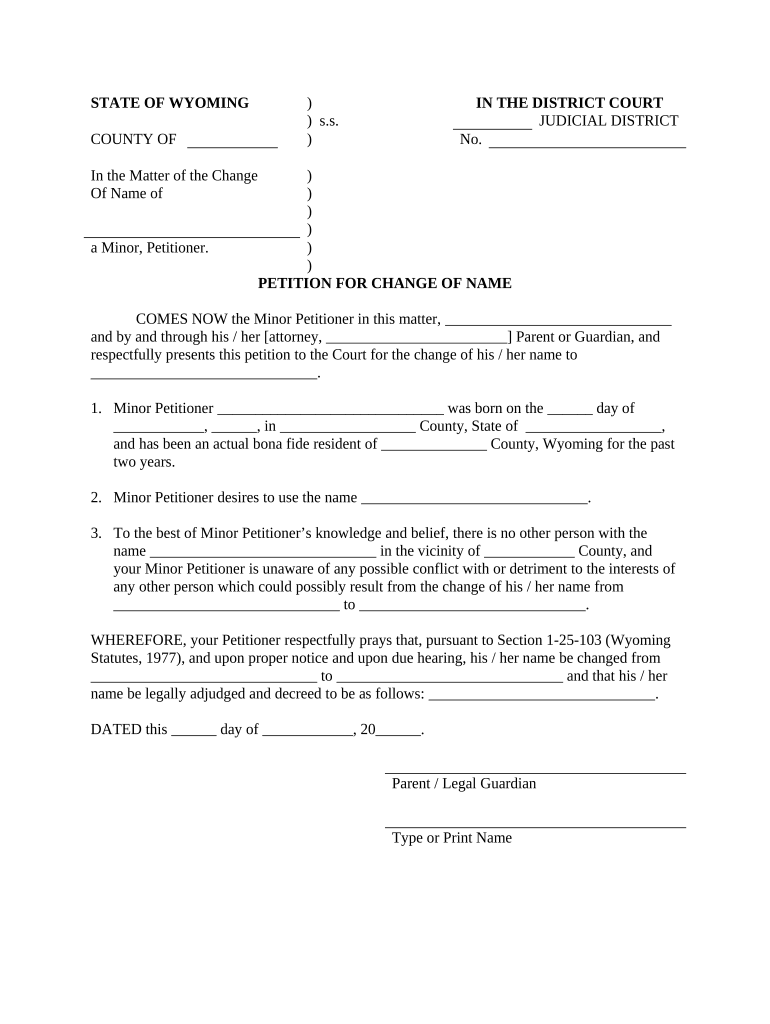
Petitioner Information

Full legal name, current address, date of birth, and contact information for identity verification and clerk correspondence.

Proposed Name

Exact new name requested, including middle name or suffix, to avoid ambiguity in the court’s decree and downstream record updates.

Statement of Reason

Concise, truthful explanation for the change; courts evaluate reasons and any public interest concerns when granting relief.

Signature and Verification

Petitioner signature, date, and a jurat or notarization if the local court requires sworn statements or acknowledgements.

Relief Requested

Clear request language asking the court to grant the name change and direct relevant agencies to update records where applicable.

Supporting Documents Commonly Submitted with the Petition

Attach documents that establish identity, lineage, and authority where relevant; completeness reduces requests for supplemental evidence.

Government ID

State ID or passport copy to verify identity and current legal name for the court record.

Birth Certificate

Certified copy to corroborate name at birth and parentage for minor petitions when required.

Proof of Residency

Utility bill or lease demonstrating current residence in the jurisdiction where you file.

Court Orders

Divorce decree, adoption order, or other judgments that affect name rights or require consistent record updates.

Typical Timelines and Deadlines to Expect

Timing varies by county; the following items represent common deadlines and windows to track during a name-change case.

Filing to Hearing:

Often scheduled 2–8 weeks after filing depending on court calendar.

Publication Window:

When required, notice periods typically range from two to four weeks.

Objection Period:

Third parties may have a limited time to file objections following notice or publication.

Entry of Order:

Judge signs final decree after hearing or uncontested review, producing the official record.

Record Updates:

Allow additional days for agencies to process changes after the court order is issued.

Key Milestones from Filing to Final Decree

Track these core milestones to monitor progress and anticipate required actions, from submission through official record updates.

01

Prepare Petition

Assemble form, attachments, and review for accuracy before submission.

02

File with Clerk

Submit petition in person or via accepted electronic filing channel and pay fees.

03

Notice/Publication

Complete any required public notice or direct service steps as ordered by the court.

04

Final Order

Attend hearing if required and obtain signed decree for downstream updates.

Risks and Consequences of Errors or Misstatements

Filing Rejection: Clerk may reject incomplete filings
Perjury Exposure: False statements risk criminal penalties
Delays: Missing documents can extend processing times
Privileged Records: Sensitive records may require redaction
Failed Notifications: Improper notice may invalidate the proceeding
Identity Confusion: Inconsistent updates can hinder background checks

Common Mistakes to Avoid When Preparing Your Petition

  • Failing to match the petitioner name exactly to ID causes verification delays and may lead to rejection by the clerk.
  • Leaving out the required attachments such as birth certificate or proof of residency often triggers requests for supplemental filings.
  • Using informal or inconsistent formatting for dates and names can produce clerical errors that complicate downstream record updates.
  • Assuming every county has the same notice or publication procedure — local rules frequently differ and must be confirmed.

Essential Information to Include on the Petition

Case Caption: Court and county name
Petitioner Name: Full current legal name
New Name: Exact proposed legal name
Date of Birth: MM/DD/YYYY
Address: Street, city, state, ZIP
Signature: Signed and dated by petitioner

eSignature Pricing: signNow and Common Alternatives

Typical eSignature pricing models vary by user, feature set, and usage; signNow is listed first for direct comparison with widely known alternatives.

signNow DocuSign Adobe Sign PandaDoc HelloSign
Starting Price $8/user/mo $15/user/mo $14/user/mo $19/user/mo $15/user/mo
Free Trial 7-day free trial Trial available Trial available Trial available Trial available
Bulk Send Yes Yes Yes Yes No
Audit Trail Yes Yes Yes Yes Yes
HIPAA Compliant Yes Yes Yes No No

Typical Use Cases and Example Scenarios

These case examples show how petitions are used in common adult and minor name-change situations.

Adult Name Change

An adult petitioner seeks a new name following life transition, with ID and birth certificate attached

  • Petition filed at county court, hearing set three weeks later
  • The court issues a decree enabling updates to Social Security, driver’s license, and bank accounts.

Minor Name Change

A parent files to change a minor’s surname after marriage, including consent and birth certificate

  • Court examines parental authority and any objections
  • Judge enters an order and the parent updates school and medical records.

Practical Tips to Improve Accuracy and Speed

Follow these practical recommendations to minimize delays and ensure the petition is accepted and processed efficiently.

Use Official Court Forms When Available
Obtain the county’s official petition form and instructions and complete every required field; clerks are less likely to accept nonstandard formatting.
Verify Local Notice Requirements
Confirm whether the county requires publication or direct notice to interested parties and follow the specified timelines precisely to avoid rehearings.
Provide Clear Proof of Identity
Include certified copies of birth certificates and current government IDs when requested to reduce additional document requests from the court.
Keep Digital Records Secure
Store signed petitions and the final decree in encrypted storage and maintain backups for downstream agency updates and future verification needs.

Frequently Asked Questions About Wyoming Name-Change Petitions

Answers to common procedural and technical questions encountered when preparing or submitting a petition in Wyoming.


Need help? Contact support

be ready to get more
Join over 28 million airSlate SignNow users