Best Legal Contract Management Software for Businesses

Streamline your document workflows with airSlate SignNow's intuitive eSigning solution. Experience cost-effective management of contracts and agreements with ease.

Award-winning eSignature solution

What best legal contract management software for businesses does and why it matters

The best legal contract management software for businesses centralizes drafting, execution, storage, and tracking of contracts while maintaining legal enforceability. It combines eSignature capability, template libraries, role-based access, audit trails, and integration with document storage and CRM systems to reduce manual steps and errors. For U.S. organizations, compliant solutions support ESIGN and UETA requirements, secure authentication, and detailed transaction logs. Effective platforms also provide workflow automation, reporting on contract lifecycles, and retention settings to align with corporate policy and regulatory obligations.

Why businesses adopt legal contract management systems

Adopting a contract management solution reduces administrative overhead, accelerates approval cycles, and improves legal compliance by centralizing controls and preserving auditable records for signed agreements.

Why businesses adopt legal contract management systems

Common contract management challenges addressed by software

  • Scattered files across email and shared drives create version control issues and signature delays.
  • Manual approval routing causes bottlenecks and reduces visibility into signature status and timelines.
  • Inconsistent templates and fields increase legal risk and require more legal review time.
  • Poor retention and deletion policies can conflict with compliance and litigation hold needs.

Representative user roles and responsibilities

General Counsel

Typically responsible for setting contract standards, approving high-risk terms, and maintaining legal oversight. They use contract software to enforce policy, review redlines, and access comprehensive audit trails for regulatory audits and internal governance.

Procurement Manager

Manages vendor contracting, negotiates commercial terms, and tracks renewals. They rely on templates, automated approval chains, and centralized storage to reduce procurement cycle time and ensure contract compliance.

Which teams typically use contract management tools

Legal, procurement, sales, HR, and operations teams use contract management tools to standardize agreements and enforce policies.

  • Legal teams: centralize templates, approve redlines, and maintain audit logs for compliance.
  • Procurement and operations: speed supplier onboarding and manage renewal schedules reliably.
  • Sales and HR: use templates and eSignatures to shorten time-to-sign and reduce manual errors.

Cross-functional use ensures consistent contract language, centralized auditability, and easier metrics tracking across the organization.

Additional capabilities to consider for enterprise readiness

Beyond core features, these capabilities support scale, security, and complex approval scenarios in larger organizations.

Bulk Send

Sends identical documents to many recipients while tracking individual signature status and completion metrics to support mass distribution use cases.


Advanced templates

Conditional logic and dynamic fields allow a single template to accommodate multiple contract variants and jurisdiction-specific clauses without manual edits.

Advanced authentication

Options include SMS, knowledge-based verification, and certificate-based authentication for higher-risk transactions and regulatory requirements.

Field-level locking

Restricts edits to critical clauses while permitting fillable fields for signers, preserving legal terms and reducing unauthorized changes.

Role-based reporting

Custom reports for legal, procurement, and sales show bottlenecks, SLA compliance, and contract lifecycle KPIs by user role.

Retention management

Automated retention schedules apply hold and deletion policies to ensure records meet corporate and regulatory requirements.

be ready to get more

Choose a better solution

Four practical features that improve contract workflows

Key features accelerate routine processes and reduce legal overhead while preserving enforceability and record integrity.

Template library

Centralized, approved templates reduce drafting time and limit risky ad hoc language; version control ensures teams use only the latest legal-approved forms for repeatable contract types.

Workflow automation

Automated approval routing with conditional steps and reminders reduces manual follow-up and enforces preconfigured review sequences across departments and legal counsel.

Audit trail

Comprehensive, tamper-evident logs show each action, timestamp, and IP for compliance with ESIGN, UETA, and internal governance requirements.

Integrations

Prebuilt connectors to CRM, cloud storage, and HR systems enable consistent data flow and reduce duplicate entry across business systems.
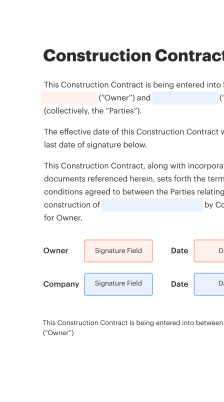
How online contract creation and signing typically flows

Most online contract workflows follow a predictable path from creation to execution and archiving to maintain compliance and streamline approvals.

  • Draft: Author or import a contract and select a template.
  • Route: Create an approval chain with roles and deadlines.
  • Authenticate: Choose authentication method and send to signers.
  • Archive: Store the executed contract with an immutable audit trail.
Collect signatures
24x
faster
Reduce costs by
$30
per document
Save up to
40h
per employee / month

Quick setup: onboarding a contract into the system

A concise four-step setup helps teams convert manual contracts into tracked, auditable agreements quickly.

  • 01
    Upload source: Import the master document or PDF into the platform.
  • 02
    Apply template: Map fields and apply a standard template to the document.
  • 03
    Define approvers: Set the approval sequence and role-based permissions.
  • 04
    Send for signature: Choose authentication level and distribute for signing.
be ready to get more

Why choose airSlate SignNow

  • Free 7-day trial. Choose the plan you need and try it risk-free.
  • Honest pricing for full-featured plans. airSlate SignNow offers subscription plans with no overages or hidden fees at renewal.
  • Enterprise-grade security. airSlate SignNow helps you comply with global security standards.
illustrations signature

Typical workflow settings to configure when deploying contract software

Review and configure these workflow settings to align the platform with internal approval processes and compliance requirements before rollout.

Setting Name Configuration
Default document approval sequence order Sequential approvals with escalation rules
Signature authentication level by document type Email, SMS, or ID verification
Reminder and escalation frequency schedule 48 hours then weekly reminders
Template publishing and version control policy Auto-publish after legal approval
Retention and archival policy configuration Custom retention per contract type

Platform compatibility and device support

Confirm device and browser compatibility to ensure signers can access, review, and execute contracts from common environments used by your organization.

  • Desktop support: Chrome, Edge, Safari
  • Mobile support: iOS and Android apps
  • Offline capability: Limited offline signing

Validate that key integrations, authentication methods, and administrative controls operate consistently across web and mobile clients and that the vendor provides clear browser and OS requirements for enterprise deployment.

Key security controls to look for

Encryption in transit: TLS 1.2+ encryption
Encryption at rest: AES-256 or equivalent
Access controls: Role-based access
Authentication options: Password and MFA
Audit logging: Immutable transaction logs
Data residency: US-based storage options

Industry examples of contract management in practice

Representative use cases show how different teams apply contract software to real workflows and compliance needs.

Healthcare provider contracting

A hospital system centralizes physician and vendor agreements into one platform to ensure consistent terms and version control

  • Template enforcement for BAAs and vendor contracts
  • Faster credentialing and standardized indemnity clauses reduce legal review time

Resulting in more reliable HIPAA compliance and faster vendor onboarding.

Education licensing agreements

A state university manages licensing and research agreements with centralized templates and approval routing

  • Role-based approvals for legal and grants offices
  • Automated retention schedules to align with FERPA and grant recordkeeping

Leading to clearer audit trails and reduced administrative burden during sponsor reviews.

Operational best practices for secure and accurate contract management

Follow these practical controls to maintain security, enforceability, and operational efficiency across contract lifecycles.

Centralize templates and legal approvals
Keep legally approved templates in a single repository with version control, restrict edit rights to authorized staff, and require legal sign-off for template changes to reduce inconsistent clause usage.
Define role-based access and approvals
Configure role-based permissions and approval chains so only authorized personnel can approve high-risk terms, minimizing exposure and ensuring proper segregation of duties for contract reviews.
Enable appropriate authentication levels
Match authentication strength to transaction risk; use stronger verification for high-value or regulated agreements and log authentication details to support legal defensibility.
Maintain auditable retention and deletion policies
Implement retention schedules and legal-hold processes that meet regulatory and corporate requirements, ensuring executed contracts remain discoverable for audits and litigation.

Frequently asked questions about contract management and signing

Answers address common setup, compliance, and operational questions to help teams adopt contract management tools efficiently.

Feature availability: signNow compared to DocuSign

A concise feature comparison highlights core capabilities and compliance posture for two widely used electronic signature and contract management providers.

Capability signNow (Recommended) DocuSign
ESIGN / UETA compliance
HIPAA support
API access REST API REST API
Bulk Send capability
be ready to get more

Get legally-binding signatures now!

Retention and review schedule examples

Set clear retention timelines and periodic review dates to meet compliance and operational needs for different contract types.

Employment agreements review:

7 years post-termination; annual review

Vendor contracts retention:

7 years after expiry; legal review at renewal

Health records agreements:

Minimum retention per HIPAA; legal oversight

Research and licensing agreements:

Retain per grant terms; review before renewal

Financial agreements:

7 years or per IRS rules

Risks of inadequate contract management

Regulatory fines: Noncompliance penalties
Contract disputes: Unclear audit trail
Data breaches: Exposure of sensitive data
Financial loss: Missed renewals and obligations
Operational delays: Approval bottlenecks
Reputational harm: Contract mishandling

Pricing and plan comparison across common providers

Pricing can vary by feature set, user count, and contract volume; the table summarizes representative plan attributes for common providers in the U.S. market.

Providers and plans signNow (Recommended) DocuSign Adobe Sign HelloSign PandaDoc
Entry-level monthly price per user $8 $10 $9 $15 $19
Free tier availability Limited free No free No free Limited free Limited free
Bulk Send included Yes on mid plans Add-on Yes Add-on Yes
API access included Yes Yes Yes Yes Yes
Enterprise features available SSO, SAML, HIPAA SSO, SAML SSO SSO SSO, Workflows
walmart logo
exonMobil logo
apple logo
comcast logo
facebook logo
FedEx logo
be ready to get more

Get legally-binding signatures now!