Factura Para Excel En La Industria Tecnológica

See your invoicing process turn quick and seamless. With just a few clicks, you can perform all the required steps on your bill for excel for Technology Industry and other crucial documents from any device with web connection.

Award-winning eSignature solution

What bill for excel for technology industry means in practice

bill for excel for technology industry describes a process where Excel-generated billing documents are combined with a secure electronic signature and workflow system to collect approvals, record acceptance, and store auditable records. For technology companies this typically covers invoices, change-order billings, time-and-materials statements, and license or subscription renewals produced from Excel spreadsheets, then routed to stakeholders for signature. The combined process reduces manual printing and scanning, preserves original spreadsheet formatting, and creates a verifiable chain of custody suitable for internal controls and external auditors.

Why integrate Excel billing with an eSignature workflow

Using eSignatures with Excel billing improves accuracy and traceability while preserving spreadsheet formulas and layouts, reducing approval cycle time and lowering the risk of manual errors across finance and product teams.

Why integrate Excel billing with an eSignature workflow

Common obstacles when sending Excel bills for signing

  • Preserving cell formatting and embedded formulas when converting an Excel file to PDF can cause layout shifts and data mismatches.
  • Ensuring signer identity for finance approvals without adding friction is difficult across external clients and internal approvers.
  • Tracking multiple versions of the same invoice when edits occur after signatory review increases reconciliation workload.
  • Aligning retention schedules and access controls for billing records to meet compliance and audit requirements is often overlooked.

Typical user personas working with Excel billing

Billing Manager

Responsible for creating and validating monthly or project-based Excel invoices, the Billing Manager prepares formula-driven spreadsheets, applies discounts or prorations, and routes finalized bills for electronic approval while ensuring records meet internal audit standards and retention policies.

Account Lead

The Account Lead presents billing to clients, tracks signed approvals, and coordinates any post-signature adjustments; they need quick access to signed copies, version history, and integration with CRM records to update account billing status.

Teams and roles that commonly use Excel billing with eSignatures

Technology organizations often involve cross-functional approval chains including finance, product management, and legal when finalizing Excel-based bills.

  • Finance teams that prepare, verify, and reconcile invoices before sending for signature.
  • Account managers who need customer sign-off on scope changes and billable adjustments.
  • Legal or procurement reviewers approving contract-adjacent billing terms and license renewals.

Coordinating these roles through a single workflow reduces handoffs, lowers approval times, and centralizes audit trails for billing transactions.

Primary tools and controls for efficient Excel billing workflows

Six capabilities help technology companies maintain accuracy, security, and speed when using Excel for billing and electronic approvals.

Field tagging

Map spreadsheet cells to form fields so line items, totals, and metadata are carried into the signing document without manual re-entry or transcription errors.


Bulk Send

Distribute the same billing document to thousands of recipients with personalized fields and independent signature tracking for each recipient.

Team templates

Store vetted invoice layouts and approval chains centrally for finance teams to reuse and enforce company policies on billing documents.

Conditional routing

Automatically route invoices for additional review when thresholds are exceeded, such as discounts beyond policy or change-order approvals.

Detailed audit trail

Maintain a tamper-evident activity log with timestamps, IP addresses, and signer actions to support compliance and dispute resolution.

API access

Programmatic creation and delivery of signed invoices from billing systems or custom Excel automation scripts.

be ready to get more

Choose a better solution

Integrations and templates that simplify Excel billing

Core integrations and template capabilities reduce repetitive work and preserve Excel structure when billing documents need signature and tracking.

Google Workspace

Two-way sync lets teams attach exports from Google Sheets or save signed PDFs back to Drive while keeping file permissions aligned with corporate sharing settings for collaboration.

CRM connectivity

Native connectors to common CRMs push signed invoice metadata and status updates into customer records so billing and account teams see signed acceptance without manual entry.

Cloud storage

Direct saving to Dropbox or other cloud repositories centralizes signed documents and supports existing backup and lifecycle policies for finance archives.

Reusable templates

Template-driven invoice layouts preserve Excel formatting and allow pre-placed signature fields, auto-fill variables, and consistent approval routing across billing cycles.
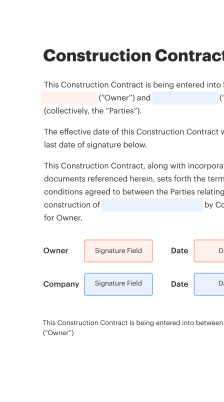
How the signing process flows across devices

Overview of the end-to-end flow from upload to signature capture, covering common touchpoints and verification steps.

  • Upload: Add the Excel file or its PDF export
  • Designate: Assign signature roles and routing order
  • Authenticate: Apply chosen verification method
  • Complete: Signers apply electronic signatures
Collect signatures
24x
faster
Reduce costs by
$30
per document
Save up to
40h
per employee / month

Quick step-by-step: send an Excel bill for signature

A concise sequence for preparing and sending an Excel-based bill to a client or internal approver using an eSignature-enabled workflow.

  • 01
    Prepare file: Finalize formulas and lock necessary cells
  • 02
    Export PDF: Convert to PDF to preserve layout
  • 03
    Add fields: Place signature and date fields
  • 04
    Route: Specify signers and authentication

Audit trail steps to capture during Excel billing transactions

Essential audit steps to collect and store metadata for each signed billing document.

01

Upload event:

Record uploader identity
02

Versioning:

Save file hash
03

Field mapping:

Log mapped cell keys
04

Authentication:

Capture method used
05

Signing timestamp:

Store exact time
06

Delivery logs:

Track delivery status
be ready to get more

Why choose airSlate SignNow

  • Free 7-day trial. Choose the plan you need and try it risk-free.
  • Honest pricing for full-featured plans. airSlate SignNow offers subscription plans with no overages or hidden fees at renewal.
  • Enterprise-grade security. airSlate SignNow helps you comply with global security standards.
illustrations signature

Recommended workflow settings for Excel billing

Suggested configuration values to optimize approval speed, security, and retention when sending Excel-derived bills for signature.

Feature Value
Reminder Frequency 48 hours
Signing Order Sequential
Authentication Level Email + MFA
Auto-fill Fields Enabled
Retention Policy 7 years

Supported devices and software for signing Excel bills

Signatures can be completed from modern web browsers, desktop clients, or mobile apps; ensure users have compatible environments before sending.

  • Mobile OS: iOS 14+ and Android 8+
  • Browser Support: Chrome, Edge, Safari, Firefox
  • Excel Versions: Office 2016+ and Microsoft 365

Confirming platform versions and access to email or SMS for authentication reduces signer friction and prevents failed deliveries, especially for external clients and contractors who may use varied devices.

Key security controls for Excel billing workflows

Encryption in transit: TLS 1.2+ for data transfers
Encryption at rest: AES-256 file storage
Access controls: Role-based permissions
Authentication methods: Password and MFA options
Document integrity: Tamper-evident sealing
Audit logging: Comprehensive event records

How technology teams apply Excel billing and eSignatures

Two concise examples show typical workflows and outcomes when Excel billing is combined with an eSignature platform in a technology setting.

Recurring SaaS invoice

A finance team exports monthly usage charges from a billing spreadsheet into a signed invoice PDF

  • Auto-populated fields preserve itemized usage and tax details
  • The signed record shortens collections and provides clear audit evidence

Resulting in faster payment cycles and cleaner audit trails for subscription revenue.

Project change order

Project managers generate change-order costs in an Excel workbook and attach the sheet for client approval

  • Conditional formatting highlights changed line items
  • Signatures capture acceptance of additional scope and new billing terms

Leading to reduced disputes and explicit authorization for billable work.

Practical best practices for secure, accurate Excel billing

Guidance to reduce errors, improve signer experience, and strengthen compliance when sending Excel-based bills for signature.

Preserve source integrity and formulas
Use a controlled export process that converts the final Excel into a fixed PDF while keeping a locked, internal copy of the original workbook to demonstrate source calculations during audits and inquiries.
Standardize templates and approval chains
Maintain centrally managed invoice templates and predefined routing rules so every bill follows the same validation, approval, and signature sequence across finance and account teams.
Apply appropriate authentication
Select signer verification levels based on transaction value and sensitivity, combining email, SMS, or government ID checks where necessary to meet risk and compliance criteria.
Keep complete audit trails
Ensure your eSignature system preserves timestamps, IP addresses, and document hash records for every action, and retain these logs according to your retention schedule for dispute resolution and regulatory review.

FAQs and troubleshooting for Excel billing and eSignatures

Answers to common questions and solutions for issues that arise when preparing, sending, and managing Excel-based bills with electronic signatures.

Feature availability across leading eSignature providers

Quick comparison of select capabilities relevant to Excel billing and enterprise deployment among major eSignature vendors.

Provider Capabilities signNow (Featured) DocuSign Adobe Sign
ESIGN and UETA legal compliance
Bulk Send capability
Native Excel integration Limited
API for automation REST API REST API REST API
be ready to get more

Get legally-binding signatures now!

Risks and potential penalties for non-compliant billing

Contract breach: Damaged relationships
Financial penalties: Fines or repayments
Audit findings: Regulatory scrutiny
Data exposure: Privacy incidents
Lost revenue: Delayed payments
Legal disputes: Litigation risk

Pricing and plan highlights for common eSignature solutions

Comparison of entry-level and typical enterprise indicators across major providers to inform cost and capability decisions for Excel billing workflows.

Provider overview signNow (Featured) DocuSign Adobe Sign Dropbox Sign PandaDoc
Starting price (per user/mo) Low-cost tier available Entry-level $10+ Entry-level $9.99+ Entry-level $15+ Entry-level $19+
API access availability Included in business plans Included in most plans Included in business plans Available Included in paid tiers
Bulk Send support Included Add-on or higher tier Included in higher tiers Limited Included in business plans
Enterprise contracts Custom enterprise options Extensive enterprise options Enterprise plans available Enterprise support available Enterprise options available
Free trial Yes Yes Yes Yes Yes
walmart logo
exonMobil logo
apple logo
comcast logo
facebook logo
FedEx logo
be ready to get more

Get legally-binding signatures now!