Bill Format in Word for Building Services

Watch your billing procedure turn fast and smooth. With just a few clicks, you can execute all the necessary steps on your bill format in word for Building services and other important documents from any device with web connection.

Award-winning eSignature solution

What a bill format in Word for building services entails

A bill format in Word for building services is a structured Microsoft Word document designed to capture labor, materials, tax, and payment terms specific to construction and facilities maintenance projects. It typically includes header details, client and job information, line-item cost tables, unit pricing, subtotals, taxes, and a clear total due field. Properly formatted Word bills can be converted to PDF for distribution, integrated with eSignature workflows, and archived to meet retention requirements. For U.S. use, templates should account for state sales tax and contractor licensing fields to support accurate invoicing.

Why structured Word billing helps building services

A consistent Word bill format reduces disputes, speeds approvals, and standardizes cost reporting across projects while supporting digital signing and recordkeeping requirements.

Why structured Word billing helps building services

Common billing challenges in building services

  • Inconsistent line-item descriptions lead to client confusion and payment delays when scope and rates are not clearly recorded.
  • Missing tax or licensing fields can cause compliance errors across different U.S. states and municipalities during audits.
  • Manual PDF conversion and email routing create bottlenecks and increase the risk of lost or unsigned invoices.
  • Poor version control on Word files results in duplicate bills or outdated rates being sent to clients.

User roles and responsibilities

Project Manager

Project Managers prepare the bill contents including labor hours, quantities, and unit pricing, verify that rates match contracts, and coordinate approvals from clients or site supervisors to confirm scope before sending for signature.

Accounts Admin

Accounts Administrators review finalized bills for billing accuracy, apply tax treatments and credits, manage invoice numbering and delivery, and reconcile payments against bank records while maintaining compliance with internal retention policies.

Typical users and teams handling Word bill formats

Project and finance teams in construction, property management, and facilities maintenance rely on standardized billing templates for consistency and auditability.

  • Project managers who track labor hours and material usage across multiple job sites for accurate invoicing.
  • Accounts payable and receivable teams that manage client billing cycles and reconcile payments.
  • Site supervisors who provide line-item details and sign off on completed work for billing.

Combining template control with digital signing and centralized storage improves traceability and reduces payment disputes across stakeholders.

Advanced capabilities for bill format workflows

Advanced features support scaling, automation, and security for teams managing many building services invoices.

Automated Reminders

Configure follow-up notifications for unpaid invoices and pending signatures to reduce overdue balances and keep projects on schedule with minimal manual tracking.


Role-Based Access

Restrict who can edit, send, or sign bills so only authorized project and finance staff can change pricing or approve final documents.

Single Sign-On

Use SSO to simplify user access control and enforce enterprise authentication policies for staff handling sensitive billing data.

API Connectivity

Programmatically generate, populate, and send Word bill templates from construction management or ERP systems to remove manual entry.

Mobile Signing

Enable on-site supervisors and clients to review and sign invoices from tablets or phones immediately after job completion.

Retention Policies

Apply configurable retention rules to automatically archive or purge signed bills according to company or regulatory schedules.

be ready to get more

Choose a better solution

Essential tools that improve Word billing

These core features streamline creation, delivery, and tracking of Word-based bills for building services operations.

Template Library

Centralized templates reduce version drift by ensuring all teams use a single, approved Word bill format populated with required fields for tax, licensing, and job-specific identifiers.

Bulk Send

Send a single finalized bill to multiple recipients with individualized fields such as client name, job number, and amount due to accelerate recurring invoicing across sites.

Audit Trail

Automatic logging captures each action—views, edits, signatures, and downloads—providing an immutable history useful for dispute resolution and compliance audits.

Integrations

Connect Word bills to accounting, CRM, and cloud storage systems to auto-populate client details, sync invoices, and persist signed records in corporate repositories.
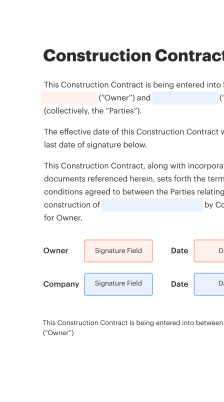
Turning a Word bill into a signed document

The typical workflow converts a finalized Word file into a signed record through export, routing, and signature capture.

  • Finalize: Lock content and confirm totals.
  • Export PDF: Create a non-editable document for signing.
  • Route: Specify signers and signing order.
  • Capture signature: Use an eSignature to record consent.
Collect signatures
24x
faster
Reduce costs by
$30
per document
Save up to
40h
per employee / month

Preparing your Word bill template — quick steps

Follow these essential steps to assemble a clear, usable bill format in Word for building services.

  • 01
    Create header: Include company, client, and job IDs.
  • 02
    Add line items: Use table rows for quantities and unit rates.
  • 03
    Tax fields: Insert state-specific tax lines.
  • 04
    Signature block: Reserve space for approver name and date.
be ready to get more

Why choose airSlate SignNow

  • Free 7-day trial. Choose the plan you need and try it risk-free.
  • Honest pricing for full-featured plans. airSlate SignNow offers subscription plans with no overages or hidden fees at renewal.
  • Enterprise-grade security. airSlate SignNow helps you comply with global security standards.
illustrations signature

Recommended workflow settings for automated billing

Configure these workflow settings to automate routing, reminders, and retention for Word-based building services bills.

Setting Name Configuration
Reminder Frequency 48 hours
Signing Order Sequential
File Format PDF locked
Retention Rule 7 years
Default Template Company standard

Supported devices and minimum requirements

Bill formatting, signing, and review should work consistently across modern desktops, tablets, and mobile devices to support on-site and office workflows.

  • Windows: Windows 10+
  • Mac: macOS 10.14+
  • Mobile: iOS 14+ or Android 9+

Ensure users have current browsers (Chrome, Edge, Safari) and PDF readers; mobile users should install the provider app when offline signing or camera-based attachment upload is needed.

Security and document protection features

Encryption: TLS in transit; AES at rest
Access Controls: Role-based permissions
Audit Trails: Immutable activity logs
Two-Factor: Optional 2FA for users
Document Locking: Prevent post-signing edits
Data Residency: Configurable storage regions

Real-world examples in building services billing

Two concise scenarios show how a Word bill format supports project billing and approvals.

Commercial HVAC retrofit

A contractor records hours, parts, and permit fees in a standardized Word bill

  • Template includes tax and license fields
  • Integration with eSignature confirms client approval quickly

Resulting in faster payment cycles and a clear audit record for the building owner.

Routine elevator maintenance

A facilities firm uses a repeatable Word invoice for monthly service visits

  • Line items capture inspections and spare parts
  • Bills are routed for digital signature and archived automatically

Leading to consistent billing, reduced admin time, and verifiable compliance documentation.

Best practices for accurate and secure billing

Follow these best practices to reduce errors, speed approvals, and maintain legal defensibility of signed bills.

Always include complete client and job identification
Ensure every bill contains a project name, job number, client contact, and site address so records match contracts and work orders during reconciliation and audits.
Standardize line-item descriptions and units
Use predefined item codes and units to avoid ambiguity on materials and labor, which helps accounts reconcile purchase orders and reduces payment disputes.
Use locked PDFs for signing
Convert Word documents to locked PDFs before signature to prevent post-signing modification and preserve a clear, auditable record of the billed amounts and terms.
Keep tax and licensing fields explicit
Include separate tax lines, contractor license numbers, and permit fees to ensure accurate tax remittance and to provide clear evidence of regulatory compliance.

FAQs and troubleshooting for Word bill signing

Answers to common questions about preparing and signing Word-formatted bills for building services, plus fixes for frequent issues.

Feature availability across leading eSignature platforms

A concise comparison of core features for Word billing workflows among popular eSignature providers.

eSignature Platform Feature Comparison Table signNow (Recommended) DocuSign Adobe Sign
Entry level monthly subscription price $8/user/mo $10/user/mo $9.99/user/mo
Bulk Send capability available
Single Sign-On support included Available Available Available
API access and developer support
be ready to get more

Get legally-binding signatures now!

Common document retention and billing deadlines

Typical retention and billing timelines for building services help align invoicing with legal and operational requirements.

Invoice submission timeframe:

Within 30 days of job completion.

Client payment terms:

Net 30 or Net 45 as contract specifies.

Tax reporting window:

Quarterly or monthly filing depending on sales volume.

Record retention requirement:

Keep signed invoices for seven years.

Dispute resolution period:

Raise payment disputes within 60 days.

Compliance risks and potential penalties

Incorrect tax reporting: Fines or back taxes
Missing signatures: Contract disputes
Unauthorized access: Data breach penalties
Poor retention: Regulatory noncompliance
Mismatched invoices: Payment delays
Invalid consent: Legal challenges

Pricing snapshot for common plans

Representative entry-level pricing and plan features for managing Word bills; numbers reflect typical published starter rates and common features.

Pricing and Plans signNow (Recommended) DocuSign Adobe Sign Dropbox Sign PandaDoc
Starter plan monthly rate $8/user/mo $10/user/mo $9.99/user/mo $15/user/mo $19/user/mo
Free trial availability 7 days 30 days 14 days 14 days 14 days
API access included Yes Limited Yes Yes Yes
Bulk send support Yes Add-on Yes Yes Add-on
SSO available Yes Yes Yes Enterprise Enterprise
Document retention features Configurable Configurable Configurable Basic Configurable
walmart logo
exonMobil logo
apple logo
comcast logo
facebook logo
FedEx logo
be ready to get more

Get legally-binding signatures now!