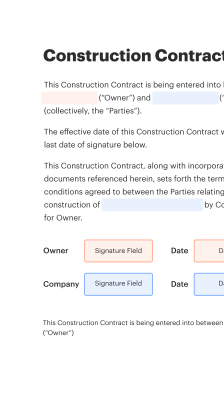
Cap Viewer Initial for Secure Document Management

Get rid of paper and automate digital document management for more efficiency and limitless opportunities. eSign any papers from your home, fast and accomplished. Discover a better strategy for doing business with airSlate SignNow.

Award-winning eSignature solution

What cap viewer initial Means in an eSignature Workflow

cap viewer initial refers to a document field or workflow action that captures a viewer's initials at a defined point in a digital form or contract. It is commonly used to confirm review of a clause, acknowledge receipt, or record a declarative acceptance without requiring a full signature. In eSignature platforms like signNow this field integrates with audit trails, access controls, and document templates so administrators can place, require, and validate initials as part of a signed transaction and compliance record.

Why use cap viewer initial for document control

cap viewer initial provides a lightweight, auditable confirmation mechanism for sections requiring acknowledgement, reducing friction while preserving legal context and recordability.

Why use cap viewer initial for document control

Common implementation challenges

  • Misplaced initial fields can invalidate a workflow or confuse signers, delaying completion by requiring re-issue of documents.
  • Insufficient validation or lack of audit metadata reduces evidentiary value for compliance or disputes.
  • Cross-platform rendering differences may shift initial field positions, causing accidental omissions.
  • Confusing instructions for initials versus signatures can produce incomplete transactions and additional administrative work.

Representative user profiles

HR Manager

An HR Manager configures cap viewer initial fields on onboarding packets, ensuring each employee initials specific policy pages. They rely on template reuse and audit logs to verify acknowledgements across large batches and maintain complete records for internal audits and regulatory reviews.

Loan Officer

A Loan Officer places initial fields on multi-page disclosures to capture per-page confirmation from applicants, reducing in-person steps. They track completion via the platform dashboard and use the audit trail to support compliance with lending regulations.

Teams and roles that typically use cap viewer initial

Organizations use cap viewer initial where brief acknowledgement is needed without a full signature, such as policy review or page-by-page confirmation.

  • Human resources teams for policy acknowledgements and employee forms.
  • Legal and contracts teams for clause-level acknowledgement during negotiations.
  • Loan and compliance officers for page initials in multi-page agreements.

In practice it reduces signer friction for routine confirmations while preserving a verifiable event in the signing record for audit and compliance purposes.

Advanced features that support scalable cap viewer initial use

For enterprise deployments, look for automation, API support, compliance tools, and integration depth to scale initial-based acknowledgements reliably.

Bulk Send

Bulk Send enables distributing documents with cap viewer initial fields to many recipients at once while preserving individualized audit records tied to each signer.

API access

A robust API allows programmatic placement of initial fields, dynamic templating, and integration with backend systems for automated document generation and routing.

Conditional fields

Conditional visibility rules let systems surface initial fields only when a specific clause or option is selected, reducing signer confusion and simplifying forms.

Document locking

Locking mechanisms prevent changes after initials are applied, ensuring the signed state and document integrity are preserved for verification.

User authentication

Support for multiple authentication methods strengthens signer identity assurance prior to accepting initials, improving evidentiary value.

Compliance reporting

Built-in reporting and exportable audit histories make it practical to demonstrate adherence to retention and signature regulations.

be ready to get more

Choose a better solution

Core cap viewer initial capabilities to evaluate

Key capabilities influence reliability and compliance when using cap viewer initial: placement accuracy, requirement enforcement, audit capture, and template reuse are central considerations.

Precise placement

Tools that snap initial fields to coordinates and support multi-page anchoring reduce misplacement and ensure consistent rendering across desktop and mobile viewers.

Requirement enforcement

Ability to mark initial fields as mandatory prevents transaction completion until each necessary initial is provided, maintaining document integrity and workflow control.

Audit trail integration

Each initial event should be recorded with signer identity, timestamp, IP address, and device metadata to support compliance and dispute resolution.

Template and bulk support

Reusable templates and Bulk Send features enable large-scale use of initial fields across batches while preserving field consistency and administrative efficiency.

How cap viewer initial integrates with signing flows

cap viewer initial functions as a discrete field type that integrates with templates, routing, and transaction state management within an eSignature platform.

  • Template linkage: Embed initial fields in reusable templates.
  • Signatory assignment: Bind fields to specific recipients.
  • Validation rules: Enforce completion before advancing.
  • Audit capture: Record event data in the transaction log.
Collect signatures
24x
faster
Reduce costs by
$30
per document
Save up to
40h
per employee / month

Quick steps to add a cap viewer initial field

Follow these basic steps to place and require an initial field in a document before sending for signature.

  • 01
    Upload document: Add the PDF or Word file to the platform.
  • 02
    Place initial field: Drag an initial field to the relevant page area.
  • 03
    Set requirements: Mark the field as required and assign to a signer.
  • 04
    Send for signing: Distribute via web link, email, or mobile.

Operational checklist to implement cap viewer initial

Use this checklist to prepare documents, configure fields, and verify behavior before sending initial-based workflows to recipients.

01

Prepare document:

Finalize content and pagination
02

Place fields:

Add initial and signature fields
03

Assign signers:

Map fields to recipient roles
04

Set validations:

Require initial before advancing
05

Test workflow:

Run through sender and signer flows
06

Monitor transactions:

Check completion and audit entries
be ready to get more

Why choose airSlate SignNow

  • Free 7-day trial. Choose the plan you need and try it risk-free.
  • Honest pricing for full-featured plans. airSlate SignNow offers subscription plans with no overages or hidden fees at renewal.
  • Enterprise-grade security. airSlate SignNow helps you comply with global security standards.
illustrations signature

Typical workflow settings for cap viewer initial

Recommended default configurations help maintain consistency and compliance when using cap viewer initial fields in automated workflows.

Workflow Setting Header Row Example Default configuration values used for workflow automation
Reminder Frequency (days between reminders) 48 hours
Expiration window for documents 30 days
Require authentication method Email and optional SMS
Audit log retention setting Seven years
Template version control policy Lock after approval

Supported platforms and device considerations

cap viewer initial fields should be tested on common desktop browsers, mobile browsers, and native apps to ensure consistent behavior across devices.

  • Desktop browsers: Chrome, Edge, Firefox supported
  • Mobile browsers: Safari and Chrome mobile
  • Native apps: iOS and Android apps

Confirm minimum OS versions and PDF rendering differences in your environment, and document supported browser versions and app releases to reduce signer issues and ensure reliable capture of initial events.

Security and authentication elements

Field-level locking: Prevents later edits
Access control: Role-based signer permissions
Two-factor options: SMS or email codes
Audit metadata: Timestamps and IPs
Document hashing: Integrity verification
Encryption in transit: TLS-protected transfer

How cap viewer initial is used in real scenarios

Two concise examples show common, practical deployments of cap viewer initial in regulated and high-volume environments.

Case Study 1

A midsize healthcare provider used cap viewer initial on patient consent forms to capture initials beside specific disclosure clauses, improving page-level acknowledgement tracking.

  • Implementation used templated initial fields on each relevant page for consistency.
  • The approach reduced in-person follow-ups and clarified which clauses were reviewed.

Resulting in improved audit readiness and a more efficient consent process.

Case Study 2

A financial institution added cap viewer initial into multi-page loan disclosures to meet internal control standards while minimizing signer effort.

  • Fields were required for select pages and tied to transaction audit logs.
  • This preserved clear evidence of page-by-page review without forcing full signatures on every page.

Leading to faster processing times and clearer compliance documentation.

Best practices for secure and accurate cap viewer initial use

Adopting consistent controls and clear signer guidance lowers risk and improves completion rates when using cap viewer initial fields.

Clearly label initial fields with concise signer instructions
Provide short, plain-language guidance adjacent to the initial field so signers understand whether a full signature or a simple initial is expected; this reduces errors and incomplete transactions.
Use templates and locked fields for recurrent forms
Lock fixed content and standardize initial placements through templates to minimize accidental changes and ensure uniform data capture across repeated documents.
Capture robust audit metadata for every initial event
Ensure each initial is recorded with timestamp, signer identity context, device and IP information to support ESIGN/UETA compliance and create reliable evidence for audits or disputes.
Test across devices and PDF viewers before deployment
Validate field rendering and behavior on desktop browsers, mobile apps, and common PDF readers to avoid misalignment, missing fields, or functionality differences for end users.

FAQs and troubleshooting for cap viewer initial

This section covers frequent questions and practical fixes when cap viewer initial fields behave unexpectedly during creation, sending, or signing.

Feature comparison: cap viewer initial support across platforms

Compare availability and technical details for cap viewer initial functionality across common eSignature providers to inform platform selection and integration planning.

Feature Criteria and Details Header signNow (Recommended) DocuSign Adobe Sign
Native mobile application availability and support
Field-level locking and document locking options
Bulk Send support for initials at scale Limited
API placement and templating capabilities REST API REST API REST API
HIPAA compliance options and BAAs Available Available Available
be ready to get more

Get legally-binding signatures now!

Retention and document lifecycle checkpoints

Establish clear retention, review, and deletion timelines that align with legal, regulatory, and internal policy requirements for documents containing cap viewer initial fields.

Initial record retention period:

Seven years from transaction completion

Audit log review frequency:

Quarterly or upon compliance trigger

Template update schedule:

Annual review minimum

Signer credential revalidation:

Every 12 months or key events

Document archival timeline:

Move to cold storage after two years

Regulatory and operational risks

Noncompliance exposure: Fines possible
Invalid evidence: Court challenges
Data breach risk: Confidentiality loss
Operational delays: Rework required
Record retention gaps: Audit failures
User confusion: Incorrect inputs

Pricing and plan comparison for initial-enabled workflows

High-level pricing and plan features can influence platform choice for cap viewer initial deployments, especially for bulk or enterprise use cases.

Plan and Vendor Comparison signNow (Featured) DocuSign Adobe Sign Dropbox Sign PandaDoc
Free tier availability and limitations Limited free trial available Limited trial options Trial available with Creative Cloud Free tier with basic features Free trial for small teams
Monthly starting price (approximate) $8 per user per month $10 per user per month $9.99 per user per month $12 per user per month $19 per user per month
API access on paid plans Included on business plans Available on developer plans Included with enterprise Available with paid plans Included with business plans
Bulk Send and high-volume support Available with higher tiers Available as add-on Available on enterprise Limited Available with enterprise
HIPAA and enterprise compliance support Offered with agreement Offered with enterprise Offered with enterprise Offered with Dropbox business Offered with enterprise

Simplify complex workflows

Create, execute, and manage workflows of any complexity, electronically from virtually anywhere. Scalable eSignature capabilities allow you to share documents with the right people in the correct order and define roles for each recipient. Execute document workflows faster and easier than ever before.

Automate document management

Optimize complex signing processes with airSlate SignNow’s powerful features to enhance your business. Control your automated eSignature workflows to ensure they're running at peak performance with instant notifications and reminders.

Optimize in team collaboration

Bring teams together in a secure, shared environment. Manage documents, use form templates and notifications to create more efficient cross-organization collaboration. Free your employees from having to spend time on repetitive activities so that they can focus on valuable, business-critical tasks.

Integrate into your existing systems

Run your projects with industry-leading integration. Collect Salesforce, Microsoft Teams, and SharePoint all in one business flow. Connect your software to a single system for endless possibilities and more productiveness.

Stay compliant with best-in-class data security

Feel safe knowing that your information remains secure by the most up-to-date in encryption security. airSlate SignNow is GDPR and eIDAS certified and provides you transparence into your signing procedure with court-admissible audit trails. Configure user access permissions and rights to manage who has access to what.


walmart logo
exonMobil logo
apple logo
comcast logo
facebook logo
FedEx logo
be ready to get more

Get legally-binding signatures now!