Digital Contract Management for Operations

Experience the ease of sending and eSigning documents effortlessly. Boost your team's productivity and reduce costs with our powerful, user-friendly solution.

Award-winning eSignature solution

What digital contract management for operations means

Digital contract management for operations centralizes creation, routing, signing, storage, and lifecycle tracking of operational agreements using electronic signatures and automated workflows. It reduces manual handoffs, standardizes templates, and enforces approval paths while producing an auditable record of every transaction. For U.S.-based organizations, systems that support ESIGN and UETA compliant signatures integrate with identity verification, access controls, and retention policies to meet operational, legal, and recordkeeping needs across procurement, vendor management, HR, and facilities workflows.

Why operations teams adopt digital contract management

Digital contract management streamlines recurring operational approvals, reduces cycle times, and improves document accuracy while maintaining an auditable trail and compliance-ready records for internal and external review.

Why operations teams adopt digital contract management

Common operational obstacles solved by digital contracts

  • Slow manual approvals that create bottlenecks across procurement and vendor onboarding processes.
  • Version control errors when multiple stakeholders edit the same contract without a central source.
  • Difficulty enforcing consistent templates, clause language, and mandatory fields across teams.
  • Lack of reliable audit trails increases time required for compliance checks and dispute resolution.

Representative user roles

Procurement Lead

Responsible for vendor selection and contract negotiation, the procurement lead uses digital contract management to standardize templates, enforce approval sequences, and maintain a searchable record of supplier agreements for audit and performance tracking across facilities and operations.

Operations Coordinator

Handles day-to-day contract routing and execution, preparing templates, assigning signing order, and monitoring completion. They rely on notifications, reminders, and integration with procurement systems to keep operational processes on schedule.

Teams and roles that benefit from contract automation

Operations groups coordinate cross-functional approvals, reduce manual steps, and centralize contract handling to maintain uptime and compliance.

  • Procurement managers who need consistent vendor onboarding and renewal processes.
  • Facilities and real estate teams handling leases, service agreements, and maintenance contracts.
  • HR and workforce operations managing offer letters, NDAs, and policy acknowledgements.

Smaller teams and large enterprises both gain faster turnaround, clearer ownership, and easier audits when processes are standardized and digital.

Core features that support operations

Operational contract systems combine signing, templates, automation, integrations, auditability, and mobile access to deliver predictable contract outcomes across teams.

eSignature

Legally binding electronic signatures with ESIGN/UETA support for U.S. transactions, plus configurable signer authentication and signature placement for consistent execution across operational agreements.


Templates

Reusable templates and prebuilt fields speed document assembly, enforce required clauses and reduce errors by locking contract sections and standardizing language for operations use.

Workflow Automation

Automated approval routing, conditional fields, and reminders reduce manual handoffs and ensure contracts move predictably through procurement and facilities workflows.

Integrations

Prebuilt connectors to CRMs, cloud storage, and productivity suites sync contract data and attachments, reducing duplicate entry and preserving document context in downstream systems.

Audit Trail

Comprehensive event logging captures signer IPs, timestamps, and actions to support audits, dispute resolution, and regulatory recordkeeping needs.

Mobile Access

Signing and document review via mobile apps or responsive web interfaces lets field teams execute agreements on site without returning to the office.

be ready to get more

Choose a better solution

Integrations that matter for operations

Connectivity with productivity and business systems prevents data silos and keeps contract metadata synchronized across operational tools.

Google Workspace

Direct integration with Google Drive and Docs enables sending contracts from within document editors and automatically archiving executed PDFs to designated Drive folders, preserving original files and metadata for operational records.

CRM Platforms

Integration with major CRMs populates templates with account and contact data, tracks contract stages on opportunity records, and logs execution details to support procurement and vendor lifecycle reporting.

Dropbox / Cloud Storage

Two-way sync with cloud storage providers ensures signed documents and backups are saved to the correct project or site folder while maintaining centralized control for versioning and retention.

API and Webhooks

Programmable API and webhook support lets operations trigger contract creation, receive status updates, and store execution artifacts within procurement or ERP systems for automated downstream processing.
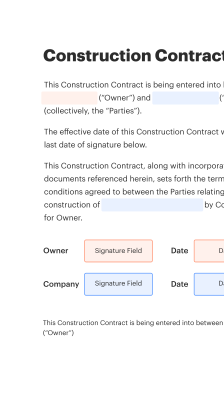
Creating and executing contracts online

A typical online contract flow moves documents from template to signature with validation steps, integrations, and final archiving to maintain operational continuity.

  • Prepare document: Choose template and add fields
  • Route for approval: Apply signing order and approvers
  • Sign electronically: Parties sign via web or mobile
  • Store and audit: Archive final PDF with audit log
Collect signatures
24x
faster
Reduce costs by
$30
per document
Save up to
40h
per employee / month

Quick setup steps for operations teams

A concise onboarding sequence helps operations teams configure templates, approvals, and storage to begin sending compliant contracts quickly.

  • 01
    Define templates: Create standard contract templates and clauses
  • 02
    Set signing order: Assign approvers and recipient sequence
  • 03
    Configure reminders: Schedule automatic follow-ups and expirations
  • 04
    Enable retention: Set archival and deletion rules

Managing and auditing contract events

Audit trail setup and review steps help operations maintain reliable evidence of execution and changes for compliance and internal controls.

01

Enable logging:

Turn on comprehensive event capture
02

Capture signer details:

Record IP, timestamp, and method
03

Secure storage:

Store logs in tamper-evident location
04

Export capability:

Provide CSV or PDF export
05

Regular review:

Schedule audit reviews quarterly
06

Retention rules:

Apply legal retention schedules
be ready to get more

Why choose airSlate SignNow

  • Free 7-day trial. Choose the plan you need and try it risk-free.
  • Honest pricing for full-featured plans. airSlate SignNow offers subscription plans with no overages or hidden fees at renewal.
  • Enterprise-grade security. airSlate SignNow helps you comply with global security standards.
illustrations signature

Recommended workflow configuration for operations

Suggested workflow settings balance speed with control, ensuring approvals, notifications, and retention are aligned to operational policies.

Feature Configuration
Reminder Frequency 48 hours
Signing Order Mode Sequential
Template Library Access Team-shared
Auto-Archive Policy 30 days after completion
Retention Period 7 years

Security controls and protection features

Encryption at rest: AES-256 encrypted storage
Transport security: TLS 1.2+ for data in transit
Multi-factor authentication: Optional 2FA for users
Role-based access: Granular permission tiers
Document redaction: Selective data masking available
Audit logging: Immutable event records

Operational examples and results

Two brief case examples show how digital contract management reduces cycle time and improves compliance across common operational scenarios.

Manufacturing Vendor Onboarding

A mid-sized manufacturer centralized supplier agreements into templates with automated approval routing

  • Single template cut negotiation prep time
  • Faster contract turnaround reduced production hold-ups

Resulting in measurable cycle-time reductions and fewer fulfillment delays for new vendor setups.

Facilities Maintenance Contracts

A national facilities team moved recurring maintenance contracts into automated renewals and reminders

  • Auto-renew workflow for multi-site service agreements
  • Reduced missed renewals and invoice disputes

Leading to steadier service continuity and clearer spend tracking across locations.

Operational best practices for secure, accurate contracts

Established practices help operations maintain control, demonstrate compliance, and scale contract volume without sacrificing accuracy.

Standardize templates and required fields
Create and govern a centralized template library to ensure consistent clause language and mandatory fields. Use locked sections for non-negotiable terms and conditional logic to present relevant fields only when applicable, reducing manual edits and approval cycles.
Enforce role-based approvals and least privilege
Define clear roles and approval thresholds for contract types. Restrict template editing to designated administrators and apply least-privilege access to signing and download functions to limit exposure and maintain internal control over sensitive operational agreements.
Maintain retention schedules and archival procedures
Implement retention policies aligned with legal and corporate requirements, automate archival after execution, and ensure exports of audit logs are stored in tamper-evident locations. Regularly review retention configurations for changes in regulatory obligations.
Train teams on workflows and compliance requirements
Provide targeted training for operations, procurement, and facilities staff on template use, signature authentication options, and audit evidence requirements. Regular refresher sessions help teams avoid errors and preserve legal defensibility of executed contracts.

FAQs and troubleshooting for operations

Answers to common questions about configuration, compliance, and operational issues when adopting digital contract management.

Feature availability comparison among major eSignature providers

A concise comparison of common operational features across leading U.S.-used eSignature platforms to inform selection decisions.

Feature Comparison signNow (Recommended) DocuSign Adobe Sign
eSignature legal validity
Bulk Send
API availability REST API REST API REST API
HIPAA support
be ready to get more

Get legally-binding signatures now!

Operational risks and potential penalties

Non-compliance fines: Regulatory penalties
Contract disputes: Litigation costs
Data breach exposure: Notification expenses
Operational delays: Lost revenue
Record retention failures: Compliance citations
Unauthorized access: Credential misuse

Pricing snapshot for operational deployments

High-level pricing and plan characteristics to compare cost and suitability for operational teams. Actual rates may vary by contract and time.

Pricing Comparison signNow (Recommended) DocuSign Adobe Sign Dropbox Sign OneSpan Sign
Starting Monthly Price $8/user/month $25/user/month $14.99/user/month $15/user/month Contact sales
Free Tier Availability No Yes (limited) No Yes (limited) No
Per-user limits Unlimited documents Varies by plan Unlimited Limited Custom limits
Advanced authentication 2FA, SAML 2FA, SAML 2FA, SSO 2FA 2FA, MFA
Integrations included Google, CRM, Dropbox Google, CRM Adobe ecosystem Dropbox, Google CRM connectors
Enterprise contract length Monthly & annual Annual Annual Monthly & annual Custom terms
walmart logo
exonMobil logo
apple logo
comcast logo
facebook logo
FedEx logo
be ready to get more

Get legally-binding signatures now!