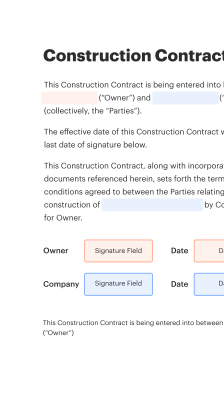
Digital Sign Certificate for Secure Transactions

Eliminate paper and automate digital document processing for higher performance and limitless possibilities. Discover a greater strategy for doing business with airSlate SignNow.

Award-winning eSignature solution

What a digital sign certificate is and why it matters

A digital sign certificate is an electronically issued credential that binds an individual or organization to a public key used to create secure electronic signatures. It is typically issued by a certificate authority (CA) and includes identifying information, validity dates, and a public key. In eSignature workflows a digital sign certificate proves signer identity, enables document integrity checks via cryptographic hashing, and supports non-repudiation. In the United States, properly implemented digital certificates are used alongside ESIGN and UETA-compliant eSignature services such as signNow to meet legal and audit requirements.

When to choose a digital sign certificate

Use digital sign certificates when legal precision, strong signer identity, or cryptographic proof of integrity is required; they provide a technically robust record for audits and regulated workflows.

When to choose a digital sign certificate

Common implementation challenges

  • Complex key lifecycle management increases operational overhead for issuing, renewing, and revoking certificates across large user populations.
  • Interoperability issues arise when different CAs, file formats, or signature standards are used in multi-vendor environments.
  • Ensuring user understanding and correct signing procedures is difficult without clear workflows and training materials.
  • Meeting sector-specific regulatory controls can require additional contractual and technical safeguards beyond standard certificate use.

Typical user profiles

IT Administrator

Responsible for procuring and deploying certificates, integrating certificate authorities, and configuring secure key storage. This role manages certificate lifecycle tasks including issuance, renewal, and revocation, and coordinates with application teams to enable signing workflows while enforcing security policies.

Compliance Officer

Focuses on aligning digital signing practices with legal and regulatory frameworks. This person documents procedures, reviews audit trails, and ensures that certificate use meets ESIGN and UETA standards and any sector-specific requirements such as HIPAA or FERPA controls.

Organizations and roles that typically use digital sign certificates

Businesses, regulated entities, and IT teams use digital sign certificates to improve identity assurance and document integrity in electronic transactions.

  • Legal and compliance teams that require auditable signature records for contracts and regulated documents.
  • IT and security teams managing certificate deployment, key storage, and revocation across the enterprise.
  • Industries such as healthcare, finance, and education where higher identity assurance reduces regulatory risk.

Adoption is driven by use case requirements for non-repudiation, forensic verification, and long-term archival of signed documents.

Additional capabilities for robust certificate-based signing

Advanced features support scalability, regulatory needs, and integration across document workflows.

Encryption

End-to-end document encryption during transit and at rest to protect signed content from unauthorized access.

Revocation Services

Support for OCSP and CRL checks to ensure certificates that are revoked are detected during verification.

Integration APIs

APIs that enable certificate-based signing within existing systems such as CRMs, HR platforms, and document stores.

Mobile Signing

Capability to perform certificate-backed signatures on mobile devices with secure key handling and authentication.

Key Management

Centralized key lifecycle controls, hardware-backed storage options, and automated renewal processes for operational security.

Compliance Reports

Exportable audit records and compliance documentation to support regulatory reviews and internal audits.

be ready to get more

Choose a better solution

Core features to expect with digital sign certificates

Understanding common capabilities helps select appropriate certificate workflows and integrate them into eSignature platforms.

Certificate Issuance

Formal issuance by a trusted certificate authority, including identity vetting and issuance metadata, allowing signatures to carry cryptographic validation and expiry information necessary for long-term verifiability.

Timestamping

Secure timestamping binds the signature to a moment in time using an authoritative time source, supporting long-term validation even after certificate expiration for archival and legal retention purposes.

Signer Authentication

Integration with authentication methods such as email OTP, knowledge-based checks, or multi-factor authentication to strengthen the link between the signer and the certificate used for signing.

Audit Trail

Comprehensive logs that record issuance, signing events, verification attempts, and any certificate lifecycle changes to support compliance and forensic review.

How a certificate-based signing process typically flows

A standard process links certificate issuance, signing, and verification into a continuous workflow for trustworthy electronic signatures.

  • Issue: CA validates identity and issues certificate.
  • Store: Private key stored securely by user.
  • Sign: Signature applied using private key.
  • Validate: Verifier checks certificate and hash.
Collect signatures
24x
faster
Reduce costs by
$30
per document
Save up to
40h
per employee / month

Quick steps to issue and use a digital sign certificate

Follow these core steps to obtain a digital sign certificate and use it in routine signing workflows.

  • 01
    Request Certificate: Submit identity verification to a CA.
  • 02
    Install Key: Import the issued certificate into secure storage.
  • 03
    Sign Document: Apply the certificate-based signature to the file.
  • 04
    Verify: Confirm signature validity via the audit trail.
be ready to get more

Why choose airSlate SignNow

  • Free 7-day trial. Choose the plan you need and try it risk-free.
  • Honest pricing for full-featured plans. airSlate SignNow offers subscription plans with no overages or hidden fees at renewal.
  • Enterprise-grade security. airSlate SignNow helps you comply with global security standards.
illustrations signature

Configuring certificate-based signing in your workflow

The following settings are commonly configured when enabling digital sign certificates in an eSignature platform.

Setting Name Configuration
Signer Authentication Method Email + OTP
Reminder Frequency 48 hours
Certificate Type X.509
Retention Period 7 years
Audit Trail Level Detailed logs

Platform and environment requirements for certificate signing

Confirm supported operating systems, browser versions, and mobile app requirements before deploying certificate-based signing.

  • Browser support: Chrome, Edge, Safari
  • Mobile OS: iOS 13+ and Android 9+
  • File format support: PDF and PDF/A

Also verify corporate firewall settings, CA trust stores, and any required browser plugins or native app permissions; coordinate with IT to test signing and verification end to end prior to production rollout.

Security controls tied to digital sign certificates

Certificate Authority: Trusted issuer
Private Key Storage: Hardware or encrypted vault
TLS Protection: Transport encryption
Multi-Factor Authentication: Stronger signer verification
Document Hashing: Integrity verification
Revocation Lists: Real-time trust checks

Industry scenarios showing how digital sign certificates are used

These examples illustrate practical ways digital sign certificates improve assurance and compliance across regulated workflows.

Healthcare

Hospitals and clinics use certificates for clinical consent forms and provider attestations to ensure signer identity and document integrity.

  • Certificate-based signatures reduce the risk of altered records and provide cryptographic proof of origin.
  • This enables secure exchange between providers and payers while meeting audit requirements.

Resulting in clearer evidence trails and reduced compliance exposure during audits.

Real Estate

Title companies and brokers apply digital certificates to closing documents to verify identities and lock document content.

  • Certificates create tamper-evident signatures that support trusted chain-of-title.
  • Parties benefit from faster closings and reduced in-person meeting needs.

Leading to accelerated transaction timelines and preserved legal evidence for post-closing disputes.

Operational best practices for digital sign certificates

Follow established practices to minimize risk and maintain reliable, legally defensible signed records.

Maintain a documented certificate lifecycle policy
Define procedures for issuance, renewal, revocation, and archival. Include roles and responsibilities, verification standards, and timelines to ensure consistent handling and legal defensibility of signed documents.
Enforce multi-factor authentication for signers
Combine certificate-based signatures with MFA to reduce impersonation risk. Require strong authentication for sensitive documents and for administrative tasks like certificate issuance and revocation.
Archive signed documents with verification data
Store signed files alongside certificate chains, timestamps, and verification metadata to permit future validation even if the original certificate expires or is revoked.
Conduct periodic audits and key rotation
Regularly review certificate usage and rotate keys per policy. Audit access to private keys and logs to detect anomalies and maintain a healthy trust environment.

FAQs about digital sign certificates

Answers to frequent questions about use, verification, and management of digital sign certificates within eSignature workflows.

Feature availability across major eSignature vendors

A high-level comparison shows which vendors support common certificate and signing features relevant to U.S. compliance and security.

Criteria signNow (Recommended) DocuSign Adobe Sign
API Access
Bulk Send
HIPAA Support Available Available (Enterprise) Available (Enterprise)
Offline Signing Limited Limited
be ready to get more

Get legally-binding signatures now!

Key timing and retention milestones

Track important dates in the certificate and document lifecycle to maintain validity and meet retention obligations.

Certificate issuance date:

Start of validity for the certificate.

Certificate expiration date:

Requires renewal before this date.

Key rotation schedule:

Periodic replacement of private keys.

Document retention deadline:

Required archival period per policy.

Audit review cadence:

Regular compliance inspections scheduled annually.

Risks and regulatory consequences

Noncompliance: Fines, audits
Data Breach: Liability exposure
Invalid Signatures: Contract disputes
Certificate Compromise: Impersonation risk
Poor Retention: Evidence gaps
Operational Downtime: Workflow delays

Pricing and plan highlights for leading eSignature products

Plan comparisons vary by feature and scale; the table below summarizes starting price points and common enterprise capabilities for current market vendors.

Feature signNow (Recommended) DocuSign Adobe Sign Dropbox Sign PandaDoc
Starting price (monthly) $8+/user $10+/user $9.99+/user $15+/user $19+/user
Free tier or trial Free plan available Limited trial Limited trial Free plan available Limited trial
API access Included Included Included Included Included
Bulk sending Included Available (advanced) Available (advanced) Available (advanced) Available (advanced)
HIPAA-ready option Available Available (Enterprise) Available (Enterprise) Available (Enterprise) Available (Enterprise)

Simplify complex workflows

Prepare, perform, and manage workflows of any difficulty, digitally from almost anywhere. Scalable eSignature capabilities allow you to share contracts with the right people in the proper order and define roles for each recipient. Execute document workflows faster and simpler than ever before.

Automate document management

Improve intricate signing tasks with airSlate SignNow�s powerful capabilities to boost your operation. Manage your automatic signature workflows to ensure they're running at peak efficiency with fast notices and alerts.

Optimize in team collaboration

Join teammates together in a safe, shared environment. Handle documents, use form templates and notifications to produce more efficient cross-company collaboration. Free your employees from having to spend time on recurring actions to enable them to center on valuable, business-crucial tasks.

Integrate into your current network

Work your jobs with market-leading integration. Capture Salesforce, Microsoft Teams, and SharePoint all in one business flow. Hook up your software to a single unit for limitless opportunities and higher performance.

Remain compliant with market-leading data protection

Feel safe with the knowledge that your information remains secure by the newest in encryption security. airSlate SignNow is GDPR and eIDAS compliant and provides you visibility into your signing procedure with court-admissible audit trails. Configure user authorization and roles to regulate who has access to what.


walmart logo
exonMobil logo
apple logo
comcast logo
facebook logo
FedEx logo
be ready to get more

Get legally-binding signatures now!