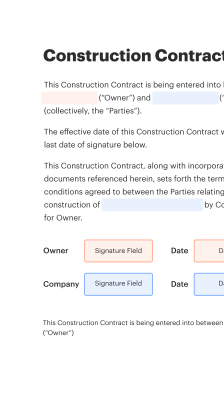
Digital Signature on Chrome: Secure and Compliant eSignatures

Remove paperwork and improve digital document managing for increased productivity and unlimited opportunities. Discover the best way of doing business with airSlate SignNow.

Award-winning eSignature solution

What digital signature on Chrome means and how it works

A digital signature on Chrome refers to an electronic signing process completed within the Chrome browser that binds a signer to a document and records evidence of the signing event. In practical terms this includes in-browser signing interfaces, integration with Chrome extensions or web apps, transport-layer protections while the page is active, and the creation of a verifiable audit trail. For U.S. use cases, the signature is effective when it meets ESIGN and UETA requirements, including intent to sign, association with the record, and reliable audit data preserved with the document.

Roles and user types for Chrome-based signing

Administrator

Administrators manage account-wide settings, domain controls, template libraries, and retention policies. They assign roles, configure authentication defaults, and review security logs to maintain compliance across Chrome-based signing activity for the organization.

Signer

Signers receive signing requests, authenticate per the configured method, and complete fields within the Chrome browser. Their interactions are recorded in the audit trail and they receive signed copies and confirmations after completion.

Core features to expect when signing in Chrome

Effective in-browser signing combines signature fields, authentication options, document templates, audit trails, integrations, and administrative controls to streamline workflows while maintaining legal and security standards.

Signature Fields

Drag-and-drop fields compatible with Chrome sessions allow precise placement for signers, initials, checkboxes, and data capture that persist in the final PDF and audit record.

Authentication

Support for email verification, SMS one-time passwords, knowledge-based verification, and options for stronger multi-factor methods to meet transaction risk requirements.

Templates

Reusable templates reduce preparation time for standard documents and preserve field positioning and roles across repeated Chrome-based signing workflows.

Audit Trail

Immutable logs capture signer identity, timestamps, IP addresses, and action history; these records support ESIGN/UETA compliance for Chrome transactions.

Integrations

Native connections to cloud storage, CRMs, and Chrome extensions let users initiate and complete signatures without leaving their preferred web tools.

Admin Controls

Role-based permissions, domain controls, and configurable retention policies support enterprise governance for browser-based signing.

be ready to get more

Choose a better solution

Integrations relevant to signing in Chrome

Integrations enable seamless document transfer and signing initiation from common productivity and storage tools used within Chrome.

Google Docs

Direct add-on or integration allows users to initiate signature workflows from within Docs, preserving layout and enabling field mapping between the source document and the signing template to minimize rework.

CRM Platforms

Connectors for common CRMs let teams trigger signature requests from contact and opportunity records, embed templates, and capture signed documents into the customer record to maintain a single source of truth.

Cloud Storage

Integrations with services like Dropbox and Google Drive enable two-way sync of signed PDFs and original documents, allowing users to start signing in Chrome and archive completed records automatically.

APIs

Developer APIs support creating, sending, and retrieving signing sessions programmatically so Chrome-based web apps can embed eSignature flows directly into custom user interfaces.

How creating and using a digital signature on Chrome works

A typical in-browser signing flow has clear stages from upload through authentication and finalization; each stage generates metadata and security checks handled by the eSignature provider.

  • Upload: Load document into the Chrome web app.
  • Assign: Add signers and place signature fields.
  • Authenticate: Use email, SMS, or stronger methods.
  • Archive: Store signed copy and audit trail.
Collect signatures
24x
faster
Reduce costs by
$30
per document
Save up to
40h
per employee / month

Quick setup: sign a document in Chrome

Follow these concise steps to prepare and sign a document in Chrome using a web-based eSignature tool.

  • 01
    Upload: Open the document in the web app through Chrome.
  • 02
    Prepare: Place signature fields and required data tags.
  • 03
    Authorize: Authenticate the signer per required method.
  • 04
    Complete: Finalize signing and save the audit record.

Managing audit trails and signed records in Chrome workflows

Preserving a clear audit trail is essential for legal defensibility and operational transparency when signatures occur in-browser.

01

Capture Events:

Record each signer action
02

Timestamping:

UTC timestamps for events
03

IP Logging:

Store originating IP addresses
04

Document Hashing:

Compute cryptographic hashes
05

Tamper Evidence:

Seal final documents
06

Export Options:

PDF + audit log bundle
be ready to get more

Why choose airSlate SignNow

  • Free 7-day trial. Choose the plan you need and try it risk-free.
  • Honest pricing for full-featured plans. airSlate SignNow offers subscription plans with no overages or hidden fees at renewal.
  • Enterprise-grade security. airSlate SignNow helps you comply with global security standards.
illustrations signature

Configuring signing workflows for Chrome

Set workflow defaults to control reminders, expiration, and signer order for consistent in-browser signing behavior.

Setting Name Configuration
Reminder Frequency 48 hours
Expiration Period 30 days
Signer Order Sequential by role
Default Authentication Email verification
Retention Policy 365 days

Platform and browser requirements for Chrome signing

Use a recent stable release of Chrome with TLS mandatory, and ensure the eSignature web application supports the browser extension or in-page APIs required for a smooth signing experience.

  • Chrome version: Latest stable release
  • Network security: TLS 1.2+ required
  • Cookies and storage: Local storage enabled

Organizations should verify corporate endpoint policies, extension whitelisting, and privacy settings before broad deployment to maintain consistent behavior across managed Chrome instances and to ensure audit data and signed documents are preserved reliably.

Security features protecting Chrome-based digital signatures

Encryption: AES-256 at rest; TLS in transit
Access Controls: Role-based user permissions
Authentication: Email, SMS, and MFA options
Auditability: Tamper-evident logs stored
Data Residency: Region-selectable storage
BAA Support: Business associate agreements

Industry scenarios for Chrome digital signatures

Common use cases show how in-browser signing increases speed and reduces manual handling across sectors.

Healthcare Intake

Patient consents completed in-browser to streamline onboarding

  • Secure form capture at point-of-service
  • Faster processing and fewer paper files

Resulting in reduced administrative burden and clearer audit trails.

Sales Agreements

Sales reps send contract links that signers complete in Chrome

  • Template fields prepopulate customer data
  • Electronic records accelerate approvals and renewals

Leading to shorter sales cycles and clearer records for audits.

Best practices for secure and accurate Chrome-based signatures

Follow these operational practices to reduce errors, meet legal requirements, and maintain security when signing in Chrome.

Verify signer identity appropriate to transaction risk
Select an authentication method aligned with the legal and business risk of the document; low-risk forms may use email verification, while higher-value agreements may require SMS one-time passcodes or multi-factor authentication to provide stronger signer identity evidence.
Maintain clear field placement and instructions
Use templates with clearly labeled fields and role assignments so signers in Chrome understand required inputs; this reduces back-and-forth and preserves consistent records across similar transactions.
Preserve audit data and store signed copies securely
Ensure the platform captures detailed audit logs, timestamps, and IP addresses and that signed PDFs are stored with tamper-evident seals and encrypted backups to support compliance and dispute resolution.
Align retention and BAA policies with regulations
Establish data retention schedules and execute business associate agreements where regulated data is involved, ensuring HIPAA or FERPA responsibilities are documented and access controls are enforced.

FAQs About digital signature on Chrome

The following frequently asked questions address legal, technical, and practical issues that commonly arise when implementing browser-based digital signatures.

Technical comparison: signNow (Recommended) versus DocuSign for Chrome signing

This table compares key technical and compliance features relevant to browser-based signing, focusing on items that affect deployment and legal standing in the United States.

Feature or Requirement for eSignature signNow (Recommended) DocuSign
ESIGN and UETA legal compliance
Audit trail and tamper-evident logs Detailed logs Detailed logs
Multiple signer two-factor authentication options SMS, Email SMS, Email
Browser compatibility and Chrome extension support Chrome extension Chrome integration
be ready to get more

Get legally-binding signatures now!

Typical lifecycle steps for a Chrome signing transaction

Understanding lifecycle stages helps administrators define automation and retention actions for browser-based signing events.

01

Drafting

Prepare document and fields

02

Initiation

Send request to signer(s)

03

Authentication

Verify signer identity

04

Signing

Signer completes fields in Chrome

05

Completion

System finalizes and seals document

06

Archival

Store signed copy and logs

07

Retention

Apply retention schedule

08

Disposition

Securely delete per policy

Document retention and backup considerations for Chrome signing

Establish clear retention and backup rules to meet legal, regulatory, and operational needs for documents signed in the browser.

Retention period for standard contracts:

Retain for minimum seven years or per policy

Retention period for employee records:

Follow HR regulatory schedules

Encrypted backup frequency:

Daily encrypted backups recommended

Export and eDiscovery readiness:

Enable exportable bundles with audit logs

Document disposal and shredding:

Automate secure deletion after retention end

Feature and plan comparison across signNow (Featured) and competitors

High-level plan and feature differences can influence vendor selection; this table summarizes availability of common capabilities rather than specific promotional pricing.

Pricing and Vendor Comparison signNow (Featured) DocuSign Adobe Sign HelloSign PandaDoc
Free trial or free tier availability Free trial and limited free tier Free trial only Trial with Acrobat subscription Free limited plan Free limited plan
API access and developer program Public API with SDKs and docs Public API with SDKs API via Acrobat Sign API available Public API with SDKs
HIPAA compliance option availability BAA available for eligible plans BAA available BAA available for enterprise BAA available with enterprise BAA available for enterprise
Bulk send and template automation support Bulk Send and reusable templates Bulk Send supported Bulk Send for enterprise Bulk Send supported Bulk send available
Google Workspace integration included Add-on and Docs integration Add-on for Google Drive Integration with Drive Google Docs add-on G Suite integration available

Simplify challenging workflows

Generate, execute, and control workflows of any complexity, digitally from almost anywhere. Scalable eSignature functionality enable you to share papers with the right people in the proper way and set up roles for each recipient. Stream document workflows faster and easier than ever before.

Automate document flow

Improve complex signing procedures with airSlate SignNow�s effective features to boost your operation. Control your automated signature workflows to make sure they're running at top functionality with immediate notices and reminders.

Enhance in team communication

Bring teams together in a protected, shared environment. Handle documents, use form templates and notices to deliver more effective cross-organization collaboration. Relieve your employees from having to spend time on repeated routines so that they can center on beneficial, business-vital projects.

Integrate into your existing systems

Work your jobs with industry-leading integration. Assemble Salesforce, Microsoft Teams, and SharePoint in one business thread. Connect your applications to a single unit for limitless opportunities and higher productiveness.

Stay compliant with industry-leading data protection

Feel safe knowing that your information is protected by the latest in encryption security. airSlate SignNow is GDPR and eIDAS certified and offers you exposure into your eSigning experience with court-admissible audit trails. Set up user access permissions and rights to manage who has access to what.


walmart logo
exonMobil logo
apple logo
comcast logo
facebook logo
FedEx logo
be ready to get more

Get legally-binding signatures now!