Draft Receiver E Signature Solutions with SignNow

Get rid of paper and automate document managing for increased efficiency and limitless opportunities. Sign any papers from your home, fast and accomplished. Experience a better way of running your business with airSlate SignNow.

Award-winning eSignature solution

What a draft receiver e signature means in practice

A draft receiver e signature describes an electronic signing workflow where the recipient (the receiver) is given an active role to populate, edit, or complete signature-related fields before finalizing the agreement. This model shifts some document preparation responsibilities to the receiver while preserving a verifiable electronic signature record. Implementations typically include field-level permissions, audit logging, and authentication options so the receiver can submit a completed, legally enforceable signed document without altering other protected content in the form.

Why organizations adopt draft receiver e signature workflows

Allowing receivers to draft or complete signature fields reduces back-and-forth, accelerates turnaround, and supports scenarios where signers supply missing details; this improves throughput without sacrificing an auditable signature trail.

Why organizations adopt draft receiver e signature workflows

Common challenges when using receiver-drafted e signatures

  • Managing which fields receivers can edit requires careful role and permission configuration to avoid unintended document changes.
  • Ensuring legal admissibility needs consistent audit trails and clear evidence of intent from the receiver and sender.
  • Authentication and identity verification must be strong enough for the document’s legal and regulatory context, which can add friction.
  • Version control must prevent overwriting previously agreed terms when multiple receivers or drafts are involved in the same workflow.

Typical user profiles for draft receiver e signature

Contract Manager

Manages templates and permissions, configures which fields receivers may edit, and reviews completed drafts to confirm compliance before archiving. Responsible for retention policies and dispute resolution support.

Field Signer

A customer or on-site representative who completes required fields, uploads attachments if allowed, and applies an electronic signature; often authenticates via email or SMS OTP and receives the final executed copy.

Who commonly uses draft receiver e signature workflows

Organizations that require recipient-supplied details or signatures often use receiver-draft capabilities to streamline completion and verification.

  • Real estate agents and title companies collecting buyer-supplied financing or escrow details.
  • Field service and sales teams needing on-site customer inputs to finalize contracts.
  • HR and admissions offices where applicants provide personal data or attestations during signing.

These workflows suit regulated and transactional contexts where validated receiver input speeds execution while retaining a compliant audit record.

Expanded features to optimize draft receiver e signature operations

These capabilities improve scale, integration, and compliance when receivers contribute draft content to signed records.

Bulk Send

Distribute identical draftable templates to many recipients with individualized fields so large outbound campaigns maintain consistency and speed up processing.


APIs

Embed draft receiver workflows into existing systems using REST APIs to programmatically create documents, set draftable fields, and retrieve signed records.

Integrations

Connect with CRMs, cloud storage, and document management systems to prefill data and persist executed documents into business repositories.

Mobile sign

Provide fully supported mobile interfaces so receivers can complete and sign draftable fields securely from phones or tablets.

Template library

Centralize approved templates with draftable regions to reduce errors and ensure legal text remains consistent across transactions.

Role-based access

Grant administrative, sender, and reviewer roles to separate duties and reduce the risk of unauthorized field modifications.

be ready to get more

Choose a better solution

Core features to support draft receiver e signature workflows

Select platform capabilities that enable secure receiver input, clear permissions, and an auditable signature lifecycle to reduce risk and improve completion rates.

Field-level permissions

Configure which fields receivers can edit, lock sensitive sections, and assign field roles so only authorized recipients modify designated input areas while preserving the rest of the document.

Authentication options

Support multiple signer verification methods such as email OTP, SMS code, SSO, or knowledge-based checks to match the legal or internal risk requirements of each document.

Audit trail

Maintain tamper-evident logs that record each action, timestamp, IP address, and field-level changes so the final executed document contains a complete and admissible transaction history.

Template management

Use reusable templates with predefined draftable fields to standardize intake, reduce setup time, and ensure consistency across repeated receiver-draft transactions.
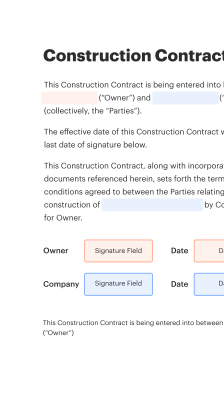
How receiver-drafted e signatures operate end-to-end

A concise flow shows interactions from sender setup to receiver completion and finalization of the signed record.

  • Sender setup: Designate draftable fields
  • Receiver action: Populate and sign fields
  • Verification: Authenticate signer identity
  • Finalization: System locks document and logs audit
Collect signatures
24x
faster
Reduce costs by
$30
per document
Save up to
40h
per employee / month

Quick setup: enabling receiver drafting in a signing flow

Follow these basic steps to allow a receiver to draft required fields while preserving signature integrity and traceability.

  • 01
    Prepare document: Upload finalized template
  • 02
    Assign editable fields: Mark fields as receiver-editable
  • 03
    Require authentication: Select signer verification method
  • 04
    Send for completion: Route to receiver for drafting

Managing audit trails for receiver-drafted transactions

Follow these steps to verify, export, and preserve the complete audit trail for documents where receivers provided drafts or inputs.

01

Access audit log:

Open document activity pane
02

Review changes:

Inspect field-level edits
03

Verify identity:

Confirm authentication events
04

Download report:

Export PDF or CSV
05

Attach supporting files:

Include uploaded attachments
06

Store securely:

Move to archival repository
be ready to get more

Why choose airSlate SignNow

  • Free 7-day trial. Choose the plan you need and try it risk-free.
  • Honest pricing for full-featured plans. airSlate SignNow offers subscription plans with no overages or hidden fees at renewal.
  • Enterprise-grade security. airSlate SignNow helps you comply with global security standards.
illustrations signature

Typical workflow settings to enable receiver drafting

Configure these settings to balance usability, security, and compliance when enabling receivers to draft document fields.

Setting Name Configuration
Reminder Frequency 48 hours
Signing Order Sequential
Draft Receiver Field Enabled Enabled
Authentication Method Email OTP
Retention Policy 7 years

Supported platforms for draft receiver e signature

Draft receiver e signature workflows are supported across modern web browsers, dedicated mobile apps, and iPad/tablet interfaces for field use.

  • Web browsers: Chrome, Edge, Safari
  • Mobile devices: iOS and Android
  • Desktop apps: Windows and macOS

For consistent behavior, ensure browsers and mobile apps are kept current and that JavaScript and cookies are enabled; administrators should verify integration connectors and API tokens for server-to-server workflows.

Key security controls for receiver-drafted signatures

Encryption at rest: AES-256 encryption
Encryption in transit: TLS 1.2+ channels
Access controls: Role-based permissions
Authentication options: Email OTP or SSO
Audit logging: Field-level change log
Data residency: US-based storage

Industry examples of draft receiver e signature use

Two representative scenarios show how receiver-drafted signatures speed execution while ensuring compliance and record integrity.

Real Estate Closing

A buyer completes financing and escrow contact fields on a closing package

  • Receiver uploads supporting ID documents
  • The seller and title company receive a consolidated, signed record

Resulting in a single executed file with a time-stamped audit trail and preserved field-level provenance for downstream recordkeeping.

Field Service Agreement

A technician captures customer acceptance and completion details on-site

  • Customer fills inspection fields and signs electronically
  • The operations team receives immediate confirmation and warranty data

Leading to faster invoicing and a verifiable record that links the onsite inputs to the final signed contract.

Best practices for secure and accurate draft receiver e signatures

Apply these operational and technical controls to reduce risk and maintain legality when receivers supply or modify content in signing workflows.

Limit editable fields to the minimum necessary
Define only the fields receivers must complete; avoid granting broad edit permissions and use locked sections to protect contractual terms and prefilled legal language.
Choose authentication proportional to transaction risk
For low-risk forms, email or SMS verification may suffice; for high-value or regulated agreements, require stronger methods like SSO or knowledge-based authentication.
Preserve field-level auditability and version history
Enable detailed logging that records every edit, attachment upload, and signature event so any dispute can be resolved using a clear, timestamped record of receiver actions.
Train staff on template design and permission settings
Ensure administrators understand how to assign draft fields, apply retention policies, and configure authentication to prevent accidental exposure or invalidation of signatures.

FAQs About draft receiver e signature

Common questions and concise answers about setup, legality, and troubleshooting for workflows that let recipients draft parts of a signed document.

Feature comparison: draft receiver support and common capabilities

A concise feature availability grid comparing draft receiver support, API access, mobile support, bulk sending, and HIPAA readiness across platforms.

Criteria signNow (Featured) DocuSign Adobe Sign
Draft Receiver Support
API Access
Mobile App
Bulk Send
be ready to get more

Get legally-binding signatures now!

Recommended timelines and retention examples for draft receiver e signature

Establish clear deadlines and retention timeframes to ensure legal defensibility and efficient document lifecycle management.

Signer response window:

7 calendar days

Reminder schedule cadence:

48 hours between reminders

Document retention period:

7 years for contracts

Audit trail retention:

Same as document retention

Automatic archive trigger:

30 days post-completion

Risks and potential penalties from mismanaged drafts

Invalid signatures: Contract unenforceability
Regulatory fines: Compliance penalties
Data breaches: Breach notification costs
Contract disputes: Litigation expenses
Reputational harm: Customer trust loss
Retention failures: Document loss risk

Pricing snapshot for common eSignature plans

Representative pricing and plan characteristics across popular eSignature providers; actual prices vary by region, plan features, and contract terms.

Plan signNow (Featured) DocuSign Adobe Sign Dropbox Sign PandaDoc
Entry-level monthly price $8 per user per month $10 per user per month $14.99 per user per month $15 per user per month $19 per user per month
Team plan cost $15 per user per month $25 per user per month $30 per user per month $20 per user per month $25 per user per month
Enterprise features included APIs, SSO, BAA options Advanced workflows, APIs APIs, advanced compliance Team templates, APIs Document workflows, CRM sync
Free trial availability Yes, limited trial Yes, limited trial Yes, limited trial Yes, limited trial Yes, limited trial
Support level Email and chat; paid phone Email, phone for plans Email, phone for enterprise Email and chat Email and chat; phone paid

Simplify complex workflows

Create, execute, and manage workflows of any complexity, electronically from virtually anywhere. Scalable eSignature capabilities allow you to share documents with the right people in the correct order and define roles for each recipient. Execute document workflows faster and easier than ever before.

Automate document management

Optimize complex signing processes with airSlate SignNow’s powerful features to enhance your business. Control your automated eSignature workflows to ensure they're running at peak performance with instant notifications and reminders.

Optimize in team collaboration

Bring teams together in a secure, shared environment. Manage documents, use form templates and notifications to create more efficient cross-organization collaboration. Free your employees from having to spend time on repetitive activities so that they can focus on valuable, business-critical tasks.

Integrate into your existing systems

Run your projects with industry-leading integration. Collect Salesforce, Microsoft Teams, and SharePoint all in one business flow. Connect your software to a single system for endless possibilities and more productiveness.

Stay compliant with industry-leading data safety

Feel confident understanding that your information remains secure by the most up-to-date in encryption security. airSlate SignNow is GDPR and eIDAS compliant and gives you visibility into your eSigning procedure with court-admissible audit trails. Configure user access permissions and roles to manage who has access to what.


walmart logo
exonMobil logo
apple logo
comcast logo
facebook logo
FedEx logo
be ready to get more

Get legally-binding signatures now!