Template Management
Centralized storage of reusable documents with version control and approval workflows for template changes.



Draft signature letters reduce manual handling, create consistent documents for routine approvals, and provide an auditable signing record that supports legal compliance and faster processing across teams and external recipients.

In-house and external counsel prepare template draft signature letters to ensure consistent clause language, control signature order, and preserve an evidentiary record. They focus on enforceability, retention rules, and configuring authentication methods appropriate for the transaction.
HR managers use draft signature letters for onboarding, policy acknowledgments, and agreements. They rely on templates, bulk send, and reporting to track completions, reduce administrative overhead, and maintain compliant personnel records.
Legal, HR, procurement, and client-facing teams commonly rely on draft signature letters to standardize consent and approval processes within organizations.
These groups value templates, audit trails, and authentication options to reduce risk and speed execution while maintaining record integrity.
Centralized storage of reusable documents with version control and approval workflows for template changes.
Send the same draft letter to multiple recipients with individualized fields and tracking for each signer.
Show or hide fields based on prior inputs to simplify forms and reduce signer errors.
Define sequential or parallel signing flows to control execution order among parties.
Email or SMS reminders that reduce manual follow-up and improve completion rates.
Comprehensive records of events, IP addresses, timestamps, and signer actions for evidentiary purposes.
Import draft letters directly from Google Docs, preserve formatting and replace variables with field tags for signer data population, enabling collaborative edits before finalizing the document for signature.
Connect to CRMs to populate contact and deal fields into the draft letter automatically, ensuring recipient details are accurate and reducing manual entry when sending for signature.
Save signed letters to cloud storage providers and maintain a versioned archive that links the executed letter with the original template and metadata for retrieval and compliance.
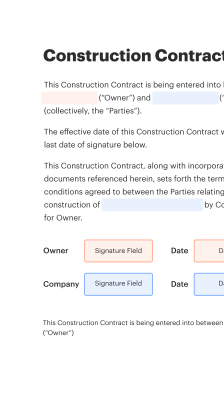
Create reusable draft signature letter templates with pre-defined fields, conditional logic, and role assignments to accelerate routine transactions and ensure consistent language across the organization.
| Feature | Configuration |
|---|---|
| Reminder Frequency | 48 hours |
| Signing Order Enforcement | Sequential |
| Template Approval Required | Yes |
| Default Expiration | 30 days |
| Retention Period | 7 years |
Draft signature letters should be accessible across modern desktop and mobile browsers as well as native apps to support signer convenience and accessibility.
Ensure browser versions are up to date, mobile apps have current security patches, and recipients are informed about supported file formats to avoid rendering issues and signing errors.
A human resources team prepares a draft signature letter containing the offer, compensation, and start date details to send to new hires.
Resulting in faster onboarding and a clear legal record for future reference.
A procurement group drafts a short amendment letter to update delivery terms and routes it to supplier signatories using a defined signing order.
Leading to accurate contract history and simplified supplier compliance tracking.
| Feature | signNow (Recommended) | DocuSign | Adobe Acrobat Sign |
|---|---|---|---|
| ESIGN/UETA Compliance | |||
| Bulk Send Support | |||
| API Access | |||
| HIPAA-ready configuration | Optional | Optional | Optional |
Seven years typical
Follow IRS rules
State-specific durations apply
Suspend disposition immediately
Respond per policy
| Plan | signNow (Featured) | DocuSign | Adobe Acrobat Sign | Dropbox Sign | PandaDoc |
|---|---|---|---|---|---|
| Monthly Starting Price | $8/user/mo billed annually | $10/user/mo personal | $9.99/user/mo individual | $15/user/mo | $19/user/mo |
| Annual Business Tier | $8–$15/user/mo | $25/user/mo | $14.99/user/mo | $12–$20/user/mo | $19–$29/user/mo |
| API Included | Available on API plan | Available via plan | Available via plan | Available via plan | Available via plan |
| HIPAA Compliance Option | Business plans offer BAA | Enterprise BAA | Enterprise BAA | Available on request | Available on request |
| Bulk Send Capacity | High-volume available | High-volume available | Enterprise bulk tools | Bulk via higher tiers | Bulk via higher tiers |
Create, execute, and manage workflows of any complexity, electronically from virtually anywhere. Scalable eSignature capabilities allow you to share documents with the right people in the correct order and define roles for each recipient. Execute document workflows faster and easier than ever before.
Optimize complex signing processes with airSlate SignNow’s powerful features to enhance your business. Control your automated eSignature workflows to ensure they're running at peak performance with instant notifications and reminders.
Bring teams together in a secure, shared environment. Manage documents, use form templates and notifications to create more efficient cross-organization collaboration. Free your employees from having to spend time on repetitive activities so that they can focus on valuable, business-critical tasks.
Run your projects with industry-leading integration. Collect Salesforce, Microsoft Teams, and SharePoint all in one business flow. Connect your software to a single system for endless possibilities and more productivity.
Feel safe knowing that your information remains secure by the latest in encryption security. airSlate SignNow is GDPR and eIDAS compliant and gives you transparence into your eSigning procedure with court-admissible audit trails. Configure user access permissions and roles to control who has access to what.