Dual Signatory Solutions with SignNow

Get rid of paper and improve document processing for increased efficiency and endless opportunities. Explore the best strategy for running your business with airSlate SignNow.

Award-winning eSignature solution

What dual signatory means for electronic documents

Dual signatory describes a signature workflow that requires two distinct authorized parties to sign the same document, either sequentially or concurrently. In practice this is used to enforce internal approval checks, combine sign-off responsibilities across departments, or ensure an independent witness or guarantor signs alongside the primary party. Implemented correctly, a dual signatory process records each signer’s identity, timestamp, and intent while maintaining a complete audit trail and preserving legal enforceability under U.S. electronic signature laws such as ESIGN and UETA.

Why organizations use dual signatory workflows

Dual signatory reduces single-point approval risk and strengthens internal controls by requiring two independent approvals for sensitive agreements or compliance-critical documents.

Why organizations use dual signatory workflows

Common challenges when implementing dual signatory

  • Coordinating signers across different locations can create delays when required signatures must be captured in sequence.
  • Ambiguity about signer order or role can cause returned documents and require manual rework or clarification.
  • Maintaining consistent audit records and proof of identity for both signers requires configured authentication methods.
  • Integrating dual signatory flows with legacy systems or CRMs may need API work and testing to avoid data mismatches.

Representative user roles for dual signatory setups

Contract Manager

A contract manager configures dual signatory templates, assigns signer roles, and monitors completion status. They ensure the workflow enforces the required signer order and that audit logs capture identity verification and timestamps for both signers.

HR Director

An HR director uses dual signatory on employment and benefits documents so an HR representative and an executive both sign. They rely on templates and reminders to reduce turnaround time while preserving compliance documentation.

Typical teams and scenarios that rely on dual signatory

Legal, finance, procurement, and HR teams frequently adopt dual signatory controls for higher‑risk documents and internal approvals.

  • Legal teams verifying contract language and counterparty acceptance prior to execution.
  • Finance departments requiring approvals for high-value invoices or payment authorizations.
  • HR groups using two signatures for offer letters or employment contract authorizations.

Small businesses and enterprise organizations both use dual signatory patterns where policies or regulations mandate two authorized approvals before execution.

Core features that support dual signatory workflows

Effective dual signatory workflows rely on a combination of template controls, authentication, auditability, and integration points to maintain security and operational efficiency.

Template Controls

Reusable templates let administrators predefine signer roles, required fields, and the signer order to enforce consistent dual signatory behavior across documents and teams.


Authentication Options

Multiple verification methods—email, SMS OTP, phone, or SSO—allow organizations to match identity assurance levels to the legal or internal requirements for each signer.

Conditional Fields

Conditional logic displays fields only after prior signatures or approvals, reducing signer confusion and ensuring the correct signer completes assigned obligations.

Sequential and Parallel

Configurable execution modes let you require one signer before another or allow concurrent signing when both approvals can proceed simultaneously.

Audit Trail

Detailed, tamper-evident logs record each signer’s email, IP address, timestamps, and authentication method to support legal admissibility and internal audits.

API Integration

APIs enable embedding dual signatory flows into existing CRMs and business systems to automate initiation, routing, and status tracking without manual steps.

be ready to get more

Choose a better solution

Integrations and template features that aid dual signatory workflows

Integration with document editors, storage, and business systems streamlines dual signatory processes and reduces manual file handling.

Google Workspace

Integration with Google Docs enables sending documents directly from the editor, applying dual signatory templates, and capturing signatures without separate file downloads or uploads.

CRM Connections

CRM integrations allow populating signer fields and contact data automatically, triggering dual signatory flows from opportunity or account records and updating status back to the CRM.

Cloud Storage

Dropbox and Google Drive integrations store executed documents in the appropriate folders and sync signatory metadata for retention policies and easy retrieval.

API Webhooks

Webhooks notify business systems when each signature step completes, enabling automated downstream tasks like contract activation, billing, or provisioning.
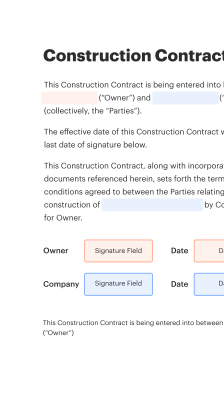
How a dual signatory flow operates at a glance

This short sequence explains how a document moves between signers and how the system enforces dual signatory requirements.

  • Initiate: Sender configures document and assigns two signer roles.
  • First signer: Signer one receives request and authenticates.
  • Second signer: After first signs, signer two is notified to complete signing.
  • Finalization: System seals document and records both signatures with an audit trail.
Collect signatures
24x
faster
Reduce costs by
$30
per document
Save up to
40h
per employee / month

Step-by-step: Setting up a dual signatory document

Follow these steps to configure a dual signatory workflow so two required parties can sign in the order and manner your policy requires.

  • 01
    Upload document: Start by uploading the source PDF or Word file.
  • 02
    Define signers: Add two signer roles and assign contact details.
  • 03
    Set signing order: Choose sequential or parallel execution per policy.
  • 04
    Add fields: Place signature, date, and conditional fields for each signer.

Managing completed dual signatory documents and audit trails

After both signatures are captured, follow these steps to store, verify, and audit completed documents for compliance and recordkeeping.

01

Verify signatures:

Confirm both signer identities and authentication events.
02

Export PDF:

Generate final signed PDF with embedded audit trail.
03

Store securely:

Save to encrypted cloud storage with limited access.
04

Record metadata:

Log signer emails, IPs, and timestamps centrally.
05

Retention policy:

Apply legal retention schedules consistently.
06

Audit review:

Periodically review logs for anomalies.
be ready to get more

Why choose airSlate SignNow

  • Free 7-day trial. Choose the plan you need and try it risk-free.
  • Honest pricing for full-featured plans. airSlate SignNow offers subscription plans with no overages or hidden fees at renewal.
  • Enterprise-grade security. airSlate SignNow helps you comply with global security standards.
illustrations signature

Configuration settings for a standard dual signatory workflow

These settings represent a typical configuration to enable two required signers, enforce authentication, and maintain audit logging.

Setting Name Configuration
Signer Order Sequential
Dual Signatory Mode Two required signers
Authentication Level Email + SMS OTP
Reminder Frequency 48 hours
Audit Retention 7 years

Supported platforms and system requirements for dual signatory

Dual signatory workflows are supported across web, mobile, and API platforms; ensure endpoint compatibility before deployment.

  • Web browsers: Modern browsers supported
  • Mobile apps: iOS and Android apps
  • API access: RESTful API available

Confirm browser versions, mobile OS support, and API authentication methods during planning to avoid integration delays and ensure consistent signer experience across devices.

Security controls relevant to dual signatory transactions

Encryption at rest: AES-256 encryption for stored documents
Encryption in transit: TLS 1.2+ protects data transfer
Authentication methods: Email, SMS OTP, and SSO options
Access controls: Role-based access and permissions
Audit logging: Full event and signature logs
Document integrity: Tamper-evident PDF signing

Real-world examples of dual signatory in practice

Use cases below show how dual signatory workflows solve approval and compliance needs across industries.

Financial Services Approval

A bank requires internal credit officer approval before a loan officer sends terms

  • Two-step sign-off on loan documents
  • Ensures regulatory checks and supervisor review

Resulting in improved compliance evidence and reduced unauthorized lending

Healthcare Consent Forms

A clinic needs both provider and guardian signatures for certain procedures

  • Concurrent signing simplifies patient visits
  • Provides clear documentation of consent and witness or guardian agreement

Leading to stronger defensibility and accurate patient records

Practical best practices for secure dual signatory processes

Follow these practices to reduce risk and improve the reliability of dual signatory workflows across teams and systems.

Define clear signer roles and order
Document the business rule that requires two signatures, specify whether the flow is sequential or parallel, and assign signer responsibilities to avoid confusion and rework during execution.
Use appropriate authentication levels per document
Match authentication methods—such as SMS OTP for routine approvals or stronger methods for high-risk agreements—to the legal and internal risk profile of the document.
Standardize templates and version control
Maintain approved templates for common dual signatory agreements, control template edits centrally, and track versions to ensure every executed document uses the correct language and fields.
Retain full audit evidence and backups
Configure automatic retention of signed PDFs, audit logs, and metadata in secure storage with backup and access controls to support compliance reviews and legal defensibility.

FAQs and troubleshooting for dual signatory processes

Common questions and resolutions for issues with dual signatory workflows, signer acceptance, and auditability.

Feature comparison for dual signatory support

A concise comparison of how common eSignature platforms support dual signatory workflows and related capabilities.

Criteria signNow (Recommended) DocuSign Adobe Sign
Dual signatory support
Sequential signing
Parallel signing
Advanced authentication SMS OTP Phone OTP Phone OTP
be ready to get more

Get legally-binding signatures now!

Risks and compliance consequences to consider

Invalid authorization: Enforcement challenges
Data breaches: Regulatory fines possible
Noncompliance: Contract disputes risk
Process delays: Operational bottlenecks
Insufficient logs: Evidentiary gaps
Misconfigured roles: Incorrect signer binding

Simplify complex workflows

Create, perform, and control workflows of any intricacy, electronically from virtually anywhere. Scalable eSignature functionality let you exchange papers with the right users the correct sequence and define roles for every recipient. Perform document workflows faster and simpler than ever before.

Automate document flow

Improve complicated signing procedures with airSlate SignNow�s powerful tools to enhance your operation. Control your automatic signature workflows to ensure they're operating at maximum functionality with instant notices and alerts.

Optimize in team collaboration

Bring teams together in a safe, shared workspace. Handle paperwork, use form templates and notices to deliver better cross-company collaboration. Relieve your staff from having to hang out on repeating activities so that they can concentrate on beneficial, business-crucial duties.

Integrate into your current systems

Manage your tasks with market-leading integration. Collect Salesforce, Microsoft Teams, and SharePoint in one business thread. Connect your applications to a single system for countless possibilities and higher efficiency.

Stay compliant with industry-leading data protection

Feel safe knowing that your data remains secure by the newest in encryption security. airSlate SignNow is GDPR and eIDAS compliant and gives you transparence into your eSigning procedure with court-admissible audit trails. Configure user authorization and rights to regulate who has access to what.


walmart logo
exonMobil logo
apple logo
comcast logo
facebook logo
FedEx logo
be ready to get more

Get legally-binding signatures now!