Editable Medical Bill Template PDF for Facilities

Effortlessly customize and eSign your medical billing documents. Unlock a cost-effective, user-friendly solution to streamline your facility's financial processes.

Award-winning eSignature solution

What an editable medical bill template PDF for facilities is

An editable medical bill template PDF for facilities is a standardized, fillable document designed for hospital billing departments, clinic administrative teams, and third-party billing services to record charges, patient responsibility, insurance adjustments, and payment terms. These templates keep line items, CPT/HCPCS codes, dates of service, modifiers, and facility-specific fees in a consistent layout that can be reused across patients and encounters. In a digital workflow the template can include form fields, calculated totals, and signature placeholders to support review, approval, and secure electronic signing under U.S. electronic signature laws and healthcare privacy requirements.

Why facilities adopt editable medical bill template PDFs

Using an editable PDF template reduces manual entry errors, standardizes billing line items across departments, and supports faster claim submission and patient invoicing while aligning with U.S. electronic signature and records frameworks.

Why facilities adopt editable medical bill template PDFs

Common billing and template challenges facilities face

  • Inconsistent field labeling across departments leads to mismatched line items and delays in reconciliation and claims processing.
  • Manual recalculation of adjustments and totals increases transcription errors and slows billing cycle times for accounts receivable.
  • Maintaining HIPAA-compliant access controls for PDFs shared with external billers and patients can be administratively complex.
  • Ensuring signed PDFs meet ESIGN and UETA documentation standards while preserving audit trails is often overlooked.

Representative user profiles for facilities

Billing Manager

Responsible for overall billing operations, this user configures templates, monitors submission workflows, and reviews exceptions. They coordinate with clinical teams to ensure coding accuracy and with finance for aging and reconciliation activities.

Facilities Administrator

Manages facility-level templates and permissions, enforces retention policies for billing records, and ensures that PDFs distributed to patients or payers meet internal compliance and storage requirements.

Who typically uses editable medical bill templates

Facilities rely on a mix of clinical billing staff, revenue cycle teams, and administrative personnel to prepare and process medical bills.

  • Revenue cycle managers overseeing claim accuracy and denial prevention across facilities.
  • Clinic billing specialists preparing patient statements and insurance submissions.
  • Third-party billing services handling batch invoicing for multiple facilities.

Templates improve consistency across roles, reduce rework, and create a single source of truth for billing data.

Essential features for effective editable bill templates

Facilities should evaluate template functionality that directly reduces billing friction and supports compliance across departments.

Fillable fields

Support typed input, dropdowns for standardized codes, and checkboxes for modifiers to ensure consistent data capture across billers and sites.


Calculated totals

Automatic arithmetic for line item totals, tax, adjustments, and patient balances to eliminate manual math errors and speed previews.

Conditional logic

Show or hide fields based on service type or payer requirements to simplify form completion and reduce irrelevant data entry.

Signature blocks

Include designated signature and date fields for provider attestation, patient acknowledgment, and administrative approvals under electronic signature standards.

Template versioning

Track template revisions and enforce version control to ensure teams use the latest billing formats and rate schedules.

Export options

Export completed bills as secured PDFs, machine-readable records, or structured data for submission to billing systems or payers.

be ready to get more

Choose a better solution

Integrations and document features that matter

Key integrations and document capabilities improve accuracy, reduce duplication, and connect billing templates with core systems.

EMR connectivity

Direct integration with electronic medical record systems lets billing templates pull demographic, encounter, and coding data automatically to reduce manual entry and ensure consistent mapping between clinical documentation and billing line items.

Cloud storage

Secure cloud repositories enable centralized retention, versioning, and controlled access to signed PDFs, simplifying audit responses and supporting data retention policies across facilities.

Document calculation

Built-in field calculations and conditional logic compute totals, apply adjustments, and present payment responsibility dynamically, reducing manual recalculation errors in the billing workflow.

Secure sharing

Granular sharing controls and link expirations allow templates and signed bills to be distributed to patients or payers while limiting access and preserving confidentiality.
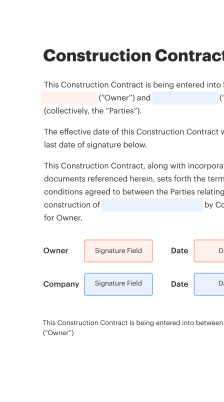
How creating and using an editable PDF works in practice

This sequence shows document preparation through signing and archival for a typical facility billing event.

  • Create template: Author a PDF with editable fields for repeated use.
  • Populate data: Complete patient and service details as needed.
  • Secure and sign: Apply authentication and capture signatures electronically.
  • Store record: Archive signed PDFs in a secure retention system.
Collect signatures
24x
faster
Reduce costs by
$30
per document
Save up to
40h
per employee / month

Step-by-step: preparing an editable medical bill template PDF

Follow these core steps to build a reusable, compliant medical bill template that supports electronic completion and signature.

  • 01
    Gather fields: List required patient, service, and charge fields.
  • 02
    Design layout: Organize line items, totals, and payment terms clearly.
  • 03
    Add form fields: Insert fillable fields for codes, quantities, and dates.
  • 04
    Validate: Test calculations and signature placement before use.
be ready to get more

Why choose airSlate SignNow

  • Free 7-day trial. Choose the plan you need and try it risk-free.
  • Honest pricing for full-featured plans. airSlate SignNow offers subscription plans with no overages or hidden fees at renewal.
  • Enterprise-grade security. airSlate SignNow helps you comply with global security standards.
illustrations signature

Typical workflow settings for template automation

Configure workflow parameters to automate reminders, approvals, and archival for completed medical bill PDFs.

Workflow Setting Name and Configuration Default Configuration
Approval routing rules Sequential approvals
Reminder Frequency 48 hours
Auto-archival window 90 days
Signature authentication type Email OTP
Retention policy 7 years

Supported devices and platform considerations

Editable medical bill templates should be accessible on standard desktop and modern mobile browsers for staff and patients.

  • Desktop browsers: Chrome, Edge, Safari
  • Mobile devices: iOS, Android supported
  • PDF readers: Modern PDF viewers

Ensure mobile responsiveness for patient-facing forms, validate field behavior in common browsers, and verify signature capture works consistently across devices before deployment.

Security controls commonly applied to medical bill templates

Data encryption: AES-256 at rest
Transport security: TLS 1.2+
Access controls: Role-based permissions
Authentication: Multi-factor enabled
Audit logging: Detailed event trails
Secure storage: Encrypted cloud vaults

Facility use cases for editable medical bill template PDFs

Real-world implementations show how templates streamline workflows across inpatient, outpatient, and consolidated billing operations.

Consolidated outpatient billing

A regional clinic standardized a single template across five sites to capture CPT codes and modifiers consistently

  • Pre-filled common facility fees
  • Reduced coding discrepancies by team members

Resulting in faster claim submission, fewer denials, and clearer patient statements that improved collections and reduced inquiries.

Hospital charge master alignment

A hospital network used editable PDFs to map charge master items to billing line items for charting

  • Automated calculated totals
  • Easier cross-checks against insurer remittance

Leading to consistent auditing records, streamlined AR workflows, and measurable time savings during monthly reconciliations.

Best practices for secure, accurate templates

Adopt these operational and technical practices to reduce errors, support compliance, and streamline billing cycles.

Standardize field naming conventions
Use consistent labels and controlled vocabularies for codes, modifiers, and fee types across templates so data mapping to EMR and billing systems is reliable and reduces reconciliation work.
Enforce role-based access
Limit who can edit templates versus who can complete them. Separate template administrators from bill preparers and require multifactor authentication for administrative roles to protect PHI.
Retain detailed audit trails
Store comprehensive event logs for template edits, field changes, and signature events to support compliance reviews, dispute resolution, and forensic analysis if needed.
Test across devices and viewers
Validate templates in common desktop and mobile PDF viewers and within integrations to confirm field behavior, calculations, and signature capture function consistently for all users.

FAQs: common issues when using editable medical bill template PDFs

Answers to frequently asked questions about template errors, signature validity, integrations, and compliance for facility billing teams.

Feature comparison: signNow versus leading eSignature providers

Compare core capabilities relevant to facilities using editable medical bill templates, focusing on compliance, bulk operations, API access, and audit features.

Feature and Vendor Availability Comparison Table signNow (Recommended) DocuSign Adobe Acrobat Sign
HIPAA compliance
Bulk Send capacity High High Medium
API access and SDKs Comprehensive Comprehensive Comprehensive
Detailed audit trail
be ready to get more

Get legally-binding signatures now!

Regulatory and operational risks to consider

HIPAA penalties: Civil and monetary fines
Data breach exposure: Notification obligations
Invalid signatures: Contract disputes
Record retention failures: Compliance audits
Billing errors: Claim denials
Unauthorized access: PHI disclosure

Pricing and plan snapshot for typical facility needs

Overview of entry-level pricing and included features for common facility use cases; actual prices vary by contract, user counts, and add-ons.

Product / Plan signNow (Recommended) DocuSign Business Adobe Acrobat Sign PandaDoc Business HelloSign Business
Entry-level monthly price $8 per user $25 per user $24.99 per user $19 per user $15 per user
HIPAA support availability Available with BAA Available with BAA Available with BAA Contact sales Available with BAA
API and automation Included via API Included via API Included via API Included via API Included via API
Bulk sending features Bulk Send included Bulk Send available Bulk Send available Bulk Send available Bulk Send available
Best fit for Cost-sensitive, integrated workflows Large enterprise integrations Enterprise document management Sales and proposal workflows Small to mid-size teams
walmart logo
exonMobil logo
apple logo
comcast logo
facebook logo
FedEx logo
be ready to get more

Get legally-binding signatures now!