Reusable templates
Save standardized treatment sheet templates with fixed and dynamic fields to ensure consistent collection of client consent, medical history items, and clinician notes across visits.



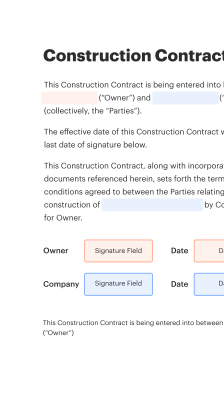
Adopting electronic signing reduces manual handling, improves client convenience, and creates a complete audit trail for every treatment sheet, while supporting secure, verifiable consent records that integrate with veterinary practice management systems.

The Clinic Manager configures templates, enforces retention policies, assigns user roles, and reviews audit logs to ensure treatment sheets meet clinical and legal standards. They coordinate with IT or vendors for integrations and oversee staff training on eSignature procedures to reduce operational risk.
Veterinarians place required fields on treatment sheets, confirm client understanding, and sign or co-sign documents as part of clinical workflow. They rely on clear templates and reliable electronic timestamps to document informed consent for procedures and medications.
Veterinary receptionists, practice managers, veterinarians, and technicians all interact with signed treatment sheets during intake and care.
Each role benefits differently: receptionists streamline check-in, clinicians get legible consents, and managers maintain retention and compliance oversight.
Save standardized treatment sheet templates with fixed and dynamic fields to ensure consistent collection of client consent, medical history items, and clinician notes across visits.
Grant specific permissions to receptionists, clinicians, and managers so only authorized users can create, send, edit, or delete templates and completed records.
Attach an immutable audit report to each completed sheet that records timestamps, IP addresses, signer emails, and field-level changes for evidentiary value.
Use conditional fields to display procedure-specific consent language, dosing calculators, or supplemental instructions only when applicable, simplifying signer experience.
Send multiple treatment sheets with individualized prefills in a single operation to support batch communications like wellness reminders or post-op consents.
Automate creation, sending, and retrieval of signed treatment sheets via API to integrate with appointment systems, billing, and electronic medical records.
Two-way integration with practice management systems syncs client and patient records, attaches completed treatment sheets to appointments, and reduces duplicate entry across scheduling, clinical notes, and billing workflows for consistent records.
Automatic archival to secure cloud repositories with configurable retention helps clinics meet internal and regulatory recordkeeping requirements while preserving tamper-evident versions for audits.
Conditional fields and required checks ensure clinicians collect necessary consent information only when relevant, reducing signer confusion and preventing incomplete treatment authorizations.
Responsive signing on phones and tablets supports in-clinic and remote signatures, with the same audit trail and security controls as desktop transactions.
| Setting Name | Configuration |
|---|---|
| Reminder Frequency | 48 hours |
| Signature Authentication | Email code |
| Retention Period | 7 years |
| Audit Log Detail | Full certificate |
| Storage Location | Secure cloud |
Electronic signing works across modern desktops, tablets, and mobile browsers; ensure your environment meets minimum software versions.
Keep browsers and apps updated, enable TLS support, and verify tablet touch input for in-clinic signing to minimize compatibility issues and ensure a consistent signer experience across devices.
A busy community clinic standardized a single treatment sheet template covering intake, consent, and follow-up instructions to reduce errors and speed check-ins by staff.
Resulting in faster throughput, fewer missing fields, and clearer audit logs for each visit that simplified record reconciliation and billing.
An emergency hospital network integrated electronic treatment sheets into its triage process to ensure timely consent during urgent care and to centralize records across sites.
Leading to improved coordination during transfers, consistent retention of consent records, and clearer documentation for aftercare instructions and legal review.
| Feature or Compliance Criteria for Vendors | signNow (Recommended) | DocuSign | Adobe Acrobat Sign |
|---|---|---|---|
| HIPAA Support | Yes (BAA) | Yes (BAA) | Yes (BAA) |
| Mobile Signing | |||
| Bulk Send | |||
| API Access |
| Plan and Vendor Pricing Overview | signNow (Recommended) | DocuSign | Adobe Acrobat Sign | HelloSign | PandaDoc |
|---|---|---|---|---|---|
| Free tier availability | Free trial available | Free trial only | Free trial only | Free tier limited | Free eSign plan |
| Entry-level price (monthly) | Starts at $8/user/mo | Starts at $10/user/mo | Starts at $9.99/user/mo | Starts at $15/user/mo | Starts at $19/user/mo |
| HIPAA support | Available (BAA) | Available (BAA) | Available (BAA) | Available (Enterprise) | Available (Enterprise) |
| Bulk Send capability | Included | Add-on or higher plan | Included | Included | Included |
| API access | Included | Included | Included | Included | Included |
Create, perform, and control workflows of any intricacy, digitally from almost anywhere. Scalable eSignature functionality let you share papers with the right people in the right way and determine roles for each recipient. Complete document workflows faster and easier than ever before.
Enhance sophisticated signing tasks with airSlate SignNow�s powerful tools to enhance your operation. Take control of your automatic signature workflows to make sure they're operating at peak performance with instant notices and alerts.
Bring teammates together in a safe, shared workspace. Handle documents, use form templates and notifications to produce more effective cross-organization communication. Relieve your employees from having to hang out on repeated activities to enable them to concentrate on beneficial, business-crucial tasks.
Manage your jobs with best-in-class integration. Assemble Salesforce, Microsoft Teams, and SharePoint all in one business flow. Link your applications to a single environment for countless possibilities and more productivity.
Feel confident knowing that your information remains secure by the latest in encryption security. airSlate SignNow is GDPR and eIDAS compliant and offers you awareness into your eSigning procedure with court-admissible audit trails. Set up user authorization and roles to manage who has access to what.