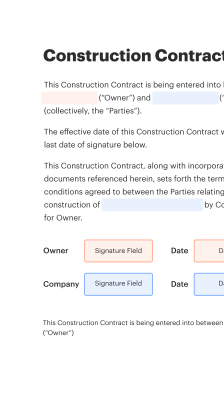
Email Signature Hold Harmless Indemnity Agreement

Eliminate paper and improve digital document processing for more efficiency and unlimited opportunities. Experience a greater strategy for running your business with airSlate SignNow.

Award-winning eSignature solution

What an email signature hold harmless indemnity agreement is and why it matters

An email signature hold harmless indemnity agreement is a contract clause or standalone document in which one party agrees to indemnify and hold another harmless for specified liabilities, often related to email communications, data disclosures, or third-party claims. When executed electronically, these agreements require a reliable signature method, clear signer intent, and preserved audit information to be admissible. In the United States, enforceability depends on compliance with ESIGN and UETA, plus sector rules such as HIPAA or FERPA where personal data or educational records are involved.

Why precise handling of these indemnity agreements is important

Using a controlled electronic workflow reduces execution errors, preserves audit trails, and supports enforceability under ESIGN and UETA while helping organizations manage contractual risk linked to email communications.

Why precise handling of these indemnity agreements is important

Common challenges when digitizing hold harmless indemnity agreements

  • Unclear signer intent when signatures are attached to email bodies rather than the indemnity clause leads to dispute risk.
  • Incomplete audit records make it difficult to demonstrate compliance with ESIGN or UETA in court or regulatory reviews.
  • Poorly formatted clauses or inconsistent document versions increase the likelihood of ambiguity and contractual disputes.
  • Insufficient authentication for sensitive agreements raises regulatory concerns for HIPAA-regulated data or education records under FERPA.

Representative user profiles for executing indemnity agreements

Risk Manager

A Risk Manager reviews indemnity language, assesses residual exposure, and ensures controls are in place. They require clear audit trails and authentication logs to substantiate risk assessments and incident responses across vendor and partner relationships.

Contracts Counsel

Contracts Counsel negotiates hold harmless terms, documents agreed language, and oversees version control. They rely on consistent signature evidence and secure storage to support enforceability and to respond to litigation or regulatory inquiries.

Teams and roles that rely on digital indemnity agreement workflows

Legal, compliance, and operations teams commonly manage hold harmless indemnity agreements and require consistent signing records before clearance.

  • Legal departments handling liability allocation in vendor and partner contracts.
  • Compliance teams ensuring records meet sector-specific rules and retention policies.
  • Operations and procurement teams streamlining vendor onboarding and contract acceptance.

Centralized electronic workflows help these groups reduce manual steps and maintain consistent documentation across departments.

Additional capabilities that improve indemnity agreement workflows

These features enhance efficiency, legal defensibility, and integration with broader document and contract management systems.

Templates

Predefined, version-controlled templates reduce drafting variance and ensure every signer receives the same indemnity language, supporting uniform acceptance and easier auditing across multiple transactions.

API Integration

API access enables embedding signing flows into existing contract management and procurement systems, automating population of indemnity clauses and capturing signing metadata programmatically.

Role Assignment

Role-based signing and approval sequences ensure the correct legal and operational stakeholders review and approve indemnity language before execution, reducing the chance of unauthorized acceptance.

Notifications

Automated reminders and status notifications help keep multi-party indemnity agreements on schedule and provide an audit trail of outreach attempts and recipient interactions.

Redaction Tools

Redaction capabilities let organizations limit exposure of unrelated sensitive information when sharing indemnity agreements or producing documents for legal review.

Exportable Evidence

Exportable audit packages bundle the signed document, signer metadata, and event logs into an evidentiary file suitable for compliance reviews or legal proceedings.

be ready to get more

Choose a better solution

Core platform capabilities to support indemnity agreement signing

Choose features that preserve legal defensibility, support authentication needs, and streamline execution and storage of signed indemnity agreements.

Template Library

Centralized templates standardize hold harmless clauses, reduce drafting errors, and maintain consistent clause placement so signers clearly acknowledge the indemnity language before signing.

Authentication Options

Multi-factor authentication, phone verification, and access codes let organizations select verification strength proportional to the agreement's legal risk and regulatory requirements.

Audit Logs

Comprehensive event histories record timestamps, IP addresses, and actions taken by each signer, providing the evidence needed to demonstrate compliance under ESIGN and UETA.

Secure Storage

Encrypted repositories and configurable retention policies ensure signed indemnity agreements are preserved according to organizational, legal, and regulatory requirements.

How electronic signing works for these indemnity agreements

Electronic signing replaces physical signature execution with validated digital actions, preserving intent, identity verification, and a clear audit trail for the agreement.

  • Prepare Document: Upload contract and designate signature fields.
  • Verify Identity: Select authentication level appropriate to risk.
  • Sign Electronically: Signer applies an electronic signature or acceptance.
  • Store Securely: Archive signed file with metadata and logs.
Collect signatures
24x
faster
Reduce costs by
$30
per document
Save up to
40h
per employee / month

Step-by-step: preparing an email signature hold harmless indemnity agreement

Follow these concise steps to prepare and collect enforceable electronic signatures for hold harmless indemnity agreements while preserving intent and auditability.

  • 01
    Draft Clause: Clearly define indemnified liabilities and scope.
  • 02
    Attach Document: Include the clause as a signed document attachment.
  • 03
    Authenticate Signer: Use appropriate identity verification methods.
  • 04
    Record Audit: Preserve timestamps and IP logs for evidence.
be ready to get more

Why choose airSlate SignNow

  • Free 7-day trial. Choose the plan you need and try it risk-free.
  • Honest pricing for full-featured plans. airSlate SignNow offers subscription plans with no overages or hidden fees at renewal.
  • Enterprise-grade security. airSlate SignNow helps you comply with global security standards.
illustrations signature

Typical workflow settings for signing hold harmless indemnity agreements

Standardize workflow settings to enforce consistent execution, reminders, and storage when circulating indemnity agreements by email or direct link.

Feature Configuration
Reminder Frequency 48 hours
Signature Order Sequential
Authentication Level MFA required
Retention Period 7 years
Final Storage Location Encrypted cloud

Platform and device requirements for reliable signing

Ensure devices and platforms meet minimum technical and security specifications before sending or receiving electronic indemnity agreements.

  • Browser Support: Modern Chromium or Safari
  • Mobile OS: iOS 13+ or Android 9+
  • Storage Requirement: Secure cloud backup

Confirming these requirements helps maintain signature validity and reduces signer friction while ensuring audit data is captured consistently across desktop and mobile environments.

Security and verification controls for signed indemnity agreements

Audit Trails: Detailed event logs
Encryption: At-rest and in-transit
Authentication: Multi-factor options
Access Controls: Role-based permissions
Document Integrity: Tamper-evident seals
Data Residency: Regional storage options

Industry examples of email signature indemnity agreements in practice

Representative case scenarios show how organizations incorporate hold harmless language into email-based workflows while maintaining compliance and traceability.

Healthcare Vendor Onboarding

A hospital requires vendors to accept a hold harmless clause during email-based credentialing

  • Clause embedded in onboarding packet
  • Protects provider from vendor-caused PHI incidents

Resulting in clearer vendor accountability and traceable acceptance records for audits

Education Research Collaboration

A university uses email-signed indemnity agreements for joint research access to student records

  • Lightweight email workflow with document attachment
  • Limits institutional liability for partner disclosures

Leading to documented consent and administrative record retention for FERPA compliance

Best practices for enforceable email-signed indemnity agreements

Apply consistent practices that emphasize clarity, authentication, and retention to reduce disputes and strengthen enforceability.

Draft concise indemnity language with clear scope
Use plain-language clauses that precisely describe the risks being indemnified, include timeframes and exclusions, and avoid ambiguous definitions that could undermine enforceability.
Match authentication level to document sensitivity
For high-risk indemnities, require multi-factor authentication or verified identity checks; for low-risk agreements, a lower friction method may be appropriate while still recording intent.
Preserve a tamper-evident audit trail
Ensure the signing platform records signer identity, timestamps, IP addresses, and version history so you can demonstrate the sequence of events and any changes made before signing.
Align retention policies with legal obligations
Define retention periods based on regulatory requirements, industry standards, and corporate policy, and ensure archived agreements remain accessible and protected for the required duration.

FAQs About email signature hold harmless indemnity agreement

Answers to common questions about drafting, signing, and preserving electronic hold harmless and indemnity agreements, focused on U.S. legal and technical considerations.

Feature comparison: signNow and other major eSignature providers

Quick comparison of key capabilities relevant to executing email signature hold harmless indemnity agreements across common providers.

Criteria signNow (Recommended) DocuSign Adobe Sign
ESIGN / UETA Compliance
Advanced Authentication Options MFA, SMS MFA, IDV MFA, IDV
Bulk Send Capability Limited
Detailed Audit Logs Comprehensive Comprehensive Comprehensive
be ready to get more

Get legally-binding signatures now!

Legal and operational risks to monitor

Contract Ambiguity: Disputes possible
Insufficient Consent: Invalidation risk
Unauthorized Access: Data breach exposure
Retention Failures: Regulatory noncompliance
Authentication Gaps: Signature challenge
Poor Version Control: Incorrect obligations

Pricing and plan comparison for common eSignature providers

Representative pricing and plan features for organizations considering electronic execution of indemnity agreements; vendor-first column lists signNow as Recommended.

Plan / Vendor signNow (Recommended) DocuSign Adobe Sign HelloSign PandaDoc
Entry-Level Monthly Price $8 per user $10 per user $14 per user $15 per user $19 per user
Advanced Authentication Availability MFA, SMS, SSO MFA, IDV, SSO MFA, IDV, SSO MFA, SMS MFA, SMS, SSO
Team / Admin Controls Role-based controls Admin dashboards Enterprise roles Team management Team roles
Document Retention Options Custom retention policies Retention presets Cloud retention Basic retention Retention settings
API Access Included Available on plans Available Available Paid add-on Available

Simplify complex workflows

Prepare, deliver, and maintain workflows of any intricacy, digitally from near any place. Scalable electronic signature capabilities let you exchange contracts with the right users the right order and assign roles for each receiver. Stream document workflows faster and easier than ever before.

Automate document management

Enhance intricate signing procedures with airSlate SignNow�s highly effective functions to improve your operation. Take control of your automatic signature workflows to ensure they're running at top performance with immediate notifications and alerts.

Optimize in team collaboration

Join teams together in a safe, shared environment. Manage documents, use form templates and notifications to produce more effective cross-organization communication. Free your workers from having to spend time on recurring actions so that they can give attention to valuable, business-critical tasks.

Integrate into your current framework

Manage your tasks with best-in-class integration. Collect Salesforce, Microsoft Teams, and SharePoint all in one business thread. Hook up your applications to a single unit for unlimited possibilities and more productiveness.

Stay compliant with industry-leading data protection

Feel safe knowing that your information remains secure by the most recent in encryption security. airSlate SignNow is GDPR and eIDAS compliant and gives you visibility into your signing procedure with court-admissible audit trails. Configure user authorization and rights to manage who has access to what.


walmart logo
exonMobil logo
apple logo
comcast logo
facebook logo
FedEx logo
be ready to get more

Get legally-binding signatures now!