Enterprise Contract Management Software for Insurance Industry

Experience seamless document eSigning and management with airSlate SignNow. Empower your business with a cost-effective solution designed for efficiency and ease of use.

Award-winning eSignature solution

What enterprise contract management software for insurance industry does

Enterprise contract management software for insurance industry centralizes creation, execution, storage, and lifecycle tracking of policies, endorsements, vendor agreements, and claims-related documents. It coordinates approvals, enforces standard clauses, automates renewals and notifications, and records signature events. In insurance operations this reduces manual handoffs, shortens underwriting cycles, and provides a single source of truth for audit and compliance teams while preserving role-based access and detailed transaction histories for regulatory review.

Legal validity and U.S. compliance considerations

Electronic signatures and contract records used by insurers must meet ESIGN and UETA requirements; records should also support HIPAA protections when protected health information is present. Choose systems that produce tamper-evident audit trails and provide options for identity authentication and long-term retention aligned with regulatory schedules.

Legal validity and U.S. compliance considerations

Typical user roles and how they use the system

Policy Manager

Policy managers use contract management tools to assemble standard policy forms, apply approved clause libraries, route documents for multi-level underwriting approvals, and monitor renewal and compliance deadlines. They rely on templates, role-based workflows, and audit reports to reduce manual errors and maintain regulator-ready records.

Claims Adjuster

Claims adjusters use the platform to collect signed authorizations, upload evidence, and obtain quick endorsements from external providers. Streamlined signing, mobile access, and integrated document search speed claims processing while preserving chain-of-custody and signature audit trails for dispute resolution.

Primary features to evaluate in insurance-focused contract platforms

Evaluate features that reduce manual work, ensure compliance, and tightly integrate with insurance systems.

eSignature

Legally binding electronic signature capture with configurable authentication methods and tamper-evident sealing to support ESIGN and UETA requirements across policy and claims documents.


Template library

Centralized templates with conditional logic and dynamic fields to assemble policy, endorsement, and vendor agreements while enforcing approved clause language.

Workflow automation

Automated routing, reminders, escalations, and parallel approvals to cut processing time for endorsements, renewals, and claim authorizations.

API and integrations

REST APIs and prebuilt connectors enable data exchange with policy administration systems, CRM platforms, and document repositories to maintain data consistency.

Reporting and analytics

Dashboards and exportable reports for signature velocity, pending approvals, and compliance checks to inform operational decision-making.

Security & compliance

Features such as MFA, encryption, audit logs, and configurable retention policies to meet internal and regulatory requirements.

be ready to get more

Choose a better solution

Integration and template capabilities relevant to insurers

Key integration points and template features reduce repetitive work and ensure data consistency across underwriting and claims systems.

CRM integration

Connects with major CRMs to auto-populate policyholder and broker data, reducing manual re-entry and ensuring contracts reflect accurate client and risk information across the underwriting lifecycle.

Document templates

Central template libraries let compliance teams maintain approved language, required fields, and conditional sections to standardize policy forms and ensure endorsements always include regulatory clauses.

Cloud storage sync

Bi-directional synchronization with cloud repositories keeps signed documents available in existing content stores while retaining signature metadata and audit logs for retrieval.

Reporting exports

Pre-built and custom reports export signature activity, pending approvals, and retention metrics to support internal audits and regulatory submissions.
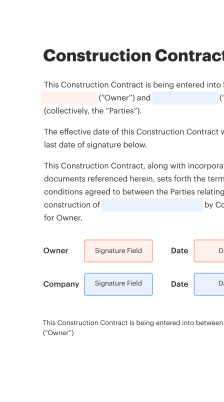
How online signature and contract workflows operate

Understanding end-to-end flow clarifies responsibilities and system touchpoints for internal and external stakeholders.

  • Document creation: Draft from template or upload PDF
  • Field placement: Add signature, date, and data fields
  • Recipient routing: Set signing order and notifications
  • Completion: Capture signatures and archive records
Collect signatures
24x
faster
Reduce costs by
$30
per document
Save up to
40h
per employee / month

Quick setup steps for enterprise contract management software for insurance industry

A concise onboarding checklist helps insurance teams configure templates, permissions, and initial workflows before broad rollout.

  • 01
    Provision accounts: Create enterprise users and assign roles
  • 02
    Import templates: Load standard policy and endorsement forms
  • 03
    Set workflows: Define approval chains and signature order
  • 04
    Enable security: Activate MFA and encryption settings

How to manage audit trails for signed insurance transactions

Consistent audit trail practices help prove authenticity and sequence of events for signed contracts.

01

Enable logging:

Activate full event capture
02

Record metadata:

Capture IP, timestamp, and method
03

Store immutably:

Archive in read-only format
04

Link records:

Attach audit to document record
05

Export for review:

Provide PDF and CSV exports
06

Retain per policy:

Apply retention rules automatically
be ready to get more

Why choose airSlate SignNow

  • Free 7-day trial. Choose the plan you need and try it risk-free.
  • Honest pricing for full-featured plans. airSlate SignNow offers subscription plans with no overages or hidden fees at renewal.
  • Enterprise-grade security. airSlate SignNow helps you comply with global security standards.
illustrations signature

Typical workflow settings for insurance document automation

Set clear defaults for reminders, expirations, and routing to reduce missed signatures and manual follow-up.

Feature Value
Reminder Frequency 48 hours
Signature Order Sequential
Expiry Notifications 7 days
Auto-Archive On completion
Signer Authentication Email+SMS

Supported platforms and device considerations

Most enterprise contract management systems provide browser-based access with dedicated mobile apps, ensuring users can send and sign documents from desktops, tablets, and smartphones.

  • Desktop: Modern browsers supported
  • Tablet: iOS and Android apps
  • Mobile: Native mobile signing available

For enterprise deployments evaluate browser compatibility, SSO integration options, and mobile OS support to ensure field agents and remote underwriters can access secure signing and receive push notifications without breaking corporate security policies.

Security controls commonly required for insurance contracts

Encryption: AES-256 for data at rest and in transit
Access Control: Role-based permissions with MFA enforced
Audit Logs: Immutable event logs for signature events
Secure Storage: Redundant cloud storage with backups
Tokenization: Tokenized identifiers in document exports
Network Security: TLS 1.2+ for all web connections

Insurance-specific use cases for contract management

Real-world workflows in underwriting, claims, and vendor management show where contract software delivers operational value and compliance control.

Underwriting packet assembly

Underwriters assemble standardized policy and endorsement packets quickly to reduce cycle time and maintain consistency across regions

  • Pre-built templates enforce required clauses and data validation
  • Reduced review rework lowers issuance delays and improves accuracy

Resulting in faster policy issuance and clearer audit trails for regulatory inspections

Claims release and authorization

Claims teams collect medical release and payment authorization forms from claimants using electronic signing workflows

  • Mobile-capable signing ensures field access and timely consent collection
  • Centralized storage links signed releases to claim records for legal review

Leading to fewer processing delays and defensible documentation during claims audits

Operational best practices for accuracy and security

Apply consistent governance, role separation, and monitoring to keep contract operations efficient and defensible.

Establish a template review and version control policy
Maintain a documented approval process for any changes to policy forms, endorsements, and standard clauses; use version control to track updates and ensure teams only use approved templates during issuance or claims handling.
Use role-based workflows and least privilege access
Assign signing and administrative permissions by job function, restrict access to sensitive claim records, and require multi-factor authentication to reduce the risk of unauthorized changes or data exposure.
Document retention aligned to regulatory schedules
Define retention periods for underwriting, claims, and vendor contracts consistent with state and federal rules; automate archival and deletion to reduce exposure and storage costs while preserving audit trails.
Audit and monitor signature activity regularly
Schedule periodic reviews of signature logs, failed authentications, and unusual workflow patterns; use alerts for anomalous behavior and reconcile signed documents with core policy systems.

Common questions and troubleshooting for contract workflows

Answers to frequent operational and technical questions when using enterprise contract management in insurance settings.

Feature availability across leading eSignature providers

A concise comparison of common enterprise capabilities that matter to insurers, showing availability and specific limits where relevant.

Feature signNow (Recommended) DocuSign Adobe Sign
Bulk Send
Advanced Workflows Limited
HIPAA Support
API Access REST API REST API REST API
be ready to get more

Get legally-binding signatures now!

Typical retention and deadline milestones for insurance documents

Retention and deadline schedules should reflect state insurance codes and company policy for different document classes.

Underwriting file retention:

7 years standard period

Claims file retention:

6 to 10 years depending on state

Policyholder communications:

Retain 3 years minimum

Vendor contracts and SLAs:

Retain 6 years

Regulatory reporting records:

Retain per state mandate

Cost and procurement characteristics across vendors

Compare procurement and enterprise purchasing characteristics rather than exact retail prices; exact pricing often depends on contract terms, user counts, and chosen modules.

Plan signNow (Recommended) DocuSign Adobe Sign OneSpan Dropbox Sign
Free Trial 14-day trial 30-day trial 7-day trial Contact sales 14-day trial
Entry plan availability Business plans available Individual and Standard plans Included with Acrobat Enterprise sales Standard plans
Volume discounts Available for enterprise agreements Available Available Available Available
API included Included with paid plans Included on paid tiers Included with team plans Enterprise API Available on paid plans
Enterprise procurement Enterprise contracts and SSO support Mature enterprise sales Enterprise licensing Focus on banks and finance Part of Dropbox enterprise
walmart logo
exonMobil logo
apple logo
comcast logo
facebook logo
FedEx logo
be ready to get more

Get legally-binding signatures now!