Form DOC for Production with SignNow

AirSlate SignNow streamlines document signing with an intuitive platform that saves you time and money while enhancing your productivity.

Award-winning eSignature solution

What form doc for production means in practice

form doc for production refers to preparing, delivering, and completing production-ready documents that require signatures, structured fields, and workflow controls. This includes converting templates into fillable forms, enforcing field-level validation, routing for approvals, and capturing an auditable signing sequence. In regulated U.S. contexts the process must preserve evidentiary metadata such as timestamps, signer identity, and audit trails so documents remain defensible for audits, compliance reviews, and operational handoffs across systems and teams.

Why adopting form doc for production matters

Using structured electronic form doc for production reduces manual errors, standardizes data capture, and shortens cycle times while preserving compliance and an auditable record.

Why adopting form doc for production matters

Common challenges when implementing production-ready forms

  • Legacy paper processes create data re-entry, increasing transcription errors and processing delays.
  • Inconsistent templates across teams lead to missing fields and nonstandard data capture.
  • Insufficient signer authentication can raise compliance and repudiation risks for critical documents.
  • Poor integration with back-office systems creates manual reconciliation work and delays downstream processing.

Who configures and who signs

Template Manager

Typically an operations or document control professional responsible for converting source documents into validated templates, setting required fields, configuring conditional logic, and maintaining template version history for audits and continuous improvement.

End Signer

An internal or external party asked to complete and sign the form; authentication levels vary by document sensitivity and may include email, SMS OTP, or identity verification depending on compliance requirements.

Typical users and team responsibilities

Organizations use form doc for production across legal, HR, sales, procurement, and operations to standardize signing and data capture.

  • Legal and compliance teams that review templates and acceptance criteria before production use.
  • Operations staff who configure workflows, set validation rules, and monitor throughput metrics.
  • Sales and HR teams that send, track, and manage signer interactions and document status.

Deployments vary by industry and scale, but consistent governance, role assignment, and audit review are common needs.

Core features to support production workflows

A robust form doc for production solution includes signing, templates, workflow controls, authentication, integrations, and audit capabilities to ensure reliable, repeatable processes.

Templates

Reusable, versioned templates with locked fields and conditional logic let teams apply consistent data capture and reduce rework when producing high-volume forms.


Bulk Send

Send identical production forms to many recipients while preserving per-recipient metadata and tracking, enabling batch workflows for payroll, policy acknowledgements, and vendor onboarding.

Advanced Routing

Sequential and parallel signer routing with escalation and reminders ensures document circulation adheres to approval requirements and reduces stalled workflows.

Identity Verification

Multi-factor options and third-party ID checks increase signer assurance for sensitive production documents and support regulatory acceptance.

API Access

REST APIs enable programmatic creation, sending, and retrieval of completed production documents, integrating signing into existing systems and automation pipelines.

Audit Trail

Cryptographically-signed audit logs capture timestamps, signer IPs, and field-level events to support compliance and evidentiary requirements.

be ready to get more

Choose a better solution

Integrations that streamline production form lifecycles

Integrations let production forms move between authoring, storage, CRM, and processing systems to eliminate manual handoffs and centralize records.

Google Workspace

Two-way integration with Google Docs and Drive enables template creation from docs, one-click sending from Drive, and automatic storage of completed forms in designated folders for centralized document management.

CRM systems

Connectors for Salesforce and similar CRMs let teams populate templates with contact and opportunity data, track document status within CRM records, and attach completed PDFs to the relevant entity for operational continuity.

Cloud storage

Built-in connectors to Dropbox, Box, and OneDrive allow automatic archival of signed documents, consistent folder organization, and retention policies applied at the storage tier for compliance.

Accounting platforms

Integration with ERPs and accounting systems supports automated invoice signing, PO approvals, and synchronization of signed documents into the financial record for auditability.
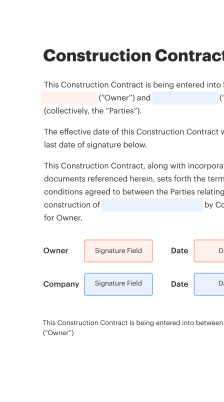
Create and use your form doc for production online

Online creation centers on template conversion, field setup, and workflow configuration before sending to signers.

  • Upload source: Import PDF or DOCX to begin.
  • Map fields: Define signatures, dates, and required entries.
  • Set rules: Add conditional logic and validation.
  • Publish: Save as production template for reuse.
Collect signatures
24x
faster
Reduce costs by
$30
per document
Save up to
40h
per employee / month

Quick steps to complete a form doc for production

Follow these practical steps to prepare, validate, and sign a production-ready document.

  • 01
    Select template: Choose the approved production template.
  • 02
    Add fields: Place required fields and validation rules.
  • 03
    Configure routing: Define signer order and notifications.
  • 04
    Send and track: Dispatch and monitor completion status.

Managing audit trails for production transactions

An auditable record should capture signer events, timestamps, and any file-level changes for each production document.

01

Event capture:

Record each signer action
02

Timestamping:

UTC timestamps applied
03

Signer metadata:

Email, IP, device type
04

Field-level logs:

Track field edits
05

Document snapshots:

Store completed PDF
06

Export options:

CSV or PDF audit export
be ready to get more

Why choose airSlate SignNow

  • Free 7-day trial. Choose the plan you need and try it risk-free.
  • Honest pricing for full-featured plans. airSlate SignNow offers subscription plans with no overages or hidden fees at renewal.
  • Enterprise-grade security. airSlate SignNow helps you comply with global security standards.
illustrations signature

Recommended workflow settings for production forms

Typical configuration values balance security, timeliness, and automation for high-volume production workflows.

Setting Name Configuration
Signer Order Sequential
Reminder Frequency 48 hours
Expiration Period 30 days
Auto-Archive On completion
Field Validation Mode Strict

Supported platforms for form doc for production

Choose platforms that match how your teams and signers work: mobile, tablet, and desktop support ensures accessibility.

  • Desktop browsers: Chrome, Edge, Safari
  • Mobile platforms: iOS and Android
  • Offline signing: Limited support

Ensure the chosen provider supports current browser versions, responsive mobile flows, and secure storage in U.S. regions to meet internal IT and compliance policies when operating production workflows.

Security controls commonly applied

Encryption: AES-256 at rest
Transport security: TLS 1.2+
Access control: Role-based permissions
Authentication: Email, SMS OTP
Audit logging: Immutable event trail
Data residency: US-based storage

Industry scenarios using form doc for production

Below are representative case studies that illustrate common production use cases and outcomes.

Construction Subcontractor Agreements

A general contractor standardized subcontractor onboarding documents into validated templates with required insurance and lien-waiver fields

  • Template validation and conditional fields enforced missing data checks
  • Faster approvals and fewer back-and-forths reduced project start delays

Resulting in measurable reduction in administrative hold-ups and clearer contract acceptance records.

Higher Education Enrollment Forms

A university converted paper enrollment and FERPA consent forms into fillable forms with multi-signer routing

  • Integration ensured student data flowed into the student information system
  • Built-in access controls and signed consent captured audit metadata

Leading to consistent records, improved privacy handling, and simplified compliance reporting.

Best practices for secure, accurate production forms

Implementing consistent governance and validation reduces errors and supports auditability for production use.

Standardize and version templates
Maintain an approved template library with clear version control and a change-review process so production documents remain consistent, auditable, and traceable to governance decisions.
Apply field-level validation rules
Use required fields, formats, and conditional logic to enforce correct data capture at entry, reducing downstream reconciliation and improving data quality for automated processing.
Define signer authentication levels
Classify documents by risk and apply appropriate signer authentication such as email OTP for low-risk and identity verification for high-risk documents to meet compliance expectations.
Schedule retention and backup
Establish retention policies and secure backups aligned to legal and operational requirements so signed production records remain accessible and defensible for mandated retention periods.

FAQs About form doc for production

Common questions address validity, signer identity, template issues, integrations, and error handling for production workflows.

Feature availability comparison for production use

Compare essential production features across common eSignature providers to inform selection for U.S.-centric deployments.

Criteria signNow (Recommended) DocuSign Adobe Sign
Legal validity (US)
Bulk Send capability
API and webhooks REST API REST API REST API
Mobile app support
be ready to get more

Get legally-binding signatures now!

Regulatory and operational risks to consider

Noncompliance: Fines
Data breach: Liability
Invalid signature: Rejection
Operational delay: Penalties
Audit failure: Remediation
Lost evidence: Disputes

Pricing and plan comparison for production deployments

High-level plan structures and feature availability across vendors; use this as a starting point for procurement discussions and exact quoting.

Feature signNow (Recommended) DocuSign Adobe Sign HelloSign PandaDoc
Entry-level plans Individual and Business tiers available Personal to Business plans Individual and Small Business tiers Essentials plan available Free and Essentials plans
API access availability API access on Business Premium and above API with paid developer plans API via Business and Enterprise API on Business plan API on Business plan
Template management Versioned template library included Template library and advanced tools Template authoring with library Template storage included Template capabilities with limits
Enterprise support Enterprise support available Dedicated enterprise services offered Enterprise SLAs and support Business-level support available Enterprise plans with support
Trial and testing Free trial and developer sandbox Free trial and demo options Free trial available Free trial offered Free trial and sandbox
walmart logo
exonMobil logo
apple logo
comcast logo
facebook logo
FedEx logo
be ready to get more

Get legally-binding signatures now!