Freight Bill Format for Quality Assurance

Streamline your document workflow with airSlate SignNow's easy-to-use and cost-effective eSign solution. Enhance accuracy and efficiency with our customizable freight bill templates.

Award-winning eSignature solution

What the freight bill format for quality assurance is and why it matters

A freight bill format for quality assurance is a standardized document layout used to capture shipment, billing, and acceptance details consistently across carriers and shippers. It defines required fields, labeling conventions, signature blocks, and verification checkpoints so quality teams can validate completeness and accuracy before payment or settlement. In digital workflows, the format includes embedded field validation, mandatory signatures, and an audit trail to support dispute resolution, regulatory compliance, and process metrics while reducing manual errors and reconciliation time.

Why a standard freight bill format improves QA

Using a consistent freight bill format reduces variability, shortens verification cycles, and lowers billing disputes by ensuring required data and signatures are present and auditable across systems.

Why a standard freight bill format improves QA

Common challenges when freight bill formats are informal or inconsistent

  • Missing or inconsistent field names cause manual reconciliation and invoice mismatches across carriers and finance systems.
  • Handwritten signatures and paper forms introduce delays and increase likelihood of lost documentation during transit or audit.
  • Lack of validation rules allows incorrect weights, addresses, or billing codes to move downstream into payments.
  • Insufficient audit trails make it difficult to resolve disputes or prove acceptance dates for claims and chargebacks.

Typical users and how they interact with the format

Logistics Manager

A logistics manager configures the freight bill template to require specific shipment identifiers, carrier rates, and mandatory acceptance fields. They use the format to enforce data quality at pickup and to generate consistent records for carrier audits and internal KPIs.

Quality Assurance Lead

A QA lead reviews submitted freight bills for completeness, enforces signature and inspection checkpoints, and oversees exception workflows. They rely on standardized fields and audit trails to investigate discrepancies and to produce compliance reports for stakeholders.

Who typically uses a QA-focused freight bill format

Logistics, billing, and quality teams rely on standardized freight bills to verify shipments and support payments.

  • Shippers and freight forwarders who need consistent billing and proof of delivery.
  • Carriers and third-party logistics providers tracking acceptance and charge reconciliation.
  • Accounts payable teams validating invoice accuracy before releasing payments.

Standardized formats improve cross-functional communication and shorten resolution times between operations and finance.

Core features to include in a freight bill QA solution

When defining a freight bill format, include features that enforce data quality, streamline approvals, and preserve an auditable record.

Template Fields

Predefined, labeled fields for shipment ID, weights, rates, and billing codes enforce consistent data capture and reduce reconciliation errors during QA checks.


Conditional Logic

Rules that reveal inspection or exception fields only when specified conditions occur, ensuring that additional documentation is captured when needed without cluttering routine bills.

Bulk Send

Ability to send identical freight bill templates to multiple recipients simultaneously to accelerate mass acceptance processes for multi-stop shipments or large customer bases.

Offline Signing

Support for capturing signatures without connectivity at pickup or delivery, then syncing signed records when a device reconnects to preserve QA integrity.

API Access

Programmatic creation and retrieval of freight bills to integrate with TMS, ERP, and billing systems for automated validation and downstream processing.

Audit Trail

Immutable event logs showing who viewed, modified, and signed each freight bill, with timestamps for dispute resolution and compliance reporting.

be ready to get more

Choose a better solution

Integrations and templates that support freight bill QA

Practical integrations and template capabilities reduce duplicate entry and ensure consistent data capture across systems.

Google Docs

Synchronize freight bill templates from Google Docs to eliminate copy-and-paste errors, maintain a single source of truth for field naming, and enable quick template updates that propagate to signed documents and audit logs.

CRM Integration

Connect freight bill templates to CRM records so shipments pull customer account numbers, billing codes, and contact details automatically, reducing manual lookup and improving invoice accuracy during quality checks.

Dropbox / Cloud

Save completed freight bills to cloud folders for centralized backup and versioning, enabling QA teams to access historical documents for audits and dispute resolution without manual retrieval.

Template Library

Maintain reusable freight bill templates with predefined validation and signature fields so teams can deploy consistent QA formats across lanes, customers, and carriers with minimal setup time.
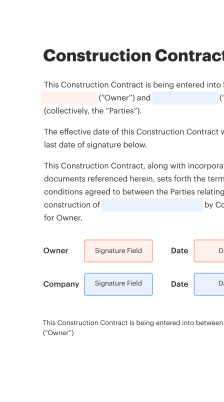
How the digital freight bill process typically flows

A digital freight bill moves through upload, validation, signing, and archival to complete a QA-ready record of the shipment and acceptance.

  • Upload: Attach shipment documents
  • Configure: Apply template and rules
  • Send: Route for signatures
  • Track: Monitor status and logs
Collect signatures
24x
faster
Reduce costs by
$30
per document
Save up to
40h
per employee / month

Step-by-step: set up a freight bill format for QA

Follow these core steps to create a controlled freight bill template that supports quality checks and auditability.

  • 01
    Define fields: List required data elements
  • 02
    Add validation: Set mandatory rules
  • 03
    Set signing: Require signatures and dates
  • 04
    Archive: Store with immutable logs
be ready to get more

Why choose airSlate SignNow

  • Free 7-day trial. Choose the plan you need and try it risk-free.
  • Honest pricing for full-featured plans. airSlate SignNow offers subscription plans with no overages or hidden fees at renewal.
  • Enterprise-grade security. airSlate SignNow helps you comply with global security standards.
illustrations signature

Typical workflow settings for freight bill QA automation

Configure these workflow settings to automate validation, reminders, and archiving so QA checkpoints happen consistently.

Setting Name Configuration
Default reminder frequency in hours 48 hours
Document signing order and routing Sequential
User authentication method required Email OTP
Automatic archival after completion 30 days
Third-party integrations enabled CRM and Cloud

Device and platform considerations for field capture and signing

Ensure the freight bill workflow supports the devices your teams use for pickups, deliveries, and office processing.

  • iOS support: iOS 13 or later
  • Android support: Android 8.0 or later
  • Desktop browsers: Chrome, Edge, Safari, Firefox

Test templates across the chosen devices and browsers to confirm field rendering, offline signing behavior, and attachment handling before wide deployment.

Security and compliance controls relevant to freight bill formats

ESIGN / UETA: Legal e-signature standards
Encrypted Storage: At-rest encryption
Access Controls: Role-based permissions
Audit Logs: Immutable event history
Two-factor Auth: Optional MFA support
HIPAA Consideration: Protected data controls

Industry examples: freight bill format applied in practice

Two operational examples show how a QA-focused freight bill format solves real problems in transportation and logistics.

National Carrier Standardization

A national carrier implemented a template requiring weight, cube, and broker references on every freight bill

  • The template enforced field validation and mandatory driver signature
  • That reduced billing disputes and manual corrections by enabling automated reconciliations

Resulting in faster payment cycles and fewer invoice exceptions for both carrier and shipper

Third‑party Logistics Exception Handling

A third-party logistics provider added conditional inspection fields to freight bills for high-value shipments

  • Conditional logic prompted extra documentation when discrepancies occurred
  • The additional data accelerated root-cause analysis and minimized chargebacks by providing fuller evidence

Leading to measurable declines in claim resolution time and improved carrier relationships

Best practices to keep freight bills accurate and secure

Apply consistent controls and regular reviews to ensure freight bills remain reliable inputs for QA and billing.

Standardize field names and formats across templates
Adopt a controlled vocabulary for all freight bill fields, enforce single formats for dates and weights, and maintain a central template repository to prevent divergence across teams and carriers.
Validate data before sending or signing
Implement rule-based checks that block submission of incomplete or inconsistent records, reducing manual follow-up and preventing downstream payment errors and disputes.
Keep retention and archival policies consistent
Define retention periods aligned with legal and audit requirements, ensure secure backups, and apply legal holds when necessary to preserve evidence during disputes or investigations.
Perform periodic QA audits and template reviews
Schedule routine reviews of template fields and exception workflows to incorporate regulatory changes, operational lessons, and carrier feedback to continuously reduce exceptions.

FAQs and troubleshooting for freight bill format issues

Answers to common questions and troubleshooting steps for template, signing, and integration problems encountered with freight bill formats.

Feature availability: signNow versus leading alternatives

A quick capability comparison shows which providers support core freight bill QA features and compliance options.

Capability matrix across leading providers signNow (Recommended) DocuSign Adobe Sign
Legally binding eSignatures
Bulk Send / mass routing
API for automated workflows REST API REST API REST API
HIPAA-compliant configurations Optional Optional
be ready to get more

Get legally-binding signatures now!

Retention, backup, and legal timelines to apply

Set clear timelines for storing, backing up, and reviewing freight bills to meet legal and operational needs.

Standard retention period:

Seven years storage

Legal hold duration:

Until case closure

Backup schedule:

Daily incremental backups

Template review cycle:

Annual review and updates

Signature expiry check:

Validate within 90 days

Risks and potential penalties from poor freight bill control

Payment Delays: Lost cash flow
Dispute Costs: Higher admin cost
Regulatory Fines: Noncompliance risk
Carrier Chargebacks: Unexpected fees
Reputational Damage: Client trust loss
Data Breach Risk: Legal exposure

Pricing snapshot across eSignature providers for freight bill workflows

Compare typical starting prices, free tiers, API access, and support options to evaluate cost and fit for freight bill QA needs.

Pricing Overview by Vendor signNow (Featured) DocuSign Adobe Sign Dropbox Sign OneSpan
Starting price (per user/month) From $8/user/month From $10/user/month From $15/user/month From $15/user/month From $20/user/month
Free tier or trial availability Free trial available Limited trial Trial available Free tier exists Trial available
Enterprise and volume discounts Custom enterprise plans Custom pricing Enterprise plans Custom enterprise Volume pricing
API access included Included in plans Included Included Included Included with license
Typical support offerings Email and chat support Phone and email Phone and chat Email support Enterprise support options
walmart logo
exonMobil logo
apple logo
comcast logo
facebook logo
FedEx logo
be ready to get more

Get legally-binding signatures now!