Industrial Estimating Software for Pharmaceutical Needs

industrial estimating software for Pharmaceutical

Award-winning eSignature solution

What industrial estimating software for pharmaceutical does and why it matters

Industrial estimating software for pharmaceutical centralizes cost modeling, materials and labor estimates, and regulatory-related expense forecasting for manufacturing and facility projects. It combines standardized templates, configurable bill-of-materials, labor-rate libraries, and scenario analysis so estimators can produce repeatable, auditable estimates that align with quality and regulatory controls. For pharmaceutical contexts the software typically includes vendor cost catalogs, cleanroom or containment cost drivers, validation and qualification line items, and integration points to procurement and project management systems to reduce manual rework and improve traceability.

When this solution is appropriate for pharmaceutical teams

Use industrial estimating software for pharmaceutical when you need consistent cost inputs, audit-ready estimate records, and integration with procurement or quality systems to support compliant project decisions.

When this solution is appropriate for pharmaceutical teams

Common challenges addressed by estimating software

  • Fragmented spreadsheets increase error risk and reduce version control across cross-functional estimate reviews.
  • Manual price lookups slow turnaround and create inconsistencies between project estimates and procurement orders.
  • Regulatory traceability requirements complicate informal estimate records and make audit preparation lengthy.
  • Lack of reuseable templates forces repeated work for similar packaging, cleanroom, or validation projects.

Representative user profiles

Lead Estimator

The Lead Estimator manages rate libraries, constructs bill-of-materials, and verifies cost assumptions. They coordinate with engineering and procurement to validate vendor quotes, maintain historical estimate baselines, and prepare audit-ready documentation for capital projects and process upgrades.

QA/Validation Manager

The QA/Validation Manager reviews estimates for compliance impacts, flags validation cost items, and ensures traceability of validation labor and material costs. They use the software to confirm that estimate records align with quality plans and regulatory submission requirements.

Primary users and team roles

Estimating, procurement, engineering and project management teams typically interact with industrial estimating software for pharmaceutical during budgeting and planning.

  • Estimators and cost engineers who build and validate detailed component and labor estimates.
  • Procurement and sourcing staff who need accurate cost rollups for vendor negotiations and purchase orders.
  • Project managers and QA/validation leads who require traceable estimate records for regulatory and audit purposes.

Teams often share responsibility for maintaining rate libraries and templates to ensure consistent, auditable estimates across projects.

Key features to evaluate for pharmaceutical estimating

Select features that support repeatability, traceability, and integration with procurement and quality systems to meet pharmaceutical requirements.

Template Management

Centralized templates let teams codify regulatory and validation line items, enforce mandatory fields for compliance, and reduce variation between estimates for similar equipment or facility projects.


Rate and Catalog Libraries

Configurable material and labor libraries support vendor-specific pricing, escalation rules, and effective dating so historical estimates remain auditable while new bids reflect current market rates.

Scenario Modeling

Scenario or what-if analysis allows parallel estimate versions for differing cleanroom classifications, vendor options, or validation approaches and summarizes cost deltas across scenarios.

Integration Connectors

Prebuilt or configurable connectors to ERP, procurement, or PLM systems synchronize item masters, vendor quotes, and purchase requisitions to reduce duplicate data entry and errors.

Audit Trail

Immutable change logs capture who changed what and when, including version comparisons and exportable reports suitable for inspections and internal reviews.

User Roles and Approvals

Granular role definitions and multi-step approval workflows ensure technical, procurement, and QA sign-off before estimates are finalized and used for ordering or capital requests.

be ready to get more

Choose a better solution

Integration and template capabilities to look for

Integration and templating reduce manual work and improve consistency when estimates feed procurement and validation processes.

ERP and Procurement Connectors

Out-of-the-box connectors or APIs that sync part masters, vendor pricing, and purchase requisitions with common ERPs reduce reconciliation work and help ensure estimates convert accurately into orders.

Document and Template Library

A managed template library that combines technical estimate forms with required validation and QA documentation simplifies packaging of audit-ready estimate records for regulatory review.

Cloud Storage integrations

Secure integration with enterprise cloud storage providers enables centralized archival of estimate snapshots, attachments, and exportable audit reports for retention policies.

API and Webhooks

APIs and webhook support allow real-time synchronization to other systems, automated notifications on status changes, and integration into CI/CD or project orchestration pipelines.
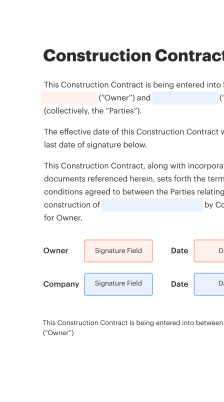
How the online estimate workflow typically operates

Core workflow steps show how users create, review, and approve estimates while preserving traceability and integration with other systems.

  • Initiate: Start a new estimate from a template or blank model
  • Populate: Add BOM items, labor, and validation entries
  • Review: Route for technical and compliance review
  • Finalize: Lock estimate and generate audit-ready records
Collect signatures
24x
faster
Reduce costs by
$30
per document
Save up to
40h
per employee / month

Quick setup: getting started with the software

A concise setup path helps teams adopt industrial estimating software for pharmaceutical for repeatable, compliant estimates.

  • 01
    Create templates: Build standard estimate templates for project types
  • 02
    Load libraries: Import material and labor rate catalogs
  • 03
    Define roles: Assign permissions and approval flows
  • 04
    Validate outputs: Run sample estimates and audit logs

Managing audit trails and finalized estimate records

Maintaining clear audit records ensures estimates are defensible during internal or regulatory review.

01

Enable versioning:

Store each estimate version automatically
02

Record approvals:

Capture approver, timestamp, and comments
03

Attach evidence:

Link vendor quotes and validation plans
04

Export reports:

Generate exportable audit packages
05

Retention policy:

Apply organization retention settings
06

Access logs:

Review who accessed estimate records
be ready to get more

Why choose airSlate SignNow

  • Free 7-day trial. Choose the plan you need and try it risk-free.
  • Honest pricing for full-featured plans. airSlate SignNow offers subscription plans with no overages or hidden fees at renewal.
  • Enterprise-grade security. airSlate SignNow helps you comply with global security standards.
illustrations signature

Recommended workflow settings for pharmaceutical estimates

Standardized workflow settings help maintain compliant processes and consistent estimate outputs across teams and projects.

Technical Workflow Setting Header Name This header explains each setting and its default operational configuration for teams
Reminder Frequency for Signer Notifications Every 48 hours until signed or canceled
Signature Order Enforcement Setting Sequential approvals required for QA then procurement
Template Access Control Level Restricted to estimator and QA groups
Document Expiration Policy Estimates auto-expire after 180 days
Audit Trail Retention Period Retain logs for ten years

Supported platforms and device guidance

Verify platform compatibility for desktop, tablet, and mobile access to ensure estimators and reviewers can work from preferred devices.

  • Web Browser Support: Modern browsers: Chrome, Edge, Safari
  • Mobile OS Support: iOS 13+ and Android 8+
  • Desktop Requirements: Windows 10+, macOS 10.14+, stable internet

For secure environments, confirm browser policies, network allowlists, and single sign-on configurations are compatible with corporate IT and validation requirements before broad roll-out.

Security controls and protections

Data encryption: AES 256-bit at rest
Transport security: TLS 1.2+ in transit
Access controls: Role-based permissions
Authentication options: SAML and MFA support
Activity audit: Immutable logs retained
Data isolation: Tenant-level separation

Practical examples from pharmaceutical operations

Two concise scenarios illustrate how estimating software supports compliant projects and cost control in pharmaceutical settings.

Facility Expansion Estimate

A capital project team prepared a multi-scenario estimate covering HVAC, cleanrooms, and utilities using a template-driven model to standardize assumptions

  • Automated BOM generation reduced manual line-item errors
  • Validation and quality line items were included for direct traceability

Resulting in a single, auditable estimate package that shortened review cycles and improved budget accuracy across stakeholders.

Equipment Qualification and Upgrade

A manufacturing group estimated the cost to upgrade fill/finish equipment and included qualification labor and spare parts as discrete line items

  • The estimator pulled vendor catalog pricing and applied standardized labor rates
  • Integration with procurement produced matched purchase requisitions for each line item

Ensures the project maintained compliant documentation and reduced procurement discrepancies during validation activities.

Best practices for secure and accurate pharmaceutical estimating

Adopt controls and workflows that reduce risk, improve repeatability, and maintain regulatory traceability for estimate records.

Standardize templates and assumptions
Document required fields and validation items in templates, include standard labor and material assumptions, and maintain versioned templates to preserve auditable history and reduce variability across estimators.
Enforce role-based approvals
Implement sequential approvals that include technical, procurement, and QA sign-offs; require approver justification in comments to support audit trails and change rationale.
Integrate with enterprise systems
Use API or connector-based integrations to synchronize item masters, vendor pricing, and purchase requisitions to avoid double entry and ensure estimates align with procurement transactions.
Retain and export audit packages
Regularly export finalized estimates, attachments, and change logs into secure archival storage following organizational retention policies to support inspections and internal reviews.

FAQs about industrial estimating software for pharmaceutical

Common questions cover legal validity, integrations, validation, and operational troubleshooting for estimate workflows.

Digital versus paper practices and vendor capability snapshot

Comparison of core capabilities between electronic solutions and traditional paper processes for common estimating needs.

Feature and Compliance Criteria List signNow (Featured) DocuSign Adobe Sign
Template reuse and enforcement
API access for integration
HIPAA-compliant configurations Available Available Available
Offline signing or annotation Limited Limited
be ready to get more

Get legally-binding signatures now!

Retention and review schedule recommendations

Establish clear retention timelines and scheduled review points for estimate records to meet business and regulatory needs.

Template review interval:

Annual template audit and approval

Estimate revalidation window:

Revalidate estimates every 12 months

Audit log retention:

Retain logs for ten years

Project archive date:

Archive after project close plus five years

Regulatory review checkpoint:

Quarterly compliance sampling

Regulatory and business risks from poor estimating controls

Regulatory noncompliance: Inspection findings
Cost overruns: Budget shortfalls
Delayed validation: Project timeline slips
Procurement disputes: Vendor claim risk
Audit gaps: Incomplete records
Rework: Increased project cost

Pricing and plan feature comparison for electronic signature and document workflows

High-level pricing and plan features vary by vendor; the table lists typical entry-level pricing, free tier availability, and selected advanced capabilities relevant to pharmaceutical workflows.

Plan and Vendor Column Headers signNow (Featured) DocuSign Adobe Sign PandaDoc HelloSign
Entry-level monthly price $8 per user $15 per user $9 per user $19 per user $15 per user
Free tier availability Limited free trials No free tier Free trial available Free trial available Limited free tier
Advanced template support Template and Bulk Send Extensive templates Form and template library Template workflows Basic templates
API and developer access REST API with SDKs REST API with SDKs REST API with SDKs REST API with SDKs REST API with SDKs
HIPAA and enterprise features HIPAA options; SSO HIPAA BAA; SSO HIPAA support; SSO Enterprise plans with SSO Business plans with SSO
walmart logo
exonMobil logo
apple logo
comcast logo
facebook logo
FedEx logo
be ready to get more

Get legally-binding signatures now!