Make Signature with SignNow's Secure eSignature Solution

Create a signature space for your PDF file and adjust it in a few seconds. Deliver your electronic papers to customers and have the docs eSigned from any type of device and from anywhere.

Award-winning eSignature solution

What it means to make signature electronically

Making a signature electronically means applying an electronic mark or cryptographic token to a document to indicate intent to sign. This covers simple typed or drawn signatures, email-based acceptance flows, and stronger digital signatures that use certificates and timestamps. In the United States, electronically made signatures are commonly relied on under ESIGN and UETA when the parties consent and the record is retained. Tools like signNow provide platforms for creating, routing, and storing such signatures while integrating with common business systems and document formats.

Why modern teams choose to make signature digitally

Making signatures electronically reduces turnaround time, lowers paper handling costs, and centralizes records for audits and compliance while preserving legal validity when implemented correctly.

Why modern teams choose to make signature digitally

Common obstacles when you try to make signature

  • Inconsistent signing methods across teams cause delays and errors in final documents.
  • Verifying signer identity can be complex without standardized authentication measures.
  • Paper-based workflows create bottlenecks, lost forms, and manual reconciliation burdens.
  • Retention and compliance tracking become difficult without auditable, centralized records.

Representative user profiles for make signature workflows

Sales Manager

A Sales Manager prepares quotes and agreements, sends them for signature, and tracks completion. They rely on template reuse and bulk send features to process multiple contracts quickly and need clear audit logs for revenue recognition.

HR Administrator

An HR Administrator manages offer letters, tax forms, and onboarding packets that require signatures. They require secure authentication, role-based access, and document retention controls to meet internal policy and federal privacy standards.

Who typically needs to make signature in organizations

  • Sales teams for closing contracts and NDAs quickly.
  • HR teams for onboarding, I-9 forms, and benefits enrollment.
  • Legal and procurement for contract execution and amendments.

Smaller teams and large enterprises both make signature workflows part of day-to-day operations to reduce cycle time and improve recordkeeping.

Additional capabilities that improve how you make signature

Beyond core signing, several advanced features streamline workflows, integrate systems, and increase control for teams that rely on frequent document execution.

API

APIs allow embedding signing flows into internal applications and automating document generation, sending, and status checks to remove manual steps and ensure consistent processing.


Integrations

Native connectors for CRMs, cloud storage, and HR systems let documents move seamlessly between platforms without manual downloads and reuploads, keeping records synchronized.

Role-based permissions

Granular permission controls let administrators limit who can create templates, send documents, or access completed records, improving governance and reducing accidental exposure.

Reporting

Built-in analytics track turnaround times, signer completion rates, and outstanding agreements to help teams identify bottlenecks and measure performance.

Conditional logic

Conditional fields and branching let documents adapt to responses and only display relevant fields, simplifying signer experience and preserving document integrity.

Mobile signing

Mobile-optimized signing experiences support on-the-go approvals and allow signers to complete transactions from tablets and phones securely.

be ready to get more

Choose a better solution

Core features to make signature reliably

When you make signature at scale, prioritize features that support identity verification, template reuse, automation, and cohesive storage across systems.

Templates

Reusable document templates let teams standardize fields and signer roles for common agreements, reducing preparation time and preventing missing fields while ensuring consistent language and placement across repeated documents.

Bulk Send

Bulk Send enables sending the same agreement to many recipients with personalized fields, automating distribution and tracking to accelerate mass enrollments or batch contract execution.

Authentication

Multiple signer authentication options include email verification, SMS one-time passcodes, and third-party identity providers to align signer assurance with the transaction's legal and risk requirements.

Audit Trail

Comprehensive audit records capture timestamps, IP addresses, and activity history to support disputes, compliance reviews, and internal governance with verifiable evidence of the signing process.
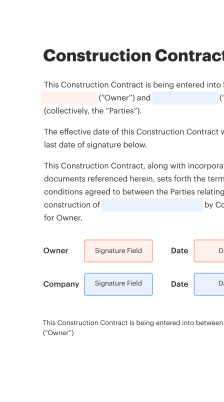
How to create and use make signature flows online

An online make signature flow typically moves a document from upload through tagging, routing, signing, and final storage with audit metadata captured at each step.

  • Upload: Import file from device or cloud storage.
  • Tag fields: Drop signature, date, and text fields.
  • Route: Define signer order and reminders.
  • Complete: Capture signatures and finalize document.
Collect signatures
24x
faster
Reduce costs by
$30
per document
Save up to
40h
per employee / month

Quick steps to make signature for a single document

Follow a simple four-step flow to prepare, send, sign, and archive a document for an enforceable electronic signature.

  • 01
    Prepare: Upload document and add required fields.
  • 02
    Assign: Set signer roles and authentication methods.
  • 03
    Send: Distribute via email or direct link with reminders.
  • 04
    Archive: Store completed document with audit log.
be ready to get more

Why choose airSlate SignNow

  • Free 7-day trial. Choose the plan you need and try it risk-free.
  • Honest pricing for full-featured plans. airSlate SignNow offers subscription plans with no overages or hidden fees at renewal.
  • Enterprise-grade security. airSlate SignNow helps you comply with global security standards.
illustrations signature

Typical workflow settings to configure when you make signature

Configure these common workflow settings to align signing flows with organizational policies and expected turnaround behavior.

Setting Name Configuration
Reminder Frequency 48 hours
Signer Order Sequential
Authentication Level Email or SMS
Retention Period 7 years
Notification Settings Email only

How to make signature on different devices

  • Desktop browsers: Chrome, Edge, Safari supported
  • Mobile browsers: Responsive signing pages
  • Native apps: iOS and Android available

Ensure that documents render correctly across platforms, that authentication methods function on mobile, and that mobile-optimized fields are used to improve signer completion rates.

Security and authentication options when you make signature

TLS encryption: In transit
At-rest encryption: AES-256
Multi-factor authentication: Optional
Access controls: Role-based
Audit logging: Detailed records
Certificate support: Digital signing

Industry examples of how teams make signature

These concise case summaries show common scenarios where organizations replace paper with electronic signature workflows to improve speed and control.

Healthcare Enrollment

A hospital HR team digitized onboarding packets to reduce processing time and document errors for new employees and contractors.

  • The system included identity checks and HIPAA-compliant storage.
  • This minimized manual entry and improved privacy controls for sensitive medical staff records.

Resulting in faster onboarding, fewer compliance gaps, and clearer audit trails.

Real Estate Transactions

A brokerage moved purchase agreements and disclosures to electronic processes to avoid paper delays across distributed agents and clients.

  • The workflow used guided fields and document templates.
  • That reduced missing signatures and accelerated closings.

Leading to shorter transaction cycles, clearer signer accountability, and improved client experience.

Best practices when you make signature for business use

Follow established controls and documentation standards to maintain legal validity, security, and operational efficiency when implementing electronic signature processes.

Document and enforce an e-signature policy across teams
Create a written policy that defines acceptable signature methods, required authentication levels for different document classes, retention schedules, and roles responsible for oversight to ensure consistent application across the organization.
Use templates and field validation to reduce errors
Standardize commonly used agreements and apply field-level validation so signers cannot skip required entries, which reduces rework and maintains data quality for downstream systems.
Match authentication strength to transaction risk
Require stronger identity verification such as SMS codes or validated IDs for high-value or sensitive transactions, while allowing lighter methods for routine approvals to balance user experience and security.
Maintain clear audit logs and retention practices
Ensure each signed record includes a tamper-evident audit trail, and apply retention policies aligned with legal and industry requirements so documents remain accessible for disputes and compliance reviews.

FAQs about how to make signature and troubleshooting

Answers to common questions and troubleshooting tips related to making signatures, signer access, and validation of completed documents.

Feature availability when you make signature: vendor comparison

Compare typical technical capabilities relevant to how organizations make signature across leading providers; signNow is listed first as the recommended option for this comparison.

Signing Solutions Comparison Table Header signNow (Recommended) DocuSign Adobe Sign
Multi-factor authentication and identity verification
Bulk send and mass distribution limits
Audit trail and compliance reporting availability Detailed Detailed Detailed
Offline signing and mobile app support
be ready to get more

Get legally-binding signatures now!

Risks and compliance considerations when you make signature

Invalid consent: Contract unenforceable
Poor authentication: Identity disputes
Weak records: Audit failure
Retention lapses: Regulatory fines
Privacy breaches: HIPAA/FERPA exposure
Improper access: Unauthorized changes

Pricing snapshot for providers used to make signature

This pricing snapshot shows typical entry-level and feature indicators for common eSignature providers; signNow is listed first and labeled Recommended in this overview.

Annual Pricing Comparison Header signNow (Recommended) DocuSign Adobe Sign Dropbox Sign PandaDoc
Starting monthly price (approx.) $8 per user/mo billed annually $10 per user/mo $24.99 per user/mo $15 per user/mo $19 per user/mo
Free trial availability Yes, trial available Yes, trial available Yes, trial available Yes, trial available Yes, trial available
API included in plan Available on business plans Available on higher tiers Available on enterprise tiers Available via API plan Available on growth plans
Enterprise and volume discounts Negotiable enterprise pricing Negotiable enterprise pricing Negotiable enterprise pricing Negotiable enterprise pricing Negotiable enterprise pricing
Educational or nonprofit pricing Discounts available Case-by-case discounts Nonprofit options Academic plans offered Nonprofit discounts

eSign and Manage Files Easily with airSlate SignNow

airSlate SignNow is really a sturdy, full-featured, and award-winning solution for eSigning and managing files both on desktop computer and cell phone. A great deal of companies, notably Xerox, CBS Sports, and Colliers already have experienced the benefits of employing airSlate SignNow. Not only does it improve and enhance document turnover as the majority of eSignature software does, it also brings flexibility to the process of eSigning.

The differentiating features of airSlate SignNow that make it an exclusive and prevailing tool among the competitors are the following:

  • Upload ready contracts or create templates in the on-line editor and reuse them in the future.
  • Use handwritten, typed in, or scanned signatures. Prior to sending a file out for verification, you may define what kind of signature a receiver of the email can use.
  • Send a contract out for signing to one or many signers via email or link.
  • Configure an expiry date to have your contract signed by the due date.
  • Stay updated with reminders. All users including the sender will receive notifications until each role is done (changeable in advanced settings).
  • Keep your signing procedure comfortable for users. Signees don't have to register or sign-up to validate the agreement.

airSlate SignNow's intuitive user interface makes it convenient for users to share folders between departments, and build branded workflows. Utilizing the apps for iOS and Android, handling and validating contracts on the go is actually a reality.

Staying compliant with leading security standards, airSlate SignNow ensures your data is safe. The embedded, court-admissible Audit Trail keeps track of every change to your file, keeping every person responsible.

Sign up for a free trial and start creating effective eSignature workflows with airSlate SignNow.


walmart logo
exonMobil logo
apple logo
comcast logo
facebook logo
FedEx logo
be ready to get more

Get legally-binding signatures now!