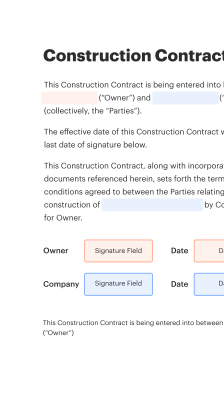
Move Signed Validated Documents Securely with SignNow
What move signed validated means in practice
Why validating signed documents matters
Validating a signed document confirms signer identity, records signature timing, and captures integrity checks, reducing disputes and supporting compliance with ESIGN and UETA requirements.
Common challenges before adopting validated eSignatures
- Missing or incomplete audit trails lead to weak evidentiary value when a signature is contested.
- Inconsistent signer authentication increases the risk of fraud or repudiation of signatures.
- Poor document version control creates uncertainty about which signed file is the authoritative copy.
- Nonstandard file formats or metadata loss can invalidate automated validation and long-term storage processes.
Representative users and roles
In-house counsel
Corporate legal teams use move signed validated when executing contracts that may be subject to dispute, regulatory audit, or third-party review. Their focus is on preserving an unbroken audit trail, documented authentication steps, and a tamper-evident final file suitable for litigation or compliance records.
HR manager
Human resources professionals rely on validated signed documents for onboarding, benefits elections, and policy acknowledgements. They require clear signer verification, time-stamped consent, and retention metadata to demonstrate compliance with employment and privacy rules.
Who typically performs move signed validated workflows
Legal, HR, sales, and compliance teams commonly run validated signature processes to secure contracts and regulated records.
- Legal departments managing executory contracts and dispute-prone agreements.
- Human resources processing employment and benefits paperwork requiring identity confirmation.
- Sales and procurement teams closing revenue-critical contracts with audit needs.
Teams prioritize validation when documents require probative value, regulatory proof, or lifecycle tracking for audits and retention policies.
Choose a better solution
Core features to support move signed validated
Authentication options
Supports email confirmation, SMS access codes, knowledge-based authentication, and third-party identity verification to match signature assurance to risk and regulatory needs.
Audit trail
A detailed, time-stamped record captures signer actions, IP addresses, and device data so each completed signature has clear provenance for compliance or dispute resolution.
Tamper-evident PDF
Final signed documents are locked with embedded validation metadata and cryptographic hashes to detect post-execution changes and preserve evidentiary integrity.
Template library
Reusable templates standardize field placement and validation steps, reducing errors and ensuring consistent application of signer authentication and retention settings.
How the move signed validated process flows
-
Draft: Create or upload the document.
-
Authenticate: Apply chosen signer verification.
-
Execute: Signers complete required fields.
-
Archive: Store signed file with audit data.
Quick step-by-step: complete move signed validated
-
01Prepare document: Upload file and add signature fields.
-
02Set authentication: Choose ID verification or access code.
-
03Send to signers: Define signing order and notifications.
-
04Finalize and validate: Generate audit trail and lock PDF.
Why choose airSlate SignNow
-
Free 7-day trial. Choose the plan you need and try it risk-free.
-
Honest pricing for full-featured plans. airSlate SignNow offers subscription plans with no overages or hidden fees at renewal.
-
Enterprise-grade security. airSlate SignNow helps you comply with global security standards.
Typical workflow configuration for validated signing
| Workflow Setting Name Header Column | Configuration value or default used by the signing platform |
|---|---|
| Automatic reminder frequency in minutes | 1440 minutes (24 hours) |
| Signing order enforcement setting | Sequential signing enabled |
| Authentication method for signers | Email or SMS access code |
| Audit trail retention period | 7 years by default |
| Final document storage location | Secure cloud vault with versioning |
Platform and device requirements for validated signing
move signed validated workflows require basic browser support, secure connectivity, and platform account configurations to perform authentication and generate audit data.
- Supported browsers: Chrome, Edge, Safari
- Mobile OS support: iOS and Android
- Minimum connectivity: TLS-secured internet
Ensure users update browsers and mobile apps regularly, enforce TLS for all connections, and configure account security settings so authentication methods and audit logging operate reliably on desktops, tablets, and smartphones.
Real-world examples of validated eSignatures
Financial compliance record
A mid-size lender required validated signatures for loan agreements to meet audit standards and document retention rules.
- The lender used signer identity verification and time-stamped signing events.
- This reduced manual reconciliation and improved chain-of-custody for regulatory review.
Resulting in faster audits and clear evidence of authenticity for examiners and legal teams.
High-volume vendor onboarding
A national retailer onboarded thousands of suppliers and needed consistent signed contracts with integrity checks.
- They applied standardized templates and automated validation steps for each executed agreement.
- This reduced onboarding time and ensured each contract preserved signer metadata and version control.
Leading to streamlined supplier activation and defensible contract records during supplier disputes.
Best practices for accurate move signed validated workflows
FAQs and troubleshooting for move signed validated
- Signed document shows no audit trail
If a completed PDF lacks an audit trail, check whether the signing workflow enforced audit logging and whether the final file was exported or flattened after signing. Retrieve the original completed envelope or transaction record from the platform dashboard to access the preserved audit metadata.
- Signature integrity check fails after download
A failed integrity check may indicate the file was altered post-execution or exported incorrectly. Verify the stored copy in the platform’s secure archive, compare hashes, and restore the tamper-evident version. Avoid opening and re-saving signed PDFs in editors that may strip validation data.
- Signer authentication method was not applied
Confirm the template or sending workflow specified the required authentication method. If an access code or KBA was not enforced, re-send using the correct settings and document the discrepancy for recordkeeping. Update templates to lock authentication choices where needed.
- How to retrieve signer IP and timestamp details
Access the transaction audit report within the platform to view signer IP addresses, timestamps, and event sequence. Export the audit log as a PDF or CSV for archival and attach it alongside the signed PDF for complete validation records.
- Validating signatures for court or regulatory use
Provide the tamper-evident signed PDF plus the platform-generated audit trail, signer authentication records, and any identity verification reports. Ensure the evidence set aligns with ESIGN and UETA expectations and is accompanied by vendor documentation describing validation mechanics.
- Correcting recipient email or signer errors post-signing
If signer details were entered incorrectly before signing, review whether correction is permitted without invalidating the signature. For minor metadata fixes, maintain an explanatory amendment record; for substantive changes, reissue a corrected document and obtain fresh validated signatures.
Feature availability comparison for validated signing
| Feature Criteria and Vendor Support Matrix | signNow | DocuSign | Adobe Sign |
|---|---|---|---|
| Bulk Send Capability and Availability | |||
| Detailed Audit Trail Output | |||
| Advanced signer authentication options | Email/SMS/KBA | Email/SMS/KBA | Email/SMS |
| Tamper-evident final PDF |
Get legally-binding signatures now!
Retention and key deadlines for validated documents
Short-term retention for transactional records:
1 to 3 years for routine contracts
Standard financial record retention:
7 years for tax and audit purposes
Employment and HR document retention:
4 to 7 years depending on jurisdiction
Regulated healthcare records schedule:
Follow HIPAA and state rules
Periodic validation audits:
Annual verification of archive integrity
Operational risks when validation is absent
Plan-level comparison: pricing and features
| Plan and feature header row | signNow | DocuSign | Adobe Sign | HelloSign | PandaDoc |
|---|---|---|---|---|---|
| Free trial availability and length | Free trial available | Free trial available | Free trial available | Free trial available | Free trial available |
| Entry-level monthly plan includes eSignatures | Individual plan with core eSignatures | Personal plan | Adobe Acrobat Sign starter | Essentials plan | Individual eSign plan |
| API access and developer support | Available via paid plans | Available via paid plans | Available via paid plans | Limited API | Available via paid plans |
| Enterprise features (SSO, SAML, advanced auth) | Available on enterprise tier | Enterprise only | Enterprise only | Enterprise options | Enterprise tier available |
| HIPAA compliance and BAA offering | BAA available upon request | BAA available | BAA available | Case-by-case | BAA available upon request |
Simplify complex workflows
Create, execute, and manage workflows of any complexity, electronically from virtually anywhere. Scalable eSignature capabilities allow you to share documents with the right people in the correct order and define roles for each recipient. Execute document workflows faster and easier than ever before.
Automate document management
Optimize complex signing processes with airSlate SignNow’s powerful features to enhance your business. Control your automated eSignature workflows to ensure they're running at peak performance with instant notifications and reminders.
Optimize in team collaboration
Bring teams together in a secure, shared environment. Manage documents, use form templates and notifications to create more efficient cross-organization collaboration. Free your employees from having to spend time on repetitive activities so that they can focus on valuable, business-critical tasks.
Integrate into your existing systems
Run your projects with industry-leading integration. Collect Salesforce, Microsoft Teams, and SharePoint all in one business flow. Connect your software to a single system for endless possibilities and more productiveness.
Stay compliant with best-in-class data security
Feel confident understanding that your information remains secure by the latest in encryption security. airSlate SignNow is GDPR and eIDAS certified and gives you transparence into your eSigning process with court-admissible audit trails. Set up user access permissions and roles to regulate who has access to what.