Oblige Mark: Secure eSignature Solutions with SignNow

Get rid of paper and improve document managing for more efficiency and unlimited possibilities. Explore the best manner of running your business with airSlate SignNow.

Award-winning eSignature solution

What oblige mark is and how it functions

The oblige mark is a designated eSignature field type used to record an explicit acceptance, obligation, or legal acknowledgment within a document. It functions as a required, auditable marker that can be configured to force signer interaction, record a timestamp, and be tied to identity checks. In practice, oblige mark fields ensure a signer explicitly confirms a clause or obligation rather than relying on a full signature alone. Platforms such as signNow support oblige mark as part of their field set, allowing integration into templates, workflows, and audit trails for traceability.

Why use an oblige mark in workflows

An oblige mark reduces ambiguity by requiring explicit acknowledgement for specific clauses, improves document clarity, and strengthens evidentiary value in disputes while maintaining simple signer experience.

Why use an oblige mark in workflows

Common implementation challenges with oblige mark

  • Misplaced oblige marks that contradict overall signing order, creating signer confusion and workflow delays.
  • Failure to document authentication level can weaken enforceability in high-risk transactions.
  • Inconsistent template usage across a team leads to variations in where and how marks are applied.
  • Assuming paper-equivalent formality may overlook digital audit details required for admissibility.

Representative user profiles for oblige mark

Real Estate Closer

A Real Estate Closer coordinates multiple signers and documents during property transactions, using oblige marks to confirm specific disclosures and contingency acknowledgements. They rely on audit trails and signer authentication to validate each required acceptance and to produce clear closing records for title and lender review.

HR Administrator

An HR Administrator manages policy distribution and employee acknowledgements, applying oblige marks to privacy notices and benefit election forms. They use templates and reminders to track completions and to produce compliance reports for audits and internal governance.

Typical users and teams adopting oblige mark

Legal, HR, compliance, and operations teams commonly apply oblige mark fields where explicit agreement to a clause is required.

  • Legal counsel adding mandatory acknowledgments to contracts and amendments.
  • Human resources requiring employees to confirm policy updates or acknowledgements.
  • Finance and procurement teams accepting specific payment or liability terms.

Wider adoption occurs where clear acceptance reduces downstream disputes and supports regulatory recordkeeping requirements.

Additional tools that support effective oblige mark use

Extended platform features help scale oblige mark usage across teams and systems while preserving control and oversight.

Templates

Create reusable templates with predefined oblige marks to ensure consistency across documents and teams, speeding deployment and reducing configuration errors for repeatable processes.


Bulk Send

Distribute documents containing oblige marks to multiple recipients at once, tracking individual completions and consolidating audit data for high-volume acknowledgement needs.

API Access

Programmatically create, place, and enforce oblige marks within automated document generation and signing flows to integrate acknowledgements into existing business systems and CRMs.

Role-based Access

Assign granular permissions for who can create, edit, or remove oblige marks to maintain governance and limit accidental or unauthorized field changes.

Document Locking

Lock document sections after signing to prevent post-signature edits, preserving the original state in which the oblige mark was accepted for evidentiary integrity.

Time-stamping

Apply secure timestamps to oblige mark events to record the exact execution moment, useful for compliance, SLAs, and dispute resolution timelines.

be ready to get more

Choose a better solution

Primary oblige mark capabilities to configure

Oblige mark settings let administrators tailor visibility, enforcement, and auditability to meet transactional and compliance needs.

Required Field

Designate the oblige mark as mandatory so the signer cannot finalize without selecting or acknowledging the field, ensuring explicit acceptance of a specific clause or condition.

Conditional Logic

Show or hide oblige marks based on prior responses or signer roles, enabling dynamic forms that present acknowledgements only when relevant to the signer or transaction.

Identity Binding

Link the oblige mark event to signer authentication methods such as SMS codes or knowledge-based checks to strengthen evidentiary value for high-risk documents.

Audit Capture

Record the oblige mark interaction, including user identity, timestamp, IP address, and device details, for complete traceability in later reviews or disputes.
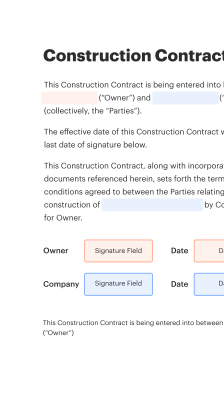
How oblige mark operates during a signing session

This sequence explains how an oblige mark behaves from signer view through completion and record capture.

  • Signer prompt: Interface highlights the oblige mark during review.
  • Authentication step: System enforces chosen identity verification method.
  • Mandatory action: Signer must explicitly acknowledge the field to proceed.
  • Finalization: Timestamp and audit entry recorded at completion.
Collect signatures
24x
faster
Reduce costs by
$30
per document
Save up to
40h
per employee / month

Quick start: Adding an oblige mark to a document

Follow these concise steps to place and require an oblige mark inside a document using a typical eSignature platform.

  • 01
    Upload document: Import PDF or DOCX into the platform.
  • 02
    Place oblige mark: Drag the oblige mark field to the relevant clause.
  • 03
    Set required: Mark the field as mandatory before sending.
  • 04
    Send for signature: Assign signers and deliver the document.

Audit trail and recordkeeping steps for oblige mark actions

Maintain a reliable record of oblige mark usage by following these capture and storage steps.

01

Enable logging:

Turn on comprehensive event logging.
02

Capture identity:

Record authentication method and identifier.
03

Timestamp event:

Record precise completion time.
04

Store snapshot:

Archive signed document PDF.
05

Retain metadata:

Keep IP and device details.
06

Export reports:

Generate compliance-ready logs.
be ready to get more

Why choose airSlate SignNow

  • Free 7-day trial. Choose the plan you need and try it risk-free.
  • Honest pricing for full-featured plans. airSlate SignNow offers subscription plans with no overages or hidden fees at renewal.
  • Enterprise-grade security. airSlate SignNow helps you comply with global security standards.
illustrations signature

Typical workflow settings when using oblige mark

Standard configurations help ensure consistent behavior for oblige marks across documents and automated processes.

Setting Name Configuration
Reminder Frequency 48 hours
Expiry Period 30 days
Signer Order Sequential
Authentication Method Email or SMS
Retention Period 7 years

Supported platforms for oblige mark interactions

Oblige mark interactions are supported across modern desktop browsers and native mobile apps, with minor feature differences depending on platform capabilities.

  • iOS support: iOS 13 or later
  • Android support: Android 8 or later
  • Desktop browsers: Chrome, Edge, Safari

For secure authentication flows and device-specific behaviours—such as SMS verification and native app biometrics—validate platform settings and update applications to the latest supported versions to ensure consistent oblige mark behavior across all signer devices.

Security controls related to oblige mark

Encryption at rest: AES-256 encrypted storage
Encryption in transit: TLS 1.2+ protected transmission
Access controls: Role-based permissioning
Two-factor auth: Optional MFA for accounts
Audit logging: Immutable event records
Document locking: Post-signature tamper-evidence

Practical examples of oblige mark in industry workflows

Two brief case examples show how oblige mark clarifies responsibility and supports recordkeeping across common business scenarios.

Real Estate Closing

At closing, the oblige mark highlights buyer acceptance of specific disclosures and contingency waivers, ensuring distinct assent to those clauses

  • Field forces signer interaction on disclosure pages
  • Confirms acceptance for title and lender records

Resulting in clearer closing evidence and fewer post-closing disputes.

Student Records Release

A university uses oblige mark for FERPA release authorizations to ensure students explicitly accept sharing permissions, attached to identity checks

  • The field is required before submission
  • Provides a clear audit of who consented and when

Resulting in defensible consent records for compliance reviews and parent inquiries.

Best practices for secure and accurate oblige mark use

Follow these practical practices to maintain reliability, compliance, and clarity when using oblige mark fields across documents and teams.

Use templates for consistency
Standardize oblige mark placement with approved templates to avoid variations that could create ambiguity. Templates reduce configuration errors, speed document preparation, and ensure consistent audit metadata across similar transaction types.
Choose appropriate authentication levels
Match authentication strength to transaction risk; for routine acknowledgements, email or SMS OTP may suffice, while high-value or regulated agreements benefit from multi-factor authentication or identity verification integrations.
Record and preserve audit data
Retain full audit logs, signed PDFs, and metadata for the retention period required by your compliance program. Ensure backups and export procedures are in place to meet legal discovery or regulatory requests.
Train users and review templates
Provide clear training on when to apply oblige marks, review templates regularly for legal accuracy, and include version control to prevent outdated acknowledgements from circulating.

FAQs About oblige mark

Answers to common questions cover enforceability, configuration, mobile behavior, and compliance considerations for oblige mark usage.

Feature comparison: oblige mark support across platforms

A concise comparison of key technical capabilities related to oblige mark functionality across common eSignature platforms.

Feature signNow (Recommended) DocuSign
Required field support
Bulk Send capability
HIPAA-ready options
Native mobile apps
be ready to get more

Get legally-binding signatures now!

Potential legal and operational risks

Invalid acceptance: Voidable contract
Insufficient authentication: Evidentiary weakness
Data loss: Regulatory fines
Misapplied fields: Transaction delays
Noncompliance: Contract disputes
Retention lapses: Audit failures

Pricing and plan snapshot for oblige mark capable services

Representative plan and capability details to compare cost and features for platforms that support oblige mark workflows. Prices may change; verify with vendors for current offers.

Plan / Vendor signNow (Recommended) DocuSign Adobe Sign Dropbox Sign PandaDoc
Starting price From $8/user/month billed annually From $10/user/month From $14.99/user/month From $15/user/month From $19/user/month
Free trial availability Yes, 7-day trial Yes, trial period varies Yes, limited trial Yes, trial available Yes, trial available
API included Available in business plans Available in most plans Available in enterprise tiers Available in paid plans Available in business plans
HIPAA support BAA available BAA available BAA available BAA available via enterprise BAA available via enterprise
Bulk send limits High-volume options available Enterprise bulk options Enterprise bulk options Batch send available Bulk send in paid plans

Streamline challenging workflows

Prepare, execute, and maintain workflows of any complexness, digitally from near any place. Scalable electronic signature functionality allow you to exchange documents with the right people in the proper way and assign roles for each receiver. Execute document workflows faster and easier than ever before.

Automate document management

Enhance complicated signing processes with airSlate SignNow�s effective tools to improve your business. Manage your automatic eSignature workflows to make sure they're running at peak efficiency with immediate notifications and reminders.

Enhance in team communication

Bring teammates together in a safe, shared workspace. Handle paperwork, use form templates and notices to deliver more effective cross-organization interaction. Relieve your workers from having to hang out on recurring actions to enable them to focus on valuable, business-vital duties.

Integrate into your existing network

Work your assignments with market-leading integration. Collect Salesforce, Microsoft Teams, and SharePoint in multi functional business flow. Link up your software to a single unit for unlimited possibilities and more productivity.

Remain compliant with industry-leading data safety

Feel safe understanding that your information is protected by the most recent in encryption security. airSlate SignNow is GDPR and eIDAS certified and offers you visibility into your signing process with court-admissible audit trails. Configure user access permissions and rights to regulate who has access to what.


walmart logo
exonMobil logo
apple logo
comcast logo
facebook logo
FedEx logo
be ready to get more

Get legally-binding signatures now!