Separate credential delivery
Ability to deliver passwords or one-time codes via a different message channel than the document reduces single-channel compromise risk and supports secure receipt verification for sensitive transactions.



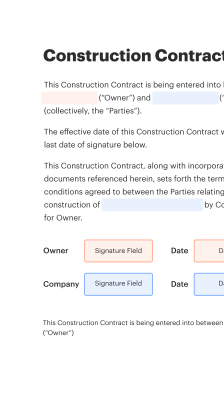
Using a dedicated password teller email separates credentials from the document itself, limiting exposure if one channel is compromised and reinforcing access control without changing signer workflow.

The IT Administrator configures email authentication, outbound mail policies, and integration points for password delivery. They validate domain settings, monitor deliverability, and work with security teams to ensure the password teller email process aligns with organizational encryption and logging requirements.
The Compliance Officer defines retention, access, and audit requirements for password delivery. They document the separation of credentials and signed documents, ensure policies meet ESIGN and UETA expectations, and advise on HIPAA or FERPA controls where applicable.
Organizations handling regulated or sensitive records typically adopt password teller email for an additional access-control layer.
Adoption is most effective when IT, compliance, and operations align on delivery standards and incident handling procedures.
Ability to deliver passwords or one-time codes via a different message channel than the document reduces single-channel compromise risk and supports secure receipt verification for sensitive transactions.
Set time-limited passwords or tokens that automatically expire to limit exposure from long-lived credentials and reduce the window for unauthorized access attempts.
Support for one-time codes that are invalid after use prevents reuse of credentials and mitigates risk of intercepted passwords being exploited in later attempts.
Comprehensive event logging that records password generation, delivery, document access, and signing times provides a robust chain of evidence for compliance and dispute resolution.
Capabilities for SPF/DKIM/DMARC setup, sender reputation monitoring, and suppression lists help ensure teller emails reach intended recipients and avoid spam filtering.
Granular recipient verification options, such as ID checks, phone verification, or knowledge-based prompts, complement password delivery to strengthen overall authentication.
| Setting Name | Configuration |
|---|---|
| Password Delivery Method | Separate email |
| Password Expiration | 72 hours |
| Token Type | Single-use code |
| Reminder Frequency | 48 hours |
| Audit Retention | 7 years |
A hospital sends a protected release form to a patient via eSignature platform
Resulting in an auditable, HIPAA-aligned access record and reduced exposure risk.
A registrar provides an encrypted transcript that requires a passcode to view
Leading to consistent FERPA-compliant handling and clear auditability for institutional records.
| Criteria | signNow (Recommended) | DocuSign | Adobe Sign |
|---|---|---|---|
| Separate password delivery | |||
| Single-use tokens | Limited | ||
| Custom expiration controls | Configurable | Fixed options | Configurable |
| Integrated audit trail | Full | Full | Full |
| Plan | signNow (Recommended) | DocuSign | Adobe Sign | PandaDoc | HelloSign |
|---|---|---|---|---|---|
| Starting monthly cost | From $8 per user | From $10 per user | From $12 per user | From $19 per user | From $15 per user |
| Advanced authentication included | Yes in most plans | Add-on in many plans | Add-on or enterprise only | Included in business plans | Enterprise only |
| Bulk send and templates | Available | Available | Available | Available | Limited |
| Compliance/enterprise features | Available across enterprise tiers | Extensive enterprise support | Broad enterprise controls | Enterprise packages available | Enterprise options |
| Free trial availability | Yes trial offered | Yes trial offered | Yes trial offered | Yes trial offered | Yes trial offered |
Create, execute, and manage workflows of any complexity, electronically from virtually anywhere. Scalable eSignature capabilities allow you to share documents with the right people in the correct order and define roles for each recipient. Execute document workflows faster and easier than ever before.
Optimize complex signing processes with airSlate SignNow’s powerful features to enhance your business. Control your automated eSignature workflows to ensure they're running at peak performance with instant notifications and reminders.
Bring teams together in a secure, shared environment. Manage documents, use form templates and notifications to create more efficient cross-organization collaboration. Free your employees from having to spend time on repetitive activities so that they can focus on valuable, business-critical tasks.
Run your projects with industry-leading integration. Collect Salesforce, Microsoft Teams, and SharePoint all in one business flow. Connect your software to a single system for endless possibilities and more productiveness.
Feel confident understanding that your data remains secure by the newest in encryption security. airSlate SignNow is GDPR and eIDAS compliant and provides you exposure into your eSigning procedure with court-admissible audit trails. Set up user access permissions and roles to control who has access to what.