Publish Signed Register with SignNow

Eliminate paper and optimize document processing for higher productivity and countless opportunities. Sign anything from a comfort of your home, fast and feature-rich. Experience the perfect manner of running your business with airSlate SignNow.

Award-winning eSignature solution

What it means to publish a signed register

Publishing a signed register refers to producing and distributing a definitive record that lists executed signatures, document metadata, and verification artifacts so that stakeholders can view or archive the authoritative signing record. This process typically bundles the final signed document, a tamper-evident audit trail, timestamps, signer authentication details, and any consent notices. For organizations, publishing a signed register supports compliance, long-term retention, and audit readiness by creating a consistent, verifiable output suitable for internal records, regulators, or counterparties while preserving legal admissibility under U.S. electronic signature laws.

Why publish a signed register matters

Publishing a signed register creates a verified, auditable record for compliance, dispute resolution, and secure archival storage.

Why publish a signed register matters

Common challenges when publishing signed registers

  • Ensuring the audit trail is tamper-evident and legally admissible across jurisdictions.
  • Maintaining signer authentication details while minimizing privacy exposure.
  • Coordinating retention schedules with organizational and regulatory requirements.
  • Delivering a readable register format that integrates with archival systems.

Typical roles responsible for publishing a register

Office Administrator

An Office Administrator prepares the signed register bundle, verifies included audit files and metadata, and routes the published package to the archive or recipients. They coordinate retention tagging and ensure storage locations comply with organizational policy, often working with IT to set access controls.

Compliance Officer

A Compliance Officer reviews register contents for regulatory completeness, confirms that signature evidence meets ESIGN/UETA requirements, and documents retention schedules. They also approve redaction or privacy actions and validate the register before final publication and external disclosure.

Who typically publishes signed registers

Organizations that handle regulated records and frequent contract execution publish signed registers to centralize and preserve authoritative signing records.

  • Legal and compliance teams tracking executed agreements and retention obligations.
  • Human resources managing employment documents and background verifications.
  • Finance and procurement teams reconciling signed contracts and approvals.

Publishing a signed register reduces retrieval time, simplifies audits, and provides a consistent record for internal and external stakeholders.

Additional platform features that aid publication

These features support scale, automation, and legal robustness when publishing signed registers across teams and systems.

API Automation

APIs enable programmatic export, packaging, and archival of signed records so organizations can automate register publication within existing systems and eliminate manual steps while maintaining consistent evidence formats.


Bulk Send and Export

Bulk Send and Bulk Export let administrators process many documents and corresponding audit artifacts in a single operation, reducing time and ensuring consistent register content across large transaction volumes.

Template-based packaging

Templates predefine which artifacts and metadata to include with each published register, ensuring every bundle contains the required evidence for a specific record type.

Secure archival connectors

Connectors to records management and cloud archive systems allow published registers to move directly into compliant storage with retention and access policies applied automatically.

Role-based approvals

Approval workflows ensure that a compliance or legal approver reviews the register bundle before it is published or archived, adding an administrative control to the process.

Multi-format exports

Support for PDF/A, CSV, and JSON exports ensures registers and audit trails are compatible with long-term archival requirements and downstream processing tools.

be ready to get more

Choose a better solution

Core tools that support publishing registers

Several platform features make it straightforward to assemble, secure, and publish a signed register while preserving evidentiary value.

Audit Export

A complete, downloadable audit trail that records every signing event, timestamp, signer action, and IP address, formatted for inclusion in the published register and suitable for legal review.

Batch Packaging

Ability to bundle multiple signed documents, associated attachments, and corresponding audit logs into a single archive file, simplifying distribution to archives or stakeholders in one consistent package.

Retention Tagging

Metadata tagging for each record to define retention periods, legal holds, and disposal rules that remain attached to the published register for compliance with organizational policies.

Encryption & Access

End-to-end encryption plus role-based access controls so published registers are protected in transit and at rest, with granular permissions for viewing or downloading the package.
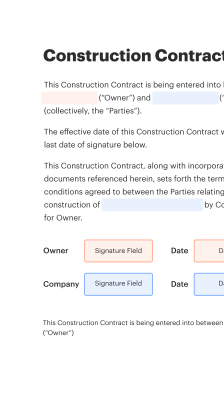
How publishing a signed register works in practice

Publishing a register connects document finalization, evidence export, and secure distribution into a repeatable sequence.

  • Finalize document: Complete all signatures and approvals.
  • Generate evidence package: Export audit logs and verification artifacts.
  • Apply encryption: Secure the package for transit or storage.
  • Publish or archive: Deliver to recipients or to a long-term archive.
Collect signatures
24x
faster
Reduce costs by
$30
per document
Save up to
40h
per employee / month

Step-by-step: preparing a signed register for publication

Follow these steps to assemble and publish a compliant signed register ready for archiving or distribution.

  • 01
    Collect documents: Gather final executed PDFs and related attachments.
  • 02
    Export audit trail: Include timestamps, IPs, and event logs.
  • 03
    Verify metadata: Confirm signer names, emails, and roles.
  • 04
    Apply protections: Encrypt, sign, and set retention metadata.

Audit trail management checklist

Key actions to maintain and manage audit trails that will be included with published registers.

01

Export logs:

Download full event logs
02

Timestamp verification:

Confirm consistent timestamps
03

Hashing records:

Compute and store file hashes
04

Preserve originals:

Keep unaltered master copies
05

Access review:

Audit who viewed exports
06

Archive copies:

Store in long-term archive
be ready to get more

Why choose airSlate SignNow

  • Free 7-day trial. Choose the plan you need and try it risk-free.
  • Honest pricing for full-featured plans. airSlate SignNow offers subscription plans with no overages or hidden fees at renewal.
  • Enterprise-grade security. airSlate SignNow helps you comply with global security standards.
illustrations signature

Recommended workflow settings for register publication

Configure these settings to automate consistent register creation and reduce manual errors when publishing signed records.

Setting Name Configuration
Audit Export Format PDF/A and JSON
Default Encryption AES-256
Retention Policy Template 7 years standard
Publication Destination Secure archive
Notification Recipients Compliance inbox

Device and platform considerations for publishing

Publishing a signed register is typically performed from a desktop or server environment where exports, encryption, and archival workflows are managed.

  • Desktop access: Full export functionality
  • Mobile access: View and trigger publishes
  • Server/API: Automated bulk operations

Use desktops or server processes for final packaging and encryption; mobile devices can review and initiate publication steps but are generally not used for long-term archival configuration or large batch exports.

Security controls for published signed registers

Encryption at rest: AES-256 encryption
Encryption in transit: TLS 1.2+
Access controls: Role-based access
Audit logging: Immutable event logs
Document hashing: SHA-256 hash
Multi-factor authentication: MFA for admins

Industry examples of published signed registers

Two concise examples show how publishing a signed register supports compliance and operations across sectors.

Healthcare Consent Records

A hospital bundles signed patient consent forms with a complete audit trail and authentication logs to satisfy HIPAA documentation standards.

  • The package includes timestamps and signer identity evidence.
  • It preserves a verifiable chain of custody and restricted access controls.

Resulting in a defensible electronic record that meets audit and privacy requirements while enabling secure storage.

Real Estate Closings

A title company publishes a register containing executed closing disclosures, signatures, and notarization records to its archival system.

  • The register pairs documents with signed consent and authentication details.
  • It reduces manual retrieval time and ensures consistent retention tagging across transactions.

Leading to faster post-closing audits, clearer chain-of-title evidence, and simplified regulatory reporting.

Best practices when you publish signed registers

Adopt these practices to ensure published registers remain reliable, compliant, and usable for audits and legal needs.

Include complete audit and metadata with each published register
Always attach the full audit trail, signer authentication evidence, and document metadata. This preserves context for each signature event and supports legal admissibility under ESIGN and UETA by showing intent, process, and identity verification.
Use consistent file formats and naming conventions
Standardize on PDF/A or another archival format and apply predictable file names and folder structures. Consistency improves discoverability, automates ingestion into records systems, and reduces the risk of misplaced or misinterpreted artifacts.
Apply retention schedules and legal holds before publishing
Tag registers with retention metadata and apply holds when litigation or investigations are possible. Doing so ensures records remain available for required durations and prevents premature deletion or alteration.
Limit exposure of sensitive data within registers
Redact or mask nonessential personal data and avoid including unnecessary sensitive fields. Use access controls and encryption to minimize privacy risk while retaining sufficient evidence for verification.

FAQs and troubleshooting for publish signed register

Common questions about assembling, securing, and publishing signed registers, with practical troubleshooting guidance for typical issues.

Feature comparison: publishing and register support

A concise comparison of how leading eSignature providers support register publication and related capabilities.

Feature availability across signNow, DocuSign, Adobe Sign signNow (Recommended) DocuSign Adobe Sign
Full audit trail export
Batch packaging for archives Limited
Retention metadata support
API-driven register publishing
be ready to get more

Get legally-binding signatures now!

Retention and publication timelines to consider

Typical retention milestones and deadlines to track when publishing signed registers for different record types.

Standard contract retention period:

7 years is common for many commercial contracts.

Financial record retention:

Keep for 7 years for tax and audit purposes.

Healthcare record retention:

Follow state HIPAA and local rules.

Employment record retention:

Retain for the term required by labor laws.

Litigation hold duration:

Until legal counsel releases the hold.

Risks if a signed register is mishandled

Legal exposure: Evidence disputes
Regulatory fines: Noncompliance penalties
Data breaches: Privacy incidents
Operational delays: Audit disruptions
Reputational harm: Trust loss
Incomplete records: Missing metadata

Pricing and plan types related to register features

High-level plan and feature mapping for products that support register publication and enterprise archival functionality.

Plan and Pricing Overview signNow (Recommended) DocuSign Adobe Sign HelloSign PandaDoc
Entry-level plan name Business plan Personal plan Individual plan Essentials plan Individual plan
Enterprise archival features Available on Business/Enterprise Available on Business Available on Business Limited Available on Business
API access in plan Included on Business Included on Standard and up Included on Enterprise Included on Business Included on Business
Bulk export capabilities Available on Business Available on Enterprise Available on Enterprise Limited Available on Business
Retention and legal hold Configurable in Enterprise Configurable in Enterprise Configurable in Enterprise Not robust Configurable in Enterprise

Simplify complex workflows

Create, execute, and manage workflows of any complexity, electronically from virtually anywhere. Scalable eSignature capabilities allow you to share documents with the right people in the correct order and define roles for each recipient. Execute document workflows faster and easier than ever before.

Automate document management

Optimize complex signing processes with airSlate SignNow’s powerful features to enhance your business. Control your automated eSignature workflows to ensure they're running at peak performance with instant notifications and reminders.

Optimize in team collaboration

Bring teams together in a secure, shared environment. Manage documents, use form templates and notifications to create more efficient cross-organization collaboration. Free your employees from having to spend time on repetitive activities so that they can focus on valuable, business-critical tasks.

Integrate into your existing systems

Run your projects with industry-leading integration. Collect Salesforce, Microsoft Teams, and SharePoint all in one business flow. Connect your software to a single system for endless possibilities and more productivity.

Stay compliant with market-leading data protection

Feel safe with the knowledge that your data remains secure by the most recent in encryption security. airSlate SignNow is GDPR and eIDAS certified and offers you transparence into your signing experience with court-admissible audit trails. Set up user authorization and rights to control who has access to what.


walmart logo
exonMobil logo
apple logo
comcast logo
facebook logo
FedEx logo
be ready to get more

Get legally-binding signatures now!