Qvidian Proposal Automation for Personnel

Streamline your document processes with airSlate SignNow's user-friendly and affordable eSigning solution. Empower your team to focus on what matters while we handle the paperwork.

Award-winning eSignature solution

What qvidian proposal automation for personnel does and who it serves

qvidian proposal automation for personnel is a template-driven system designed to streamline creation, approval, and delivery of personnel-focused proposals such as staffing plans, job offers, onboarding packages, and role-based service agreements. It centralizes reusable content, enforces consistent brand and legal language, and captures structured variables for dynamic output. The feature supports role assignments, conditional content, and integration with CRM and document repositories to reduce manual assembly, minimize version drift, and provide measurable cycle-time improvements for HR, staffing firms, and resource planning teams across enterprise environments.

Why teams adopt qvidian proposal automation for personnel

This functionality reduces repetitive drafting, enforces compliance-ready language, and shortens proposal turnaround by automating standard elements for personnel-related documents.

Why teams adopt qvidian proposal automation for personnel

Common challenges addressed by personnel proposal automation

  • Inconsistent role descriptions across proposals lead to review cycles and errors.
  • Manual assembly of offer packages increases time to send and risk of omissions.
  • Difficulty tracking approvals and versions causes delays and noncompliant language.
  • Lack of integration with HR systems forces duplicate data entry and reconciliation.

Representative user profiles for personnel proposal workflows

HR Operations

HR Operations managers use qvidian proposal automation for personnel to enforce approved role descriptions, compensation ranges, and onboarding checklists. They maintain the central template library, set conditional content rules for different job grades, and validate integration points with HRIS systems to ensure data flows into offer documents accurately and consistently.

Staffing Lead

A staffing lead or resource manager configures candidate-specific variables, generates repeatable proposals for client engagements or placements, and tracks approvals. They rely on built-in templates to speed delivery, reduce negotiation cycles, and retain standardized terms for billing and compliance.

Primary users and team stakeholders

Typical users include HR operations, staffing and resourcing teams, capture managers, and compliance officers who manage personnel offers and proposals.

  • HR operations teams that create standardized offer templates and candidate communications.
  • Staffing or resourcing teams needing repeatable proposals for contingent workforce placements.
  • Legal and compliance reviewers who validate template language and approval conditions.

Adoption streams from centralized template control to faster handoffs between recruiting, legal, and hiring managers.

Additional capabilities for enterprise personnel workflows

Beyond core features, these capabilities enhance scale, reporting, and integrations for complex personnel processes.

Integrations

Connectors to HRIS and CRM systems automate data transfer for candidate and role records.

Reporting

Built-in reporting surfaces cycle times, approval bottlenecks, and template usage metrics for continuous improvement.

Multi-format export

Export proposals to PDF, Word, or HTML for internal records and candidate delivery.

Role-based access

Granular permissions restrict template edits and control who can generate or approve offers.

Localization

Support for jurisdictional language variants and region-specific clauses ensures compliance across locations.

Audit trail

Comprehensive auditing captures edits, approvals, and final delivery events for legal defensibility.

be ready to get more

Choose a better solution

Four core features that support personnel proposals

These features form the foundation of efficient personnel proposal workflows and integrate with existing HR and document systems.

Template Library

Centralized templates store approved role descriptions, terms, and clauses with version controls so teams use consistent language and reduce review tasks across recurring personnel proposals.

Variable Mapping

Field mapping pulls candidate, compensation, and client details from HRIS or CRM records into templates to eliminate duplicate data entry and ensure accuracy in each generated document.

Conditional Clauses

Conditional logic inserts or removes content based on job grade, jurisdiction, or engagement type, helping legal and HR maintain tailored but compliant language without manual edits.

Approval Routing

Configurable multi-step approvals enforce signoffs from HR, legal, and hiring managers and create a recorded trail to support auditability and governance requirements.
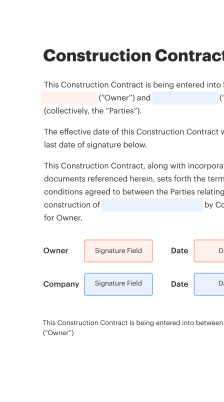
How template generation and delivery work

This sequence explains document assembly, conditional content, and how finalized proposals move through approvals to recipients.

  • Assemble: Select template and populate variables.
  • Condition: Apply conditional clauses by role or grade.
  • Approve: Route to legal, HR, and hiring manager.
  • Deliver: Export, sign, or send to recipient systems.
Collect signatures
24x
faster
Reduce costs by
$30
per document
Save up to
40h
per employee / month

Basic setup steps for qvidian proposal automation for personnel

Follow these initial steps to configure templates, variables, and approval routing for personnel-focused proposals.

  • 01
    Define templates: Create standardized offer templates.
  • 02
    Set variables: Map fields for candidate and role data.
  • 03
    Configure approvals: Assign reviewers and routing rules.
  • 04
    Test output: Generate sample proposals for validation.

Managing audit trails and approvals step-by-step

Follow these steps to ensure traceability from template creation through final delivery for personnel proposals.

01

Create Template:

Author and lock approved templates.
02

Assign Variables:

Map HRIS fields to placeholders.
03

Set Routing:

Define approval sequence and roles.
04

Capture Approvals:

Record signer identity and timestamps.
05

Archive Final:

Store signed documents in retention store.
06

Review Logs:

Export audit entries for compliance.
be ready to get more

Why choose airSlate SignNow

  • Free 7-day trial. Choose the plan you need and try it risk-free.
  • Honest pricing for full-featured plans. airSlate SignNow offers subscription plans with no overages or hidden fees at renewal.
  • Enterprise-grade security. airSlate SignNow helps you comply with global security standards.
illustrations signature

Recommended workflow settings to support personnel proposals

These example configuration settings balance governance and speed for common personnel proposal workflows.

Setting Name Configuration
Reminder Frequency 48 hours
Approval Timeout 7 days
Versioning Policy Major only
Template Locking Enabled
Audit Retention 7 years

Supported platforms and device considerations

qvidian proposal automation for personnel works with modern browsers and integrates with desktop and mobile systems used by HR and staffing teams.

  • Browsers: Chrome, Edge, Safari
  • Mobile support: Responsive web app
  • Integrations: APIs and SSO

For mobile or tablet use, ensure up-to-date browser versions, enable cookies for single sign-on flows, and verify API connectivity for data exchange with HR systems before deploying widely.

Security and authentication elements to consider

Access controls: Role-based access
Data encryption: Encryption in transit
Storage encryption: Encryption at rest
Authentication: Single sign-on
Session management: Timeout policies
Audit logging: Immutable logs

Industry examples where personnel proposals add value

Practical use cases highlight how automation reduces manual work and standardizes deliverables across industries.

Staffing Firm Proposal

A staffing firm generates consistent candidate placement proposals with role descriptions and fee schedules.

  • Configurable variables populate candidate and client details.
  • Reduces manual entry and candidate placement time.

Resulting in faster client approvals and clearer billing terms.

University Hiring Package

A university assembles faculty offer packages including salary, benefits, and compliance statements.

  • Template-driven clauses ensure faculty policy language is present.
  • Ensures consistent legal and benefits disclosures.

Leading to auditable hiring records and reduced review cycles.

Operational best practices for personnel proposal automation

Adopt these practices to reduce errors, improve compliance, and keep personnel proposals consistent and auditable.

Centralize template governance and version control
Maintain a single source of truth for role descriptions and legal clauses, use versioning to track changes, and require sign-off from legal and HR for major updates to prevent inconsistent offer language.
Map HRIS fields and validate data sources regularly
Establish and monitor field mappings between HR systems and template variables, run periodic validation checks, and implement automated tests to catch missing or malformed data before generating offers.
Define clear approval paths and escalation rules
Document required approvers for different job grades, set time-based escalations for unresponsive reviewers, and ensure that approval routing is auditable to support compliance and timely offer issuance.
Retain signed records with searchable metadata
Store final signed proposals with standardized metadata and retention tags, ensure access controls for audit purposes, and implement regular backups to meet legal and institutional retention policies.

FAQs and troubleshooting for personnel proposal automation

Common questions and resolutions for issues encountered when generating, approving, or delivering personnel proposals.

Feature availability comparison for personnel proposal workflows

A concise availability and capability comparison across providers often used for personnel proposal automation and eSignature integration.

Capability signNow (Recommended) Qvidian Adobe Sign
Template library
Conditional logic Limited
HRIS connector Native Third-party
Native eSignature Third-party
be ready to get more

Get legally-binding signatures now!

Retention and legal deadlines to track for personnel proposals

Document retention and legal deadlines vary by jurisdiction and organizational policy; these common checkpoints inform retention planning.

Offer retention period:

3 to 7 years

Background check records:

5 years

Payroll and compensation records:

7 years

Immigration documentation:

As required

Audit access window:

Minimum 6 months

Risks and potential compliance penalties to monitor

Noncompliant offers: Regulatory fines
Data exposure: Breach notifications
Incomplete records: Audit failures
Unauthorized changes: Contract disputes
Retention lapses: Legal penalties
Misclassification: Employment liabilities

Pricing and licensing considerations across providers

Representative pricing and licensing features for common providers; real costs vary by seat count, enterprise discounts, and integration requirements.

Plan signNow (Recommended) Qvidian DocuSign Adobe Sign HelloSign
Entry option Affordable single-user plans and per-document pricing suitable for small teams Enterprise licensing focused on proposal automation modules Per-user enterprise and business plans Enterprise and creative cloud bundles Free tier with limited envelopes
Enterprise support Available with SLAs and onboarding packages Enterprise professional services and integration support Enterprise templates and API support Dedicated enterprise programs and support Business plans include standard support
Integrations Prebuilt connectors for Google, Salesforce, and cloud storage Native integration with content and proposal ecosystems Wide ecosystem including Salesforce and Microsoft Broad enterprise integrations with Adobe ecosystem Integrations via API and Zapier
Authentication options SSO, OAuth, and two-factor options SSO and enterprise identity integration SSO and advanced authentication methods Enterprise identity and certificate options Standard SSO and OAuth
Compliance features ESIGN and UETA compliance with audit trails and SOC controls Compliance-focused templates and retention features ESIGN, UETA, and global compliance options ESIGN and extensive compliance tooling ESIGN compliance and basic audit trails
walmart logo
exonMobil logo
apple logo
comcast logo
facebook logo
FedEx logo
be ready to get more

Get legally-binding signatures now!