Receipt Service for Secure eSignatures

Receipt service provides a secure and compliant solution for eSignatures. SignNow ensures your documents meet U.S. legal standards while being cost-effective.

Award-winning eSignature solution

What a receipt service is and how it supports signed documents

A receipt service generates, delivers, and stores proof that a document transaction occurred, capturing signatures, timestamps, and metadata that demonstrate completion. For electronic signatures, receipts typically include the identity method used, IP address, time and date, and an audit trail showing each step of the signing process. In regulated U.S. environments, reliable receipt services help organizations meet recordkeeping, audit, and dispute-resolution needs by keeping a verifiable record tied to the signed files and the participant interactions.

Why reliable receipt generation matters for compliance and recordkeeping

Receipts provide a concise, auditable record that confirms when and how signatures were obtained, supporting legal admissibility and internal governance requirements.

Why reliable receipt generation matters for compliance and recordkeeping

Common challenges when implementing a receipt service

  • Inconsistent metadata capture can weaken evidentiary value if timestamps, signer identity, or IP details are missing or formatted inconsistently.
  • Poorly managed storage increases the risk of data loss or noncompliance when retention schedules and access controls are not applied.
  • Lack of standardized receipt formatting complicates downstream processes like audit reviews, reconciliation, and legal discovery across departments.
  • Integrating receipt exports into existing systems can be complex when APIs, formats, or authentication methods differ between platforms.

Representative user profiles for a receipt service

Compliance Officer

A compliance officer uses receipt records to demonstrate retention and signing procedures during internal and external audits. They rely on standardized audit trails, exportable receipt formats, and access controls to verify regulatory adherence and to produce evidence for investigations or legal inquiries.

Procurement Manager

A procurement manager needs immediate confirmation that negotiated contracts are signed and countersigned. They use receipt metadata to reconcile approvals, trigger vendor onboarding tasks, and ensure contract start dates align with signed agreements for operational continuity.

Who relies on receipt services and how they apply them

Organizations that require verifiable transaction records use receipt services to prove completion, maintain compliance, and support audits.

  • Legal and HR teams tracking signatures for agreements, NDAs, and employment forms where retention and auditability are essential.
  • Finance and procurement departments using receipts to reconcile approved contracts, purchase orders, and vendor agreements.
  • Healthcare and education administrators managing consent forms and records that must meet HIPAA or FERPA controls.

Receipt services also support customer-facing processes, reducing disputes and enabling automated workflows that depend on confirmed document status.

Core features to look for in a receipt service

Effective receipt services combine traceability, automation, and flexible export options to support legal, operational, and archival requirements.

Audit Trail

Comprehensive, tamper-evident event logs that capture each interaction with a document, including view events, authentication steps, signature actions, and system-generated timestamps for defensible evidence.


Receipt Delivery

Configurable delivery methods that send signed document receipts to participants or stakeholders via email, downloadable PDFs, or automated pushes to storage systems with secure links and access controls.

Template Library

Manage reusable templates that enforce required fields and signing order, ensuring receipts are generated consistently for recurring documents and reducing drafting errors across teams.

Bulk Send

Ability to send many similar documents at once while generating an individual receipt and audit trail for each recipient to support large-scale transaction workflows.

Mobile Signing

Receipt generation compatible with mobile devices so signers receive the same metadata and proof of execution regardless of platform used for signing.

APIs and Webhooks

Programmatic access to generate, retrieve, and push receipts to other systems in real time, enabling integration with back-office processes and automated archives.

be ready to get more

Choose a better solution

Integrations and templates that streamline receipt workflows

Integrations and customizable templates allow teams to standardize document composition and ensure receipts flow into the right systems automatically.

Google Docs integration

Automate document preparation from Google Docs, preserve final PDF versions with signatures, and generate receipts that include the originating document link and relevant metadata for archival or audit.

CRM synchronization

Link signed agreements and receipts directly to CRM records to consolidate contract history; receipts can be attached to account or opportunity records for sales and compliance visibility.

Dropbox integration

Persist signed documents and receipts in Dropbox folders with structured naming conventions, enabling shared access while maintaining the receipt as a separate audit artifact.

Reusable templates

Create standardized templates that include required fields, signer roles, and automated receipt generation to reduce errors and speed up repetitive transactions.
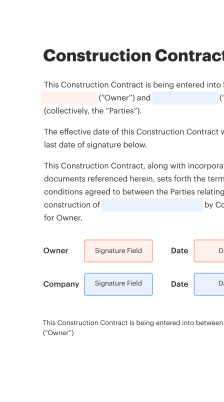
How a receipt service integrates with signing workflows

Receipt generation typically occurs automatically when a document signing flow reaches completion and may be exported or archived per retention policies.

  • Trigger on completion: Receipt creation initiated when all signers finish
  • Attach artifacts: Combine final document, audit trail, and metadata
  • Deliver receipts: Email copies to participants as configured
  • Sync to systems: Push receipts to storage or downstream apps
Collect signatures
24x
faster
Reduce costs by
$30
per document
Save up to
40h
per employee / month

Basic steps to generate a receipt after signature completion

A concise, four-step sequence describes how receipts are produced and stored after an electronic signing session completes.

  • 01
    Capture event: Record signature completion time and method
  • 02
    Collect metadata: Log IP, device, and authentication details
  • 03
    Generate receipt: Produce PDF or structured receipt file
  • 04
    Store securely: Archive receipt with access controls

How to review and export a receipt from the archive

Follow these steps to locate, review, and export receipt records for a signed transaction in a compliant manner.

01

Search:

Locate document by name, signer, or date
02

Open record:

View final document and metadata
03

Inspect audit trail:

Review timestamps and authentication steps
04

Generate export:

Create PDF or structured receipt export
05

Validate signature:

Confirm hash and signature integrity
06

Download or forward:

Export to local or integrated storage
be ready to get more

Why choose airSlate SignNow

  • Free 7-day trial. Choose the plan you need and try it risk-free.
  • Honest pricing for full-featured plans. airSlate SignNow offers subscription plans with no overages or hidden fees at renewal.
  • Enterprise-grade security. airSlate SignNow helps you comply with global security standards.
illustrations signature

Recommended technical settings when enabling receipt automation

Below are common settings administrators configure to automate receipt generation, delivery, and archival in signing workflows.

Setting Name Configuration
Reminder Email Frequency Setting in Admin 48 hours
Document Expiration and Notice Window 14 days
Signing Order and Routing Configuration Sequential signing
Authentication Level and Verification Method Email and SMS OTP
Webhook Notifications and Receipt Delivery Enabled for completed events

Device and platform considerations for receipt generation

Receipt generation works across modern browsers and mobile platforms but requires secure connections and supported authentication methods.

  • Supported browsers: Chrome, Edge, Safari, Firefox
  • Mobile platforms: iOS and Android apps supported
  • Minimum network: TLS-secured internet connection required

For reliable receipt capture on all devices, ensure apps and browsers are kept current, configure authentication methods compatible with mobile devices, and test receipt delivery to the intended archive or inbox before production use.

Security features that strengthen receipt service reliability

Encryption in transit: TLS 1.2+ with modern cipher suites
Encryption at rest: AES-256 encrypted document storage
Access controls: Role-based permissions and MFA
Audit logging: Immutable event logging and timestamps
Data isolation: Per-tenant separation for enterprise accounts
Key management: Managed or customer-managed keys available

Practical, industry-specific receipt service examples

Below are two scenarios showing how receipt services support common business processes in regulated U.S. environments.

Healthcare Consent Forms

A hospital collects patient consent for procedures using electronic forms with identity verification and timestamped signatures

  • Receipt includes signer identity method and signed document hash
  • Enables clinical teams to confirm consent and correlate with treatment records

Leading to clearer audit trails and faster compliance responses when records are requested by regulators or legal counsel.

Vendor Contract Onboarding

A procurement team completes vendor contracts digitally and needs proof of execution for onboarding systems

  • Receipt records include signing sequence, IP addresses, and final PDF snapshot
  • Those details allow automated triggers to activate vendor accounts and accounting entries

Resulting in reduced manual reconciliation, fewer onboarding delays, and an auditable record for future vendor audits.

Best practices for secure and accurate receipt service use

Adopt consistent processes and controls to maintain the evidentiary value of receipts and reduce legal and operational risk.

Verify recipient identity before sending documents
Use multi-factor or knowledge-based authentication where appropriate, matching identity assurance level to document risk, and record the method in the receipt metadata for later verification.
Standardize receipt content and format across teams
Define a consistent receipt template that includes signer identifiers, timestamps, IP addresses, and a document hash so all receipts are uniform and easily audited.
Define and enforce retention policies aligned to regulations
Establish retention periods per record type, configure automatic archival and deletion rules, and ensure receipts remain accessible for the duration required by law or internal policy.
Secure access to receipt archives using least privilege
Limit who can view, export, or delete receipts, maintain role-based access controls, and log administrative activity to protect sensitive transaction records.

FAQs About receipt service

Answers to common questions about receipt generation, storage, and compliance for electronic signatures in U.S. contexts.

Quick feature comparison of receipt capabilities

A high-level feature availability comparison for common receipt-related capabilities among major eSignature providers in the U.S. market.

eSignature Solution Comparison Table US signNow (Recommended) DocuSign Adobe Sign
Legal validity (U.S.) Yes (ESIGN/UETA) Yes (ESIGN/UETA) Yes (ESIGN/UETA)
HIPAA support Yes (BAA available) Yes (BAA available) Yes (BAA available)
Bulk Send / Mass signing Available Available Available
API access for receipts REST API REST API REST API
be ready to get more

Get legally-binding signatures now!

Common document retention and deadline guidelines for receipts

Retention schedules vary by document type and industry; below are typical timeframes organizations use to manage receipt retention and related deadlines.

Standard business contracts retention:

7 years from contract termination

Employment records and signatures:

At least 6 years from hire or separation

Healthcare consent and records:

Minimum of 6 years per HIPAA guidance

Tax and financial document retention:

7 years for many tax records

Short-term transactional receipts:

Retain 1 to 3 years based on business need

Risks of inadequate receipt management

Regulatory fines: Possible monetary penalties
Legal exposure: Weakened contract enforceability
Operational delays: Slower dispute resolution
Data breaches: Unauthorized access risks
Audit failures: Noncompliant recordkeeping
Reputational harm: Customer trust erosion

Comparing receipt-related features across providers

This table summarizes receipt and compliance-related features across prominent eSignature providers, focusing on capabilities relevant to U.S. organizations.

Plan / Monthly Price Comparison US signNow (Recommended) DocuSign Adobe Sign HelloSign PandaDoc
Free tier availability Limited free plan Trial only Trial only Free tier Free trial
API access included Available on paid plans Available (paid) Available (paid) Available (paid) Available (paid)
HIPAA compliance option BAA available BAA available BAA available BAA available Limited or none
Bulk Send capability Available on plans Available Available Available Available
Team templates and roles Template library and RBAC Robust templates and RBAC Enterprise templates and RBAC Templates and team features Templates and roles

Understanding the Receipt Service

The receipt service offered by airSlate SignNow simplifies the process of creating, sending, and managing receipts for various transactions. Businesses can easily generate digital receipts that are both professional and compliant with legal standards in the United States. This service allows users to customize receipts to include essential details such as transaction amounts, dates, and item descriptions, ensuring clarity and transparency in financial dealings.

How to Create a Receipt

Creating a receipt with airSlate SignNow is straightforward. Users can start by selecting a receipt template from the available options. Once a template is chosen, it can be customized to fit specific business needs. This includes adding logos, adjusting item descriptions, and inputting transaction details. After customization, the receipt can be saved and sent directly to clients or customers via email, ensuring a quick and efficient transaction process.

Sending Receipts for Signature

With airSlate SignNow, sending receipts for signature is a seamless experience. After creating a receipt, users can easily prepare it for eSigning. This involves selecting the recipients who need to sign the document and specifying where their signatures are required. Once sent, recipients receive a notification and can sign the receipt digitally, making the process faster and more secure than traditional methods.

Tracking Receipt Status

Tracking the status of sent receipts is essential for maintaining accurate records. airSlate SignNow provides users with the ability to monitor whether a receipt has been viewed or signed. This feature allows businesses to follow up with clients if necessary, ensuring that all transactions are completed efficiently. Users can access a dashboard that displays the status of each receipt, providing valuable insights into their document management process.

Secure Document Management

Security is a top priority when handling financial documents. The receipt service at airSlate SignNow employs advanced encryption methods to protect sensitive information. This ensures that all receipts are stored securely and only accessible to authorized users. Additionally, the platform complies with industry standards, providing peace of mind for businesses and their clients when sharing and signing receipts.

Integrating Receipts into Business Workflows

Integrating the receipt service into existing business workflows enhances productivity. Businesses can automate the receipt generation process, reducing manual input and minimizing errors. By linking the receipt service with other tools used in daily operations, such as accounting software, companies can streamline their financial processes, ensuring that all transactions are accurately recorded and easily accessible.


walmart logo
exonMobil logo
apple logo
comcast logo
facebook logo
FedEx logo
be ready to get more

Get legally-binding signatures now!