Request Signature Verification with SignNow

Eliminate paperwork and automate document management for increased performance and endless possibilities. eSign any papers from a comfort of your home, quick and accomplished. Enjoy the perfect manner of doing business with airSlate SignNow.

Award-winning eSignature solution

What request signature verification means and why it matters

Request signature verification is the process of confirming that a digital signature attached to a document corresponds to the asserted signer and that the signing event followed defined authentication and integrity checks. It combines identity verification, document integrity validation, and audit trail review to establish non-repudiation and admissibility. In the United States this process supports ESIGN and UETA compliance when implemented with appropriate authentication, tamper-evident seals, and record retention policies. Vendors such as signNow provide integrated verification and audit features to support these requirements in routine workflows.

Why implement request signature verification in your workflows

Request signature verification reduces disputes and supports regulatory compliance by establishing a clear chain of custody, documented identity checks, and tamper-evident records for electronically signed contracts and forms.

Why implement request signature verification in your workflows

Common challenges when adding request signature verification

  • Inconsistent authentication practices across teams lead to uneven verification and legal exposure.
  • Poorly configured audit trails can make it difficult to prove the signing process in disputes.
  • Legacy document formats or insecure storage increase risk of undetected tampering after signing.
  • Balancing user convenience and strong identity checks often requires careful policy design.

Representative user profiles for verification workflows

IT Administrator

An IT Administrator configures SSO, API keys, and encryption settings for request signature verification. They manage integrations with directory services and ensure that verification logs are securely stored and accessible for audit processes across the organization.

Contract Manager

A Contract Manager prepares documents, configures signer identity checks, and reviews the verification audit trail. They use verification settings to minimize risk, standardize acceptance criteria, and produce evidentiary records for compliance or dispute resolution.

Teams and roles that commonly request signature verification

  • Legal departments handling contracts and evidence preservation.
  • Human resources for onboarding and sensitive personnel records.
  • Procurement and finance for approved vendor agreements.

Implementing consistent verification policies helps these teams reduce dispute resolution time and support internal audits with reliable documentation.

Additional capabilities for advanced verification workflows

Larger or regulated organizations often need extended features to automate verification, integrate with identity systems, and apply policy-based controls to signing flows.

SSO integration

Connect with enterprise identity providers to enforce corporate authentication and reduce password management overhead.


API access

Programmatic control of verification settings and retrieval of audit records for integration with internal systems.

Conditional routing

Apply verification rules that change required identity checks based on signer role or document type.

Custom branding

Maintain consistent brand presentation in verification emails and signing pages.

Bulk processing

Send verified signature requests at scale while applying consistent authentication and audit settings for each batch.

Document templates

Predefine verification and field placement within templates to reduce configuration errors and speed request creation.

be ready to get more

Choose a better solution

Core features that support request signature verification

Effective verification depends on a small set of capabilities: reliable authentication, tamper evidence, robust audit logs, and configurable retention for compliance.

Authentication

Support for email, SMS one-time passcodes, knowledge-based verification, and SSO integration to validate signer identity before accepting a signature and to meet different assurance level requirements.

Audit trail

Immutable, detailed logs that capture timestamps, IP addresses, and verification steps to document the signing process for audits and legal review without manual record consolidation.

Tamper evidence

Digital hashing and document sealing that detect post-signing changes and preserve the original signed state so any alterations become evident during verification.

Retention controls

Configurable storage and export options to meet record retention policies, support discovery requests, and ensure signed documents remain accessible and intact over required retention periods.
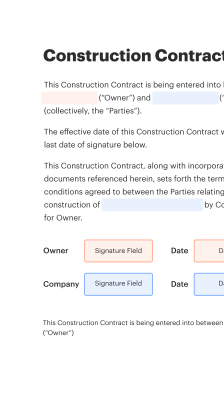
How request signature verification works in practice

Verification ties signer identity, a signing event, and document integrity into a single recorded transaction to support admissibility and compliance.

  • Authenticate user: Verify identity via configured method.
  • Record event: Capture timestamp and device metadata.
  • Seal document: Apply tamper-evident hash.
  • Store audit: Save logs for retrieval.
Collect signatures
24x
faster
Reduce costs by
$30
per document
Save up to
40h
per employee / month

Quick steps to set up request signature verification

Follow these concise steps to configure verification for incoming signature requests and ensure each signed document includes identity and integrity checks.

  • 01
    Select document: Upload file and prepare fields.
  • 02
    Define signers: Add signer contacts and roles.
  • 03
    Choose verification: Enable password, SMS, or ID check.
  • 04
    Send and audit: Send request and monitor audit trail.

Detailed verification workflow: step-by-step grid

Use this grid to verify each phase of a signing request from preparation through post-signing evidence collection.

01

Prepare:

Upload and tag fields.
02

Assign:

Set signer roles and order.
03

Authenticate:

Select verification method.
04

Sign:

Signer completes fields.
05

Seal:

Apply document hash.
06

Archive:

Store signed package.
be ready to get more

Why choose airSlate SignNow

  • Free 7-day trial. Choose the plan you need and try it risk-free.
  • Honest pricing for full-featured plans. airSlate SignNow offers subscription plans with no overages or hidden fees at renewal.
  • Enterprise-grade security. airSlate SignNow helps you comply with global security standards.
illustrations signature

Typical configuration settings for verification workflows

These common workflow settings align verification, notification, and retention to create consistent request signature verification behavior across an organization.

Feature Configuration
Reminder Frequency 48 hours
Default Verification Method SMS OTP
Audit Log Retention 7 years
Signer Authentication Timeout 15 minutes
Automatic Escalation Enabled

Device and browser considerations for verification

  • Desktop browsers: Chrome, Edge, Firefox
  • Mobile platforms: iOS and Android apps
  • Network requirements: HTTPS required

Ensure your users run updated browsers and app versions, allow push or SMS channels for OTP delivery, and configure corporate networks to permit secure connections to the eSignature provider for verification traffic and audit uploads.

Security controls used in request signature verification

Encryption: End-to-end
Access control: Role-based
Authentication: Multi-factor
Audit logging: Immutable records
Tamper seals: Digital hashing
Data residency: Configurable

Industry examples of request signature verification

Real-world implementations show how verification practices reduce risk and streamline approvals across sectors like healthcare, finance, and education.

Healthcare consent forms

A hospital digitized patient consent and applied multi-factor authentication for signatures to match identity records

  • Used device-based verification and identity questions for higher assurance
  • Reduced administrative follow-ups and invalid consents by verifying signer identity before acceptance

Resulting in clearer audit records, improved compliance with HIPAA requirements, and fewer manual verification tasks for clinical staff.

Vendor contracts

A mid-size company adopted electronic signature workflows with identity verification integrated into procurement approvals

  • Verified signers via email and SMS one-time passcodes to confirm signatory control
  • This cut signature turnaround time and centralized audit trails for vendor onboarding

Leading to faster supplier activation, better procurement governance, and a searchable compliance archive for future audits.

Best practices for secure and reliable request signature verification

Adopting clear policies and technical safeguards reduces risk while preserving signer convenience and legal defensibility of electronic signatures.

Define consistent verification policies across teams
Establish a single source of truth for when to require high-assurance identity checks versus lighter methods, document these policies, and apply them using templates or automation to avoid inconsistent enforcement.
Retain complete, tamper-evident audit trails
Ensure logs capture identity method, timestamps, IP addresses, and document hashes. Store them in a secure, immutable format with access controls for auditors and legal staff.
Integrate with enterprise identity providers
Use SSO and directory services to centralize authentication, reduce password fatigue, and align signature verification with existing access management and compliance controls.
Balance verification and user experience
Select verification methods that meet legal and business requirements while minimizing friction; use adaptive checks that increase assurance only when document sensitivity warrants stronger verification.

FAQs about request signature verification

Answers to common questions about configuring, validating, and troubleshooting signature verification in electronic signing workflows.

How signNow stacks up on verification features

A concise comparison of verification capabilities across leading eSignature providers to highlight availability and configuration differences for common verification needs.

Criteria signNow (Recommended) DocuSign Adobe Sign
Identity verification methods Email, SMS OTP Email, SMS OTP Email, Phone OTP
Audit trail details Comprehensive Comprehensive Comprehensive
HIPAA support Available Available Available
Bulk send limits High volume High volume Moderate
be ready to get more

Get legally-binding signatures now!

Retention and key dates to track for verification records

Maintain specific retention windows and scheduled reviews to meet legal, compliance, and operational needs for verified signature records.

Minimum retention for contracts:

7 years recommended

HIPAA-related documents:

6 years per guidance

FERPA-sensitive records:

Follow institution policy

Periodic audit review:

Annually schedule

Backup verification archives:

Monthly snapshots

Risks and potential penalties for weak verification

Contract disputes: Losses
Regulatory fines: Monetary
Data breaches: Exposure
Litigation costs: High
Reputational harm: Long-term
Operational delays: Process stalls

Simplify complex workflows

Create, execute, and manage workflows of any complexity, electronically from virtually anywhere. Scalable eSignature capabilities allow you to share documents with the right people in the correct order and define roles for each recipient. Execute document workflows faster and easier than ever before.

Automate document management

Optimize complex signing processes with airSlate SignNow’s powerful features to enhance your business. Control your automated eSignature workflows to ensure they're running at peak performance with instant notifications and reminders.

Optimize in team collaboration

Bring teams together in a secure, shared environment. Manage documents, use form templates and notifications to create more efficient cross-organization collaboration. Free your employees from having to spend time on repetitive activities so that they can focus on valuable, business-critical tasks.

Integrate into your existing systems

Run your projects with industry-leading integration. Collect Salesforce, Microsoft Teams, and SharePoint all in one business flow. Connect your software to a single system for endless possibilities and more efficiency.

Stay compliant with industry-leading data security

Feel confident with the knowledge that your data remains secure by the most recent in encryption security. airSlate SignNow is GDPR and eIDAS certified and gives you awareness into your signing process with court-admissible audit trails. Set up user authorization and roles to regulate who has access to what.


walmart logo
exonMobil logo
apple logo
comcast logo
facebook logo
FedEx logo
be ready to get more

Get legally-binding signatures now!