Rfp Automated Response Software for Finance

Empower your business with airSlate SignNow’s user-friendly platform. Streamline document processes and reduce costs while enhancing efficiency.

Award-winning eSignature solution

What rfp automated response software for finance does and why it matters

rfp automated response software for finance automates the creation, population, routing, and tracking of responses to supplier requests for proposals within finance teams. It centralizes templates, pre-filled data, approval workflows, and digital signature steps to reduce manual entry, standardize regulatory language, and shorten response cycles. By integrating with document storage and CRMs, the software minimizes duplication and provides a clear audit trail for review and compliance. For finance departments handling vendor contracts, pricing schedules, and risk certifications, this approach improves consistency and reduces review overhead across stakeholders.

When automated RFP responses are appropriate for finance teams

Automating RFP responses reduces repetitive tasks, enforces consistent financial disclosures, and accelerates vendor selection processes while preserving required approvals and audit logs.

When automated RFP responses are appropriate for finance teams

Common challenges finance teams face with manual RFP responses

  • Inconsistent answers across RFPs increase legal and financial risk during vendor selection.
  • Manual data re-entry wastes analyst time and introduces transcription errors into responses.
  • Lack of a centralized approval path delays submissions and complicates audit readiness.
  • Unclear versioning and retention policies make post-award reviews and compliance checks harder.

Representative user profiles

Procurement Lead

A procurement lead manages RFP timelines, consolidates supplier responses, and configures templates. They rely on automation to enforce required fields, route documents to finance and legal, and generate comparison deliverables for decision makers while maintaining a documented approval history.

Financial Analyst

A financial analyst populates pricing models, uploads supporting schedules, and verifies margin calculations. They use automated responses to pre-fill financial sections from controlled data sources, reducing repetitive calculations and improving consistency across multiple RFP submissions.

Which finance roles benefit most from automated RFP response tools

Finance, procurement, and contract teams collaborate on RFP responses and benefit from centralized templates and workflow controls.

  • Procurement managers who coordinate vendor assessments and comparative scoring.
  • Corporate finance analysts who prepare pricing schedules and financial disclosures.
  • Legal and compliance reviewers who validate contract terms and regulatory language.

Centralized automation shortens turnaround, clarifies responsibilities, and keeps compliance-ready records for audits and post-award tasks.

Advanced tools to extend RFP automation value

Beyond basics, finance teams benefit from reporting, integrations, and controls that scale automated RFP responses across complex procurement cycles.

Conditional Logic

Dynamic template logic shows or hides sections based on prior answers, ensuring respondents only complete relevant financial disclosures and reducing error rates.


Bulk Send

Bulk Send capabilities deliver customized RFP responses or invitations to multiple suppliers simultaneously while tracking individual receipt and completion status.

Audit Trail

Comprehensive audit records capture edits, comments, approvals, and signature events to support internal audits and regulatory inquiries.

Integrations

Connectors to CRMs, ERPs, and document repositories synchronize master data, reduce duplicate entries, and maintain single-source truth for financial inputs.

Reporting & Analytics

Built-in reports surface turnaround times, approval bottlenecks, and response quality indicators to improve RFP processes and resource allocation.

Role-Based Access

Granular permissions control who can view, edit, approve, or sign RFP materials, maintaining separation of duties for finance and legal teams.

be ready to get more

Choose a better solution

Core features that enable efficient RFP automation

Key functional areas streamline RFP creation, review, signature, and storage to meet finance requirements while maintaining controls.

Template Library

Centralized templates store approved financial language, required disclosures, and pricing tables so authors reuse consistent content across RFP responses and reduce review cycles.

Field Population

Automated data population pulls values from ERPs, spreadsheets, or CRMs into template fields to eliminate manual copying and ensure numerical accuracy in responses and schedules.

Approval Workflows

Configurable routing enforces sequential or parallel reviews by finance, legal, and procurement with built-in reminders and version control for auditability.

eSignature Integration

Embedded eSignature capability secures final approvals with tamper-evident signatures, timestamps, and certificate records suitable for audit and compliance needs.
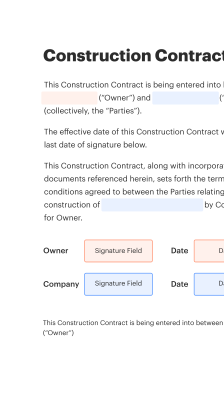
How automated responses flow through systems

Typical automation maps data sources, approval paths, and final delivery methods for RFP responses within finance workflows.

  • Data mapping: Link ERP and CRM fields to RFP templates.
  • Approval chains: Define reviewers and escalation rules.
  • Signature capture: Attach electronic signatures with timestamps.
  • Delivery: Send finalized response to the RFP issuer.
Collect signatures
24x
faster
Reduce costs by
$30
per document
Save up to
40h
per employee / month

Quick step-by-step: preparing an automated RFP response

A concise sequence to prepare, approve, and submit an automated RFP response with compliant auditability.

  • 01
    Template selection: Choose a pre-approved RFP template.
  • 02
    Auto-populate data: Pull financials and supplier details from systems.
  • 03
    Internal review: Route to finance, legal, and procurement stakeholders.
  • 04
    Finalize and sign: Apply signatures and lock the final document.
be ready to get more

Why choose airSlate SignNow

  • Free 7-day trial. Choose the plan you need and try it risk-free.
  • Honest pricing for full-featured plans. airSlate SignNow offers subscription plans with no overages or hidden fees at renewal.
  • Enterprise-grade security. airSlate SignNow helps you comply with global security standards.
illustrations signature

Typical workflow settings for automated RFP responses

Standard configuration items help teams set consistent reminders, routing, and retention behaviors for RFP response workflows.

Setting Name Configuration
Automatic Reminder Frequency Scheduling Interval First reminder after 48 hours, then every 72 hours until response
Approval Escalation Path Definition Escalate to director after 3 business days without approval
Document Retention and Archival Policy Archive completed RFPs after 7 years with immutable storage
Template Version Control and Locking Lock approved templates; allow edits via controlled version release
Signature Certificate and Storage Location Store signature certificates with the final PDF in encrypted storage

Supported devices and platform requirements

Compatible platforms include modern browsers on desktop and mobile along with native mobile apps that support eSignature and secure uploads.

  • Desktop browsers: Chrome, Edge, Safari, Firefox
  • Mobile operating systems: iOS and Android supported
  • Network requirements: TLS 1.2+ and port 443 access

For enterprise deployments, ensure single sign-on (SAML) compatibility, centralized user provisioning, and network allow-lists to maintain secure access across desktop and mobile clients.

Security and authentication features to look for

Data encryption: AES-256 at rest
Transport security: TLS 1.2+ in transit
Access control: Role-based permissions
Authentication: SAML and MFA support
Activity logging: Detailed access logs
Document integrity: Tamper-evident audit trail

Practical finance use cases

Two representative examples show how automation accelerates responses and strengthens controls for finance-driven RFPs.

Large Enterprise Vendor Selection

A corporate finance team aggregated standardized pricing and compliance language for a multi-vendor procurement

  • Template-driven sections reduced manual edits by subject-matter experts
  • Automated approval routing ensured legal and audit sign-off before submission

Resulting in faster vendor evaluation and a clear audit trail for procurement decisions.

Quarterly Banking Compliance RFP

A treasury group responded to recurring bank service RFPs using pre-approved financial statements and control attestations

  • Dynamic fields pulled current balance and fee schedules from the ERP
  • Versioning and signature tracking recorded reviewer changes and final approvals

Leading to consistent disclosures and demonstrable compliance for regulatory reviews.

Best practices for secure, accurate automated RFP responses

Implementing clear controls and consistent practices helps finance teams reduce risk and improve response quality across RFP cycles.

Maintain a single source of financial truth
Centralize authoritative data sources such as ERP exports and validated spreadsheets, and link those sources to template fields so answers remain current and auditable across responses.
Use approval gates for high-risk sections
Add mandatory review steps for pricing, liability clauses, and compliance attestations so subject-matter reviewers validate sensitive content before finalization and signature.
Standardize retention and version policies
Define retention schedules and versioning rules that align with corporate records policies so completed RFPs, supporting schedules, and approvals are preserved for audits and contract lifecycle events.
Limit editable fields to reduce exposure
Restrict who can modify core financial statements and legal language; expose only necessary input fields while keeping critical clauses locked or managed via templates.

FAQs About rfp automated response software for finance

Answers to common questions finance teams have when deploying and operating automated RFP response tools, focused on security, integrations, and compliance.

Feature availability snapshot: signNow versus DocuSign

A concise comparison of common capabilities relevant to finance RFP automation, showing availability or brief technical details for each vendor.

Criteria signNow (Featured) DocuSign
Bulk Send capability
SAML single sign-on
API for custom integrations REST API available REST API available
Tamper-evident audit trail
be ready to get more

Get legally-binding signatures now!

Regulatory and contractual risks to monitor

Noncompliance fines: Possible monetary penalties
Contract disputes: Litigation risk
Data breaches: Notification obligations
Inaccurate disclosures: Reputational harm
Retention violations: Recordkeeping penalties
Unauthorized access: Operational interruptions

Pricing and plan comparison across popular eSignature providers

Representative plan characteristics and starting price points for common eSignature providers used in finance RFP workflows; actual pricing may vary by contract and feature requirements.

Provider signNow (Featured) DocuSign Adobe Acrobat Sign PandaDoc Dropbox Sign
Starting monthly price per user $8 per user/month $10 per user/month $15 per user/month $19 per user/month $15 per user/month
Free trial available Yes Yes Yes Yes Yes
Enterprise-grade SSO and provisioning Included on enterprise plans Available on advanced plans Included on business plans Available on enterprise Available on business plans
API access and developer tools Available Available Available Available Available
Desktop and mobile apps Windows/macOS/iOS/Android Windows/macOS/iOS/Android Windows/macOS/iOS/Android Web/iOS/Android Web/iOS/Android
walmart logo
exonMobil logo
apple logo
comcast logo
facebook logo
FedEx logo
be ready to get more

Get legally-binding signatures now!