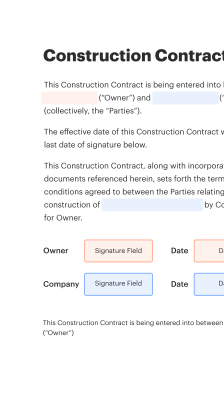
Route Signature with SignNow

Eliminate paperwork and optimize document management for more performance and limitless possibilities. Explore the best strategy for doing business with airSlate SignNow.

Award-winning eSignature solution

What route signature means and how it fits into eSigning

A route signature is a directed signing workflow that sends a document through a defined sequence of recipients so each party signs in a prescribed order. Route signature workflows enforce signing order, manage parallel or sequential steps, and can include conditional branches or sign-off gates. For organizations, route signature reduces coordination overhead, preserves document integrity, and produces a single completed record with a timestamped audit trail. In signNow, route signature is implemented as part of the document routing and workflow features, enabling administrators to set routing rules and integrate them with authentication and notifications.

Why implement route signature in document workflows

Route signature standardizes who signs, in what sequence, and when, reducing errors and speeding completion while preserving a clear audit trail for compliance and recordkeeping.

Why implement route signature in document workflows

Common routing and signing challenges

  • Unclear signing order leads to delays when multiple stakeholders must sign in a strict sequence.
  • Manual handoffs increase the risk of lost documents and inconsistent version control across stakeholders.
  • Inadequate authentication can expose agreements to repudiation or regulatory noncompliance.
  • Poorly formatted templates force signers to request clarifications and extend turnaround times.

Typical user roles and how they use route signature

Contract Manager

Contract managers set up routing templates, define signing order, and monitor progress to ensure contracts are executed on schedule and that the audit trail captures signatory authentication details for future compliance reviews.

HR Administrator

HR administrators use route signature for onboarding sequences where hiring managers, payroll, and legal must sign in order; templates reduce repetitive setup and ensure documents are complete before personnel records are finalized.

Organizations and roles that commonly use route signature

Legal, HR, procurement, and sales teams routinely use route signature workflows to ensure consistent approvals and enforce sequential signing requirements.

  • Legal teams managing contract approval sequences across internal stakeholders and external counterparties.
  • HR managing offer letters, onboarding forms, and sequential approvals for hires and contractors.
  • Procurement coordinating vendor agreements that require buying manager and finance sign-off.

Route signature is also adopted by small businesses and distributed teams to reduce administrative friction and to maintain auditable signing records.

Core route signature features to configure and monitor

When implementing route signature, prioritize features that enforce order, authenticate signers, and preserve an auditable record of the entire process.

Signing order

Explicit sequential and parallel routing with conditional branches for complex approval paths.

Role assignment

Define signer roles, delegates, and required fields per role to prevent incomplete submissions.

Authentication options

Support for email verification, SMS one-time passcodes, and identity provider authentication to meet varying assurance needs.

Reminders and expiration

Automated reminders and configurable expiration to keep routed signatures on schedule and prevent stale transactions.

Audit trail

Comprehensive event logging showing timestamps, IP addresses, and authentication method for each signing step.

Template reuse

Save routed signing configurations as templates to reduce setup time and ensure consistent routing across documents.

be ready to get more

Choose a better solution

Integrations and document sources for routed signing

Route signature works with common document sources and business systems to reduce manual uploads and maintain consistency across platforms.

Google Workspace

Create and route documents directly from Google Docs, preserving document formatting and enabling route signature flows without separate downloads or manual transfers.

CRM integration

Link signNow routing to CRM records to auto-populate recipient data, trigger route signature workflows from deal stages, and record execution status back into the CRM for sales and compliance tracking.

Cloud storage

Connect cloud repositories like Dropbox or Google Drive to pull templates and store completed routed documents with consistent naming and retention policies for audit purposes.

API access

Use signNow APIs to programmatically create routed signing sessions, set signing order, and retrieve signed documents and audit trails for integration with custom systems.

How route signature progresses through recipients

Routing can be sequential, parallel, or conditional; understanding each flow helps you pick the correct configuration for the business process.

  • Sequential: One signer completes before next receives the document.
  • Parallel: Multiple signers can sign independently at the same time.
  • Conditional: Routing branches based on form data or prior approvals.
  • Hybrid: Combine sequential and parallel stages for complex processes.
Collect signatures
24x
faster
Reduce costs by
$30
per document
Save up to
40h
per employee / month

Quick setup: creating a basic route signature workflow

Follow these core steps to configure a sequential signing route for a single document in signNow.

  • 01
    Upload document: Add your file to signNow workspace.
  • 02
    Add recipients: Enter signers in required order.
  • 03
    Place fields: Drag signature and data fields for each signer.
  • 04
    Send and monitor: Send and track progress in the dashboard.

Managing audit trails and signed document retrieval

Maintain clear records by configuring audit logging and using built-in document retrieval tools to preserve execution history for each routed signature.

01

Access audit log:

Open document activity and export events.
02

Verify timestamps:

Check signed timestamps per event.
03

Download signed PDF:

Retrieve final executed document file.
04

Store externally:

Archive to connected cloud storage.
05

Export event report:

Generate CSV of signing events.
06

Retain per policy:

Apply retention tags for compliance.
be ready to get more

Why choose airSlate SignNow

  • Free 7-day trial. Choose the plan you need and try it risk-free.
  • Honest pricing for full-featured plans. airSlate SignNow offers subscription plans with no overages or hidden fees at renewal.
  • Enterprise-grade security. airSlate SignNow helps you comply with global security standards.
illustrations signature

Recommended default workflow settings for route signature

These suggested settings balance security and usability for most sequential signing processes and can be adjusted per organizational policy.

Feature Configuration
Default Signing Order Sequential
Reminder Frequency 48 hours
Link Expiration 30 days
Authentication Requirement Email + SMS
Retention Setting 7 years

Supported platforms for route signature activities

Route signature workflows can be created, managed, and completed across desktop browsers and mobile applications to support distributed teams.

  • Desktop browsers: Chrome, Edge, Safari
  • Mobile apps: iOS and Android
  • API access: REST endpoints

For mobile use, ensure the latest app version and a stable network connection; signNow mobile apps support creating routes, completing signature steps, and reviewing audit trails for most common enterprise and SMB workflows.

Authentication and security elements used with route signature

Access controls: Role-based permissions
Authentication options: Password or SMS OTP
Document encryption: AES-256 at rest
Transport security: TLS encryption in transit
Audit logs: Complete event records
Tamper seals: Document integrity checks

Industry examples of route signature in practice

These scenarios illustrate how route signature reduces friction in common document workflows across sectors.

Commercial Lease Approval

A leasing team circulates a lease agreement through legal review, finance approval, and landlord signature

  • Sequential signing with conditional approver steps
  • Ensures each stakeholder confirms lease terms before final execution

Resulting in a single finalized document with full audit trail and enforceable timestamps

Employee Onboarding Package

HR prepares an onboarding packet that requires signatures from the new hire, hiring manager, and payroll

  • Template-driven routing enforces order and populates employee data
  • Reduces manual entry and prevents incomplete records

Leading to faster onboarding and consistent compliance with record retention policies

Best practices to ensure secure and accurate route signature processes

Adopt these practices to reduce errors, improve security, and keep routed signatures compliant with organizational policies and regulations.

Define clear signing sequences and roles
Document and standardize the required signing order and responsibilities before creating templates; include fallback delegates and specify which fields are mandatory to avoid incomplete transactions and to streamline signatory expectations.
Use strong, appropriate authentication methods
Match authentication to transaction risk—use email for low-risk forms, SMS OTP or identity verification for contracts with financial or legal significance; document the chosen authentication in retention records for compliance audits.
Leverage templates and conditional routing
Save common route signature configurations as templates and use conditional routing for approvals that depend on form values; this reduces setup time and prevents errors for recurring processes.
Maintain retention and audit policies
Establish document retention rules aligned with legal and industry requirements, ensure audit trails are preserved, and periodically review stored signed documents for integrity and accessibility.

Frequently asked questions and troubleshooting for route signature

Answers to common problems encountered when setting up or executing route signature workflows, with practical fixes and configuration tips.

Feature comparison for routed signing across major providers

This table compares routed signing capabilities and core availability across leading eSignature providers, showing whether features are supported or listing brief technical details.

Feature / Provider signNow (Recommended) DocuSign Adobe Sign
Sequential routing
Parallel routing
Conditional routing
Bulk send for routing Bulk Send
be ready to get more

Get legally-binding signatures now!

Regulatory and operational risks of improper routing

Noncompliance exposure: Fines or penalties
Invalid signatures: Contract disputes
Data leakage: Privacy breaches
Operational delays: Lost revenue
Audit failures: Regulatory scrutiny
Reputational damage: Client trust loss

Pricing and plan characteristics relevant to route signature

Overview of plan attributes that affect routed signing adoption, such as entry-level cost, trial availability, and whether enterprise-level routing features are offered.

Product signNow (Recommended) DocuSign Adobe Sign Dropbox Sign PandaDoc
Free tier availability No free eSign tier, free trial Limited free trial No free tier, trial only Free eSign plan available Free eSign plan available
Starting monthly price $8 per user $10 per user $14.99 per user $15 per user $19 per user
Per-user billing option Yes Yes Yes Yes Yes
Enterprise routing features Available Available Available Available Available
Support and onboarding Email & priority support options Enterprise onboarding Standard support Standard support Enterprise onboarding available

Streamline complex workflows

Prepare, perform, and maintain workflows of any intricacy, electronically from near any place. Scalable electronic signature capabilities allow you to share documents with the right users the right sequence and assign roles for every signee. Complete document workflows faster and easier than ever before.

Automate document flow

Improve sophisticated signing tasks with airSlate SignNow�s powerful tools to improve your business. Take control of your automatic eSignature workflows to ensure they're operating at peak efficiency with quick notifications and reminders.

Enhance in team collaboration

Get teammates together in a protected, shared workplace. Handle paperwork, use form templates and notices to create better cross-company communication. Free your staff from having to spend time on repeating routines to enable them to give attention to valuable, business-essential duties.

Integrate into your current network

Manage your tasks with market-leading integration. Collect Salesforce, Microsoft Teams, and SharePoint in multi functional business flow. Connect your software to a single system for countless opportunities and higher performance.

Stay compliant with industry-leading data security

Feel safe understanding that your data is protected by the most up-to-date in encryption security. airSlate SignNow is GDPR and eIDAS compliant and provides you awareness into your eSigning experience with court-admissible audit trails. Set up user authorization and rights to control who has access to what.


walmart logo
exonMobil logo
apple logo
comcast logo
facebook logo
FedEx logo
be ready to get more

Get legally-binding signatures now!